


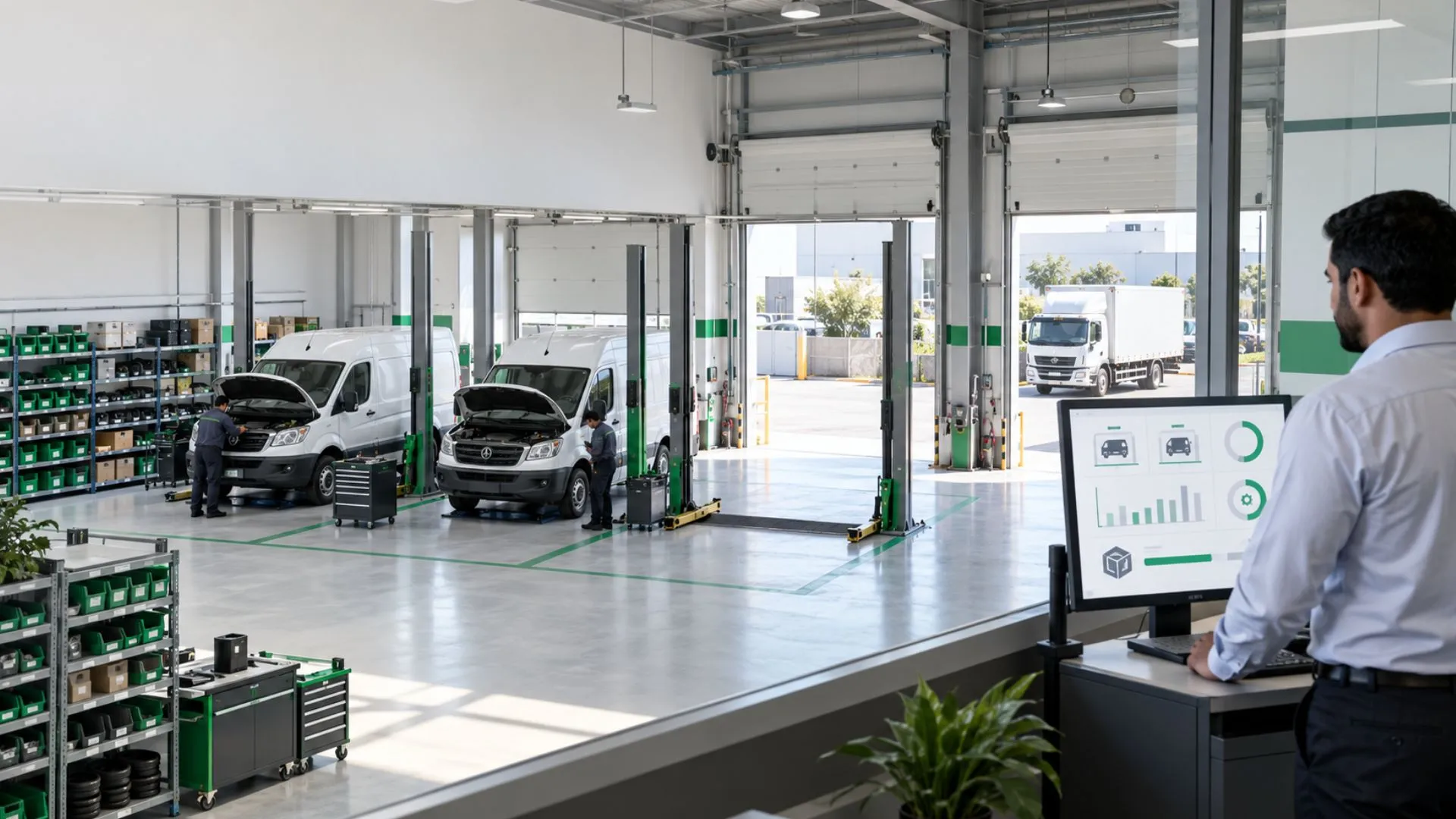
Fleet Workshop Management: Which Model Actually Costs Less?
A fleet can have its own workshop and still spend more on maintenance than it should. Empty bays, technicians waiting for work, vehicles waiting for parts, or service jobs taking longer than expected can quickly turn an in-house facility into an expensive fixed cost. Effective fleet workshop management therefore starts with a more important question than simply whether to own a workshop: which maintenance work should be handled internally, which should be outsourced, and which model delivers better control over cost, capacity and vehicle downtime?
This guide explains how to make that decision using practical workshop economics. You will learn how fleet service management differs from servicing execution, how to measure bay occupancy and internal cost per productive hour, how fleet parts inventory management affects workshop performance, and when an internal bay may or may not make sense for a small fleet. It also explains the maintenance data needed to compare in-house and outsourced service models and how Safee’s Maintenance Module, Spare Parts Management and reporting capabilities can support that analysis.
What fleet workshop management covers and what it doesn’t
Effective fleet workshop management connects three different layers of the maintenance operation.
The first is maintenance demand: what each vehicle needs, when it needs it, whether the requirement is planned or unplanned, and which tasks remain open.
The second is service execution: where the vehicle will be serviced, how long the work occupies labour and workshop capacity, which parts are consumed, when the vehicle becomes available again, and whether further work is required.
The third is economics: what the service actually costs once labour, facilities, parts, downtime, administration and outsourced charges are included.
A workshop-management decision should therefore help answer questions such as:
- How much maintenance work is the fleet generating?
- How much of that work is predictable?
- Are internal technicians and bays being used productively?
- How much vehicle availability is lost while waiting for service?
- Which parts justify holding stock?
- Which jobs are economically sensible to perform internally?
- Which jobs require external equipment, expertise or capacity?
- What is the complete cost of an internal work hour compared with an outsourced job?
What workshop management does not mean is treating every maintenance requirement as a workshop problem. Preventive scheduling, vehicle condition, task assignment, alerts and maintenance records can exist whether the physical work occurs at a company depot, dealer, independent service centre or specialist facility.
At Safee, we reflect this distinction. Our Maintenance Module supports maintenance tasks triggered by factors such as odometer readings, dates, recurring time or distance criteria and other maintenance workflows. The software layer helps organize when work is required; the fleet still decides how and where that work will be completed.
Want to assess your existing maintenance process before changing the workshop model? Request a Safee demo and review how your current maintenance schedules, tasks, reminders and records could be structured digitally.
Fleet workshop management vs preventive maintenance scheduling
Preventive maintenance scheduling answers a timing question:
When should this vehicle receive maintenance?
Fleet workshop management answers a wider resource question:
When that maintenance becomes due, how should the work be delivered economically and operationally?
A preventive schedule may indicate that a vehicle requires inspection or service based on mileage, engine usage, date or another defined maintenance trigger. Safee’s Maintenance Module supports several task structures, including odometer-based, date-based, periodic, prompt and early maintenance tasks.
Workshop management begins after that maintenance demand becomes visible.
The fleet must decide:
- Whether the work enters an internal bay or an external service queue;
- Which technician or supplier is appropriate;
- Whether required parts are available;
- How long the vehicle may remain unavailable;
- Whether another vehicle must cover the operational requirement;
- How the completed work and cost will be recorded.
This distinction matters because a well-designed preventive schedule can still produce poor economics if the fleet has too little workshop capacity, excessive idle capacity, missing parts or long service turnaround.
Conversely, outsourcing workshop activity does not remove the need for maintenance management. It makes accurate maintenance records and service follow-up even more important because the fleet is coordinating work across organizational boundaries. For the scheduling, inspection and preventive-control layer that sits upstream of workshop economics, see our fleet maintenance management guide.
Fleet service management vs fleet servicing management
The phrases fleet service management and fleet servicing management overlap, but they are useful when separated operationally.
Fleet service management is the broader management layer. It covers maintenance demand, service policies, providers, task status, cost review, vehicle availability and the information used to decide how maintenance resources should be allocated.
Fleet servicing management is closer to the execution of servicing itself: receiving a vehicle, diagnosing or confirming the required work, assigning labour, using parts, completing tasks and returning the vehicle to service.
The distinction can be summarized as:
- The management layer asks what should happen, where, when and at what economic cost?
- The servicing layer asks how this specific service requirement is completed and closed?
Our Maintenance Module sits primarily on the maintenance-management side of this workflow. Its public documentation describes maintenance schedules, records, reminders, tasks, Spare Parts Management and Maintenance Reports. Those capabilities give fleet teams structured information around maintenance activity without requiring every service to be performed in a company-owned workshop.
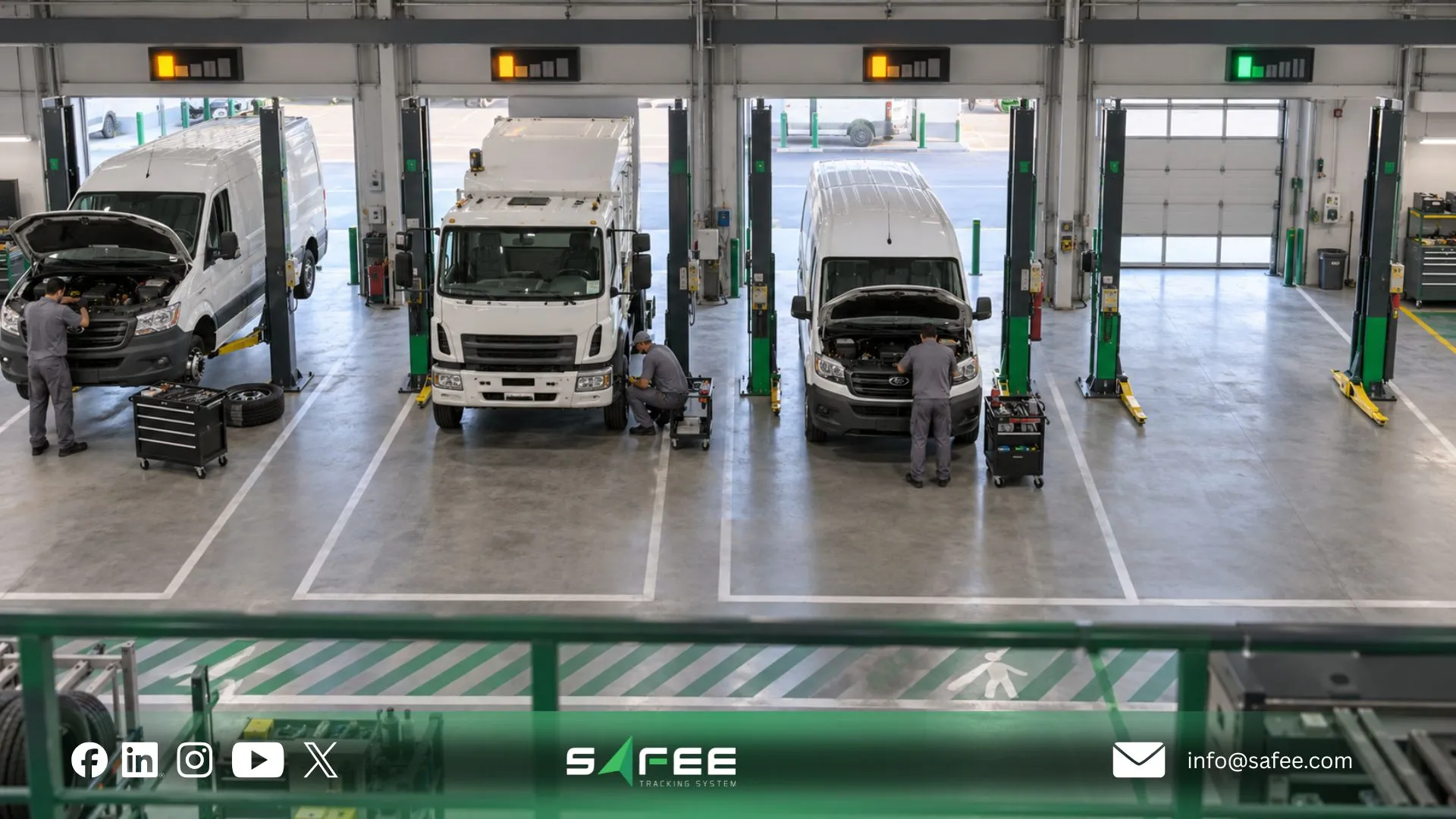
Fleet service management for in-house, outsourced and hybrid models
Choosing between an internal workshop and an outsourced centre should not begin with the external labour rate or a technician’s salary.
The models have different cost structures.
An in-house bay introduces relatively fixed resources: workshop space, technicians, supervision, tools, diagnostic equipment, utilities, administration and potentially parts stock. The economic advantage improves when suitable maintenance demand keeps those resources productively occupied.
An outsourced model shifts more of the servicing infrastructure to the provider. The fleet pays for work as required, but the relevant economic figure is not simply the supplier invoice. Travel, vehicle collection, towing where relevant, queue time, approval delays, supplier turnaround and operational downtime can affect the total cost.
A hybrid model is also possible. Repetitive, predictable jobs can remain internal while specialist repairs, warranty work, overflow capacity or equipment-intensive jobs go outside.
A practical service-model comparison should classify work before comparing models:
| Service Category | In-House Question | Outsourced Question |
| Routine preventive work | Is demand predictable enough to use internal capacity consistently? | Is external turnaround predictable enough for operational needs? |
| Minor corrective work | Can technicians diagnose and close the task efficiently? | Does sending the vehicle outside add avoidable waiting time? |
| Specialist repair | Do we have the required skills and equipment? | Which qualified provider can perform the work? |
| Peak maintenance demand | Can existing bays absorb the workload? | Can an external provider act as overflow capacity? |
| Warranty-related work | Is internal work appropriate under the applicable warranty conditions? | Does the designated provider need to perform the service? |
The strongest model may therefore differ by task rather than by fleet.
Contact Safee to discuss how maintenance tasks, records and reports can provide the operational data required for an in-house-versus-outsourced review instead of relying only on invoice totals.
Fleet servicing management through bay occupancy and capacity use
For an internal workshop, one of the first numbers to understand is bay occupancy.
A simple operating definition is:
Bay occupancy = productive bay time ÷ available bay time × 100
The numerator should represent time during which a bay is genuinely being used for maintenance work. The denominator represents the realistic period during which the bay could have been productive.
The purpose is not to maximize occupancy at any cost.
Very low occupancy can indicate that the fleet is carrying workshop space and associated resources without enough service demand to justify them. Extremely constrained capacity can create a different problem: vehicles waiting for bays, delayed preventive work and limited capacity for unplanned repairs.
Bay occupancy should therefore be interpreted alongside:
- Vehicle waiting time;
- Technician availability;
- Task duration;
- Parts availability;
- Repeat repairs;
- Vehicle downtime;
- Maintenance backlog.
- Planned versus unplanned work;
A vehicle occupying a bay while waiting for a spare part is technically occupying workshop space, but it is not evidence of productive capacity.
That is why reliable servicing control requires both workshop data and maintenance-task context.
Safee’s published Maintenance Reports include measures such as task counts, resolution time, total costs, engine working time and distance travelled. These can contribute useful maintenance context, but Safee’s public pages reviewed for this article do not document a native automatic bay occupancy metric.
A fleet that wants this KPI should therefore define how bay start, stop, waiting and completion states will be captured before treating the percentage as reliable.
Fleet service management cost per hour for internal and external service
An internal workshop hour should be calculated from the cost of maintaining productive service capacity—not technician wages alone.
A practical calculation framework is:
Internal effective cost per productive hour = total attributable workshop operating cost ÷ productive workshop hours
The cost pool may include, where applicable:
- Technician employment cost;
- Workshop supervision;
- Facility or allocated property cost;
- Utilities;
- Workshop equipment;
- Diagnostic tools and software;
- Tooling maintenance;
- Training;
- Workshop administration;
- Safety and operating supplies;
- Parts-handling overhead;
- Non-productive paid time.
The denominator is equally important. Dividing those costs by theoretical opening hours can make an underused workshop appear cheaper than it really is. Productive hours provide a more meaningful comparison.
The outsourced side needs a different framework.
Evaluate:
External service cost = provider charges + fleet-side handling costs + service-related downtime impact
Relevant variables can include:
- Quoted labour;
- Parts and consumables;
- Collection or transport;
- Towing where required;
- Inspection or diagnostic charges;
- Administrative approval time;
- Waiting time;
- Total vehicle turnaround;
- Repeat visits or rework.
Do not combine every theoretical cost indiscriminately. Define a consistent methodology that Finance and Fleet can use for both models.
Questions to ask before comparing workshop cost per hour
- Are internal overheads included consistently?
- Are productive hours or paid hours being used?
- Is vehicle downtime measured separately from repair cost?
- Are parts compared on a like-for-like basis?
- Are specialist tools and equipment included internally?
- Are external transport and handling costs included?
- Is rework recorded against the original job?
- Are warranty jobs separated from ordinary maintenance?
- Are internal and outsourced jobs being compared by equivalent job type?
- Is the result reviewed over enough completed maintenance activity to avoid basing the decision on isolated incidents?

Fleet parts inventory management and workshop economics
A workshop can have available technicians and an empty bay and still fail to return a vehicle to service because one required component is unavailable.
That makes fleet parts inventory management part of workshop economics rather than a separate warehouse issue.
The objective is not maximum stock.
The objective is to hold enough of the right parts to protect service continuity without unnecessarily tying working capital to items that move slowly or become obsolete.
Each stocked item should therefore be evaluated against several factors:
- Usage frequency;
- Supplier lead time;
- Operational criticality;
- Number of compatible vehicles;
- Alternative supply options;
- Unit value;
- Storage requirements;
- Obsolescence risk;
- Consequence of a stockout.
Our FAQ specifically documents Spare Parts Management, allowing custom spare parts to be added and managed with quantities and costs. Its Maintenance Reports can also track maintenance costs and task activity.
That gives teams a stronger maintenance record than an isolated parts spreadsheet. Inventory policy itself, however, still requires management rules around minimum stock, replenishment and criticality. For the recurring review layer around maintenance information, our fleet management reporting guide explains how reports should be structured by audience and cadence.
Fleet parts inventory management by demand, criticality and lead time
Not every commonly used part deserves the same stock policy, and not every expensive component should be excluded from stock.
A better fleet parts inventory management approach classifies parts by operational consequence.
A high-use, low-complexity service item may justify routine stocking because consumption is predictable.
A low-frequency but operationally critical part may also deserve stock if supplier lead time could keep an important vehicle unavailable for an unacceptable period.
A high-value component with reliable local availability may be better sourced when required.
One practical framework is to evaluate every material part across four questions:
| Variable | Question |
| Demand | How frequently has the fleet actually consumed this part? |
| Criticality | What happens operationally if the part is unavailable? |
| Lead time | How quickly can an approved replacement be obtained? |
| Capital | How much stock value is being held to avoid that risk? |
The maintenance record is important because purchasing patterns alone can be misleading. A spike in parts consumption might reflect expected servicing, a recurring defect, an ageing vehicle group or repeated repairs.
Parts data should therefore be viewed alongside the vehicles, tasks and service history that created demand.
Have a maintenance and spare-parts process that has outgrown spreadsheets? Talk to us about structuring maintenance tasks, spare-part quantities, costs and maintenance reporting in one workflow.
Small fleet service management based on workload, not fleet size
For small fleet service management, an internal workshop faces a structural question: is there enough recurring maintenance demand to justify dedicated capacity?
There is no universal fleet-size number that answers it.
Two fleets with the same vehicle count may produce very different maintenance workloads because of:
- Annual utilization;
- Vehicle age;
- Vehicle type;
- Operating conditions;
- Engine hours;
- Maintenance policy;
- Geographic concentration;
- Service complexity;
- Supplier availability.
A small fleet operating homogeneous vehicles intensively from one depot may have more internal maintenance potential than a larger fleet with dispersed vehicles and irregular specialist requirements.
That is why small fleet servicing management should begin with workload rather than vehicle count.
Estimate the maintenance hours the fleet genuinely generates. Then compare those hours with the productive capacity and fixed resources required to operate an internal workshop.
Key variables include:
- Expected routine service workload;
- Corrective-maintenance workload;
- Specialist jobs that would still be outsourced;
- Technician productive capacity;
- Required workshop operating hours;
- Workshop property and equipment;
- Parts requirements;
- External provider turnaround;
- Vehicle downtime;
- Availability of qualified local service providers.
If an internal bay would remain underused for substantial periods, outsourcing or a hybrid arrangement may preserve flexibility. If external servicing repeatedly creates operational delays on high-frequency work, bringing specific jobs inside may deserve evaluation.
The decision is therefore not “small fleets outsource; large fleets insource.” It is whether enough suitable maintenance demand exists to support the workshop resources being considered. Our Small Fleet Management guide covers the wider ownership and workload model for fleets operating without a dedicated full-time Fleet Manager.
12 numbers behind any fleet workshop management decision
A defensible fleet workshop management decision should be built from operating data rather than preference. At minimum, track these 12 numbers:
1. Annual maintenance demand hours: The total workshop labour requirement generated by planned and unplanned maintenance.
2. Productive technician hours: Hours spent completing maintenance work rather than total paid attendance.
3. Bay occupancy: Productive bay time divided by realistic available bay time.
4. Technician utilization: Productive technician time compared with the technician capacity available for maintenance work.
5. Average service turnaround time: Time between the agreed beginning and completion of the service workflow, defined consistently.
6. Vehicle downtime hours: The period in which a vehicle is unavailable to operations because of maintenance or repair.
7. Downtime cost per vehicle hour: An internally defined operational cost reflecting the consequence of unavailable fleet capacity.
8. Internal effective cost per productive workshop hour: Attributable workshop operating cost divided by productive service hours.
9. Equivalent outsourced service cost: The external cost for comparable maintenance work, including relevant fleet-side handling costs.
10. Parts inventory value and movement: The value of stocked spare parts considered together with consumption and stockout behaviour.
11. Repeat-work or rework rate: The share of completed jobs requiring further corrective work attributable to the same unresolved issue, according to the fleet’s chosen definition.
12. Maintenance cost per vehicle or service category: A normalized view that allows the fleet to identify where workshop economics differ across assets or types of work.
The values should not be interpreted independently. A workshop with a low hourly labour figure may still be expensive if turnaround is slow, rework is high and vehicle downtime is excessive.
Likewise, outsourced servicing with a higher visible invoice may still be economically rational for specialist jobs that would otherwise require expensive internal equipment and rarely used technical capability.
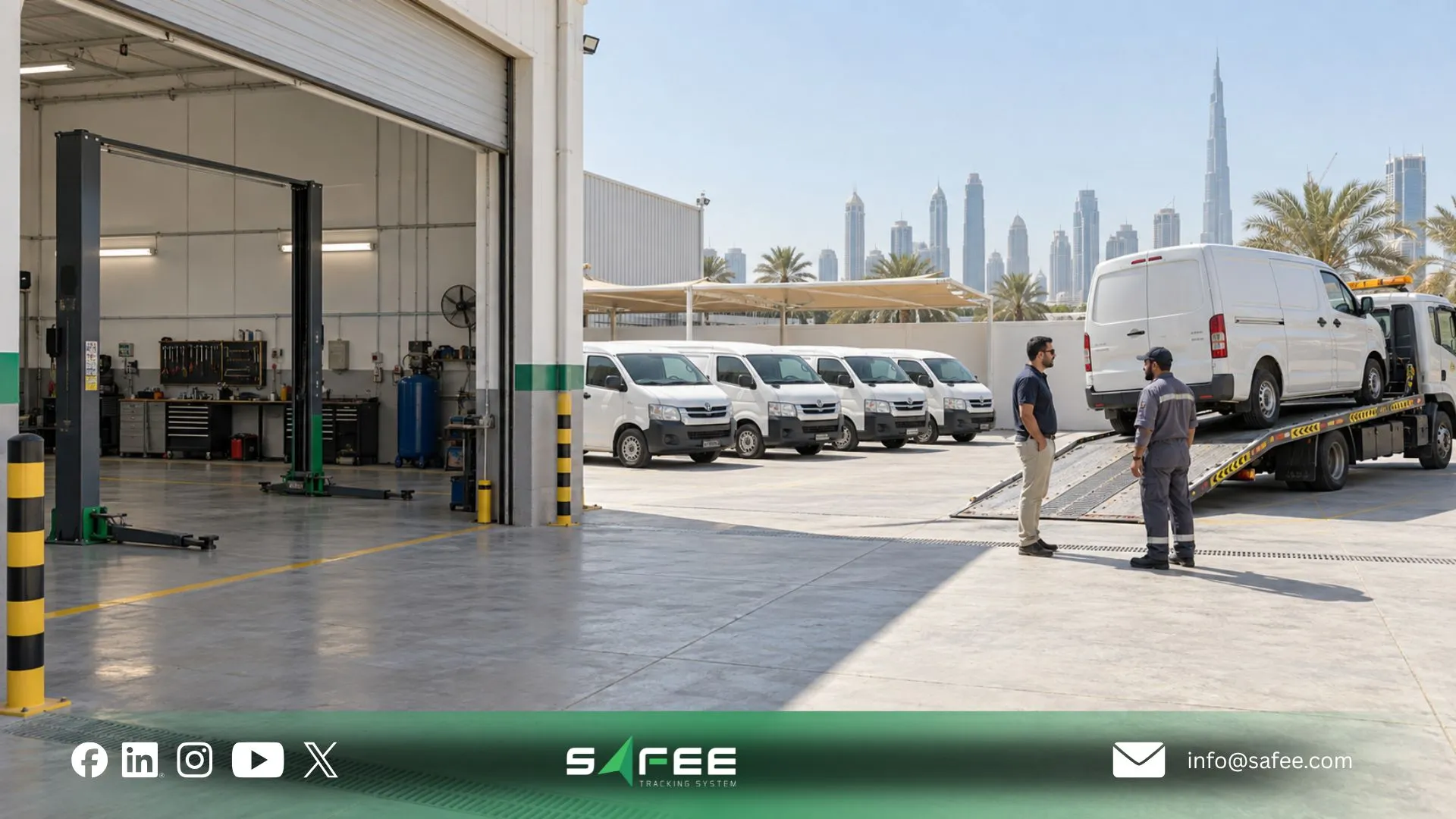
Safee: Fleet workshop management economics in one dashboard
What Safee does provide is a fleet maintenance information layer that can support many of the inputs required for workshop economic analysis.
The Maintenance Module centralizes maintenance schedules, records, reminders and task tracking. Its documented functionality includes custom task types, Spare Parts Management, and Maintenance Reports covering information such as total costs, task counts, resolution time, engine working time and distance travelled.
At Safee, we document maintenance scheduling and alerts using criteria such as odometer readings, dates, recurring time or distance rules and ignition time, depending on the workflow.
For broader management review, Fleet Reporting supports customizable reporting, filters and scheduled reporting workflows.
The practical value is not that Safee automatically makes the build-versus-buy decision. It is that maintenance teams can move important service information out of disconnected reminders and spreadsheets and into a structured fleet-management environment.
A company evaluating workshop economics can then combine Safee maintenance information with workshop-specific data—such as bay time, technician labour allocation, facility cost and outsourced invoices—to build a more defensible comparison.
Safee vs tracking workshop costs on spreadsheets
| Workshop Metric | Spreadsheet Tracking | Safee |
| Bay occupancy | Requires manual start/stop records and formulas; definitions may vary between users | Automatic bay-occupancy tracking is not documented as a native Safee capability on the public pages reviewed. Maintenance task and resolution information can provide inputs, while bay-specific timing must be captured through the fleet’s defined workshop process. |
| Downtime cost per vehicle | Often reconstructed by combining service records with manually maintained operating-cost assumptions | Safee documents maintenance task status, resolution time, total costs and related maintenance information. A monetary downtime cost still requires the fleet’s own cost methodology. |
| Parts inventory | Stock sheets, service records and costs may sit in separate files | Safee documents Spare Parts Management for custom spare parts, including quantities and costs, within its maintenance functionality. |
| In-house vs outsourced comparison | A comparison model normally has to be rebuilt or updated manually from invoices, labour and workshop records | Safee can provide maintenance cost and task data that feeds the comparison, but a native standing in-house-versus-outsourced cost comparison view is not documented on the public Safee pages reviewed. |
| Small-fleet threshold guidance | Requires a fleet-specific calculation | Safee does not publicly document a universal benchmark by fleet size. The threshold should be calculated from maintenance demand, productive capacity, workshop fixed costs, outsourced costs and downtime. |
The distinction is important.
A trustworthy fleet platform should not be credited with metrics that depend on data it does not capture. Safee can organize a substantial part of the maintenance record, but workshop-specific economics still require clear definitions for bays, labour, overhead and external service costs.
Request a Safee demo with one completed maintenance case from your fleet. Use the session to identify which service, spare-parts, cost and resolution information can be captured in Safee and which workshop-specific inputs should remain part of your internal costing model.
How Safee customers decide between in-house and outsourced workshops
There should not be one universal answer for every Safee customer.
A more defensible decision sequence is:
1. Establish maintenance demand. Use maintenance records to understand what work the fleet repeatedly generates and which requirements are predictable.
2. Separate suitable internal work from specialist work. Routine servicing should not automatically be evaluated in the same cost pool as specialist repairs requiring external expertise or equipment.
3. Measure internal capacity honestly. Calculate productive technician hours and realistic bay availability rather than theoretical maximum capacity.
4. Establish the internal cost base. Include the resources required to make that capacity available, not only direct technician wages.
5. Measure external service outcomes. Compare invoices together with turnaround, waiting, transport and the operational consequences of vehicle unavailability.
6. Review parts economics. Determine what stock is required under each model and how much capital or stockout risk it creates.
7. Compare by service category. A hybrid strategy may outperform a single all-in or all-out decision.
8. Revisit the decision as the fleet changes. Fleet size, vehicle age, utilization, geography and maintenance demand can all alter the economics over time.
Our role in this process is to improve the maintenance-information foundation: schedules, tasks, records, Spare Parts Management and reporting. The commercial decision remains a fleet-management decision built from both system data and the company’s own workshop economics.
FAQs About fleet workshop management
In-house workshop or outsourced: Which is cheaper?
Neither model is automatically cheaper. Compare the full internal cost of productive workshop capacity with equivalent outsourced service charges, turnaround, handling and vehicle downtime. The answer can differ by service category, so many fleets should evaluate a hybrid model rather than forcing every job into one channel.
What is bay occupancy and why does it matter?
Bay occupancy is the proportion of available workshop-bay time being used productively for maintenance work. It helps determine whether workshop capacity is underused or constrained, but it should be reviewed with waiting time, technician utilization, parts availability and vehicle downtime.
How much parts inventory should a fleet workshop keep on hand?
There is no universal inventory quantity. Stock levels should reflect actual consumption, part criticality, supplier lead time, vehicle compatibility, unit value and the operational consequence of a stockout rather than using a fixed percentage or arbitrary minimum.
At what fleet size does an in-house workshop make sense?
There is no reliable vehicle-count threshold by itself. An in-house workshop becomes economically relevant when suitable maintenance demand can use technicians, bays, tools and inventory efficiently compared with the full cost and turnaround of outsourcing.
Ready to improve your fleet operations?
Tell us what you would like to improve. A Safee specialist will reply by email.
Usually replies within one business day • No sales spam
Your details are used only to respond to your request. Privacy Policy