How to Improve Road Oil Transport Safety Under Hormuz Risk
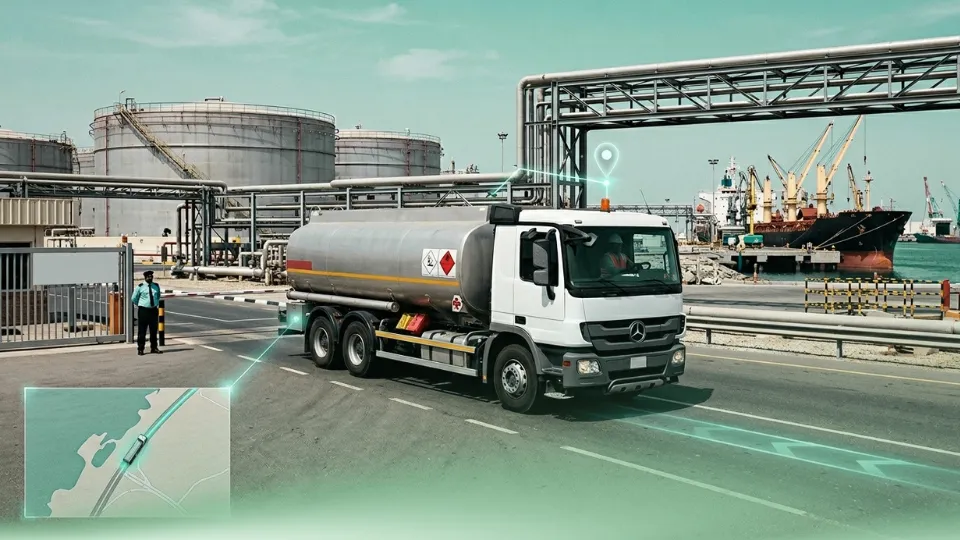
For B2B operators in the GCC’s oil and gas sector, the strategic importance of robust road oil transport safety cannot be overstated, especially when maritime routes like the Strait of Hormuz face geopolitical uncertainties. Ensuring uninterrupted, safe, and compliant overland movement of critical hydrocarbons is not just an operational necessity; it’s a cornerstone of business continuity and regional energy security.
This guide outlines practical controls and operating measures that GCC fleet managers and HSE (Health, Safety, and Environment) teams can use to improve road oil transport safety, continuity, and compliance when maritime risks disrupt logistics planning.
How Hormuz risks are reshaping GCC road transport?
The Strait of Hormuz, a vital chokepoint for global oil trade, can experience disruptions that ripple through the entire supply chain. While road transport cannot fully substitute large-scale maritime operations, it becomes a critical contingency and primary mode for inland distribution.
For GCC-based B2B operators, the focus shifts from possibility to practicality. This scenario demands a reevaluation of traditional logistics, focusing on the following:
- Strategic Route Diversification: Identifying and validating alternative inland corridors to maintain supply flows.
- Enhanced Operational Discipline: Counteracting increased dispatch pressure that can compromise safety protocols, documentation, and route adherence.
- Elevated Risk Management: Recognizing that each road transport journey, especially for hazardous materials, carries heightened stakes for business continuity and regulatory compliance.
Industry best practices consistently advocate for rigorous pre-trip assessments, dynamic route control, and comprehensive journey management as foundational risk reduction measures.
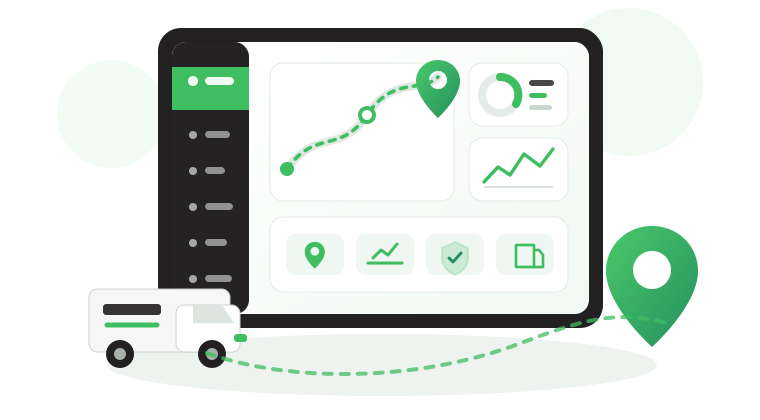
For operators managing higher-risk road movements, a more connected operating model becomes essential. That usually means stronger journey planning, real-time visibility, clearer escalation logic, and better reporting across the full trip lifecycle.
At Safee, we support that model through journey management, monitoring, reporting, video visibility, and remote-area communication tools that help operators strengthen control as logistics pressure increases.
Request a Safee demo to see how a connected fleet workflow can support higher-risk road transport operations

When does road oil transport work best?
Road transport of oil and fuel is most effective and secure when operations are meticulously planned and controlled. Ideal B2B applications include:
- Maintaining inland delivery continuity.
- Efficient depot-to-site transfers.
- Agile short-haul redistribution.
- Reliable last-mile industrial supply.
- Critical emergency support for clients facing immediate supply needs.
In these contexts, bulk oil transportation by road offers a viable continuity option, provided that route exposure, cargo controls, vehicle readiness, and dispatch governance are rigorously defined and managed.
Safee Road Oil Transport Readiness Matrix for Better Risk Control
Risk Trigger | Operational Significance | Suggested Operational Control | Safee Module Integration | Responsible Team |
Maritime route disruption | Customer supply chain vulnerability | Prioritize and approve only essential road movements | Journey Management System (JMS) | Operations |
Urgent internal demand | Increased pressure on dispatch, potential compliance lapses | Implement pre-dispatch gate checks with document holds | Monitoring & Reports | Dispatch |
Remote area operations | Loss of visibility, heightened incident risk | Utilize SATCOMM for continuous connectivity and incident fallback | SATCOMM Satellite Communications | Fleet |
Hazardous site transfers | High ignition and spill risks during loading/unloading | Enforce site checklists, mandatory sign-offs, and anomaly logging | Monitoring, Site & Reports | HSE |
Repeated route deviations | Route suitability concerns for hazardous cargo | Conduct regular corridor reviews and update operational rules | Explore History & Reports | HSE & Operations |
Any journey lacking the right driver, vehicle, documentation, approved corridor, clear communication plan, and proper receiving-site controls should not proceed
To strengthen oversight across these controls, operators should use live monitoring, reporting, and route-visibility tools that support faster operational review and intervention.
Also read: Road Oil Transport Tips for Fleets Avoiding Hormuz Risks
Pre-dispatch checks for oil transport safety
The foundation of safe road oil transport is laid before the vehicle even starts its engine. The movement of dangerous goods by road is subject to complex, multi-layered regulations. Operators must navigate varying vehicle, cargo, shipper, carrier, site, and driver obligations across different jurisdictions.
Here, OSHA refers to the U.S. Occupational Safety and Health Administration, while ADR refers to the European framework governing the carriage of dangerous goods by road.
OSHA highlights that hazardous material transport is governed by numerous agencies, while ADR regulations are specifically designed to elevate the safety standards for dangerous goods transport by road.
The following pre-dispatch checks help strengthen oil transport safety and compliance.
Before dispatch, we recommend confirming:
- Comprehensive shipment identification and load paperwork.
- Valid driver’s license and all required dangerous-goods qualifications.
- Up-to-date vehicle registration and operational approvals.
- Current tanker certificate or inspection status.
- Active insurance validity.
- All necessary route-specific authority permissions.
- Clear site delivery instructions.
- Accessible emergency numbers and a defined contact tree.
- Proper seal and handover references.
- Confirmed customer or site acceptance conditions.
For operators in Saudi Arabia, this stage is also important for aligning local workflows with WASL-related compliance and reporting requirements.
Key Local Compliance Checks for Road Oil Transport with Safee
- Country and emirate/kingdom-specific transport regulations.
- Precise dangerous-goods classification requirements.
- Scope of driver training and qualification mandates.
- Route permits and access to restricted zones.
- Receiving-site documentation and induction protocols.
- Expected spill-response capabilities.
- Insurer conditions specific to hazardous loads.
- Reporting obligations to customers and authorities.
How to build a resilient journey plan for road oil transport?
Effective Journey Management is a systematic process encompassing planning, approval, control, and review of every trip, designed to minimize risks before, during, and after travel.
The International Association of Oil & Gas Producers (IOGP) defines journey management as a structured approach to reducing workforce exposure to driving hazards, while OSHA’s guidance for oil and gas transport emphasizes pre-trip planning, transport-related risk assessment, and the selection of the safest routes and conditions.
Route risk assessment and approved corridors
Route approval should be data-driven and comprehensive, considering:
- Road class and condition.
- Congestion patterns.
- Checkpoints and border controls.
- Populated zones.
- Tunnels, bridges, and restricted areas.
- Weather exposure.
- Refueling and rest points.
- Site operating hours.
- Emergency access limitations.
- Communication black spots.
Safee advocates for an approved-corridor model over ad-hoc improvisation. Our solutions enable HSE and operations teams to define acceptable corridors for specific cargo types, routing exceptions through higher approval paths. This approach reduces decision fatigue at dispatch and ensures consistency across shifts.
This is where a structured journey management system becomes especially useful. Safee’s Journey Management System (JMS) supports trip planning, assessment, monitoring, and reporting, including configurable alerts for deviations such as speeding or route breaches.
Journey control thresholds
A robust journey management plan translates policy into measurable controls. This means establishing clear trip rules before the truck departs, preventing post-incident debates.
Minimum trip thresholds, managed by Safee, should include the following:
- Approved driver identification.
- Approved vehicle and tanker specifications.
- Permitted speed thresholds.
- Maximum journey duration.
- Checkpoint timing adherence.
- Defined rest or stop logic.
- Deviation tolerance parameters.
- Communication-loss thresholds.
- Designated escalation owners.
- Receiving-site confirmation requirements.
Safee’s Journey Management System (JMS) and SATCOMM Satellite Communications solutions provide configurable alerts, comprehensive reporting, and critical communication thresholds, enabling your teams to transition from passive tracking to active, intelligent control.
Also read: Why Leading Fleets Choose Safee Journey Management System

Critical control points for loading, unloading, and handover of hazardous cargo
Loading and unloading operations are frequently the most high-risk phases of the transport workflow, where multiple stakeholders, systems, and physical controls converge.
OSHA explicitly identifies the loading or unloading of flammable and combustible liquids as a highly hazardous operation, and HSE guidance for road tanker unloading emphasizes preventing overfill and managing safe procedures at the site interface.
Recommended safety measures for tanker loading and unloading
At a minimum, operators should confirm the following:
- Thorough site risk assessment.
- Strict ignition-source control.
- Mandatory earthing or bonding where required.
- Rigorous hose and coupling compatibility checks.
- Verification of overfill prevention systems.
- Awareness and accessibility of emergency-stop mechanisms.
- Clear traffic and pedestrian segregation.
- Readiness for spill response.
- Defined site communication protocols.
- Consideration of weather or visibility restrictions.
Handover controls for safe tanker release
Before releasing the vehicle, operators should confirm:
- Seal condition integrity.
- Accurate quantity or delivery confirmation.
- Official site sign-off.
- Comprehensive anomaly logging.
- Documentation of any delay or deviation.
- Dispatch notification confirming transfer completion.
Real-time monitoring and proactive exception management with Safee
Once a hazardous cargo journey commences, the operational focus shifts from planning to dynamic exception management. Modern control rooms need more than passive location tracking. They need live oversight, faster exception detection, historical review, and reporting that supports both operational response and auditability.
A connected operating environment helps teams combine live visibility, historical analysis, and scheduled reporting to make better decisions during hazardous journeys.
For hazardous movements, Safee enables dispatchers to actively monitor for:
- Route deviation from approved paths.
- Speed breaches beyond defined thresholds.
- Prolonged unscheduled stops.
- Critical communication gaps.
- Missed checkpoints.
- Late arrival drift.
- Geofence breaches.
- Recurrent alarms on specific corridors.
Also read: Safee Journey Risk Assessment System for Fleet Safety

Advanced visibility and connectivity for higher-risk routes
ViVMS video monitoring
For tanker fleets, raw location data often lacks the necessary context. Supervisors need to understand why an event occurred: was it driver fatigue, distraction, adverse road conditions, a harsh maneuver, or an external factor?
Safee’s ViVMS adds visual context through live visibility, AI-supported alerts, incident verification, and event documentation.
ViVMS significantly enhances the following:
- Fatigue detection and management.
- Distraction identification.
- Harsh-event verification for accurate incident assessment.
- Targeted driver coaching and performance improvement.
- Investigation quality and efficiency.
- Audit trail strength for compliance.
This is invaluable for long GCC routes, where evidence-backed coaching, rather than assumptions, drives safety culture improvements.
Explore the deeper features in 5 Ways Video IVMS Enhances Fleet Safety and Control.
SATCOMM satellite communications
Operating in remote or challenging terrains fundamentally alters the risk landscape. A route deemed acceptable within cellular coverage may become critically unsafe in a desert or border zone if communication is lost.
Safee’s SATCOMM solution helps maintain communication continuity and operational visibility when standard cellular coverage becomes unreliable. This guarantees uninterrupted control for fleets operating in the most remote areas, safeguarding critical operations.
Building a safer road oil transport model under Hormuz-related risk requires more than route changes alone. It requires stronger journey planning, better monitoring, clearer escalation logic, reliable communication, and defensible reporting across the full trip lifecycle.
For GCC operators moving oil and fuel by road, Safee supports that model through connected tools for journey management, monitoring, video visibility, reporting, and remote-area communication.
Don’t let unforeseen risks compromise your critical operations. Request our demo today to empower your fleet with the industry’s leading road oil transport management solutions.
Also read: How Telematics Vehicle Tracking Is Redefining Modern Fleet Management?
FAQs about road oil transport
How does Safee help manage risks associated with Hormuz Strait disruptions?
Safee’s solutions provide advanced journey management, real-time monitoring, and communication tools (like SATCOMM) that enable B2B operators to plan and execute alternative road transport routes safely and efficiently, ensuring business continuity even when maritime routes are uncertain. Our systems help you maintain visibility and control over your fleet, mitigating risks associated with increased overland transport.
Which Safee features support hazardous material transport compliance in the GCC?
Safee supports compliance through journey planning, monitoring, configurable alerts, reporting, WASL-related workflow support in Saudi Arabia, and video-based incident review that can strengthen investigation and driver coaching processes.
Can Safee integrate with existing fleet infrastructure?
Yes. Safee is designed to integrate with a wide range of telematics devices and operational systems, helping operators consolidate data and strengthen decision-making without replacing every existing component at once.
How does Safee ensure communication in remote areas where cellular networks are unreliable?
Safee’s SATCOMM Satellite Communications module provides uninterrupted connectivity in remote and challenging terrains, ensuring continuous GPS fleet tracking, real-time monitoring, and critical communication even beyond traditional cellular network coverage. This is vital for maintaining control and safety for fleets operating in vast desert or border regions.
What support does Safee provide to B2B fleet operators?
Safee provides implementation support, technical assistance, and ongoing guidance to help operators apply the platform effectively across their own operational workflows.
Ready to improve your fleet operations?
Tell us what you would like to improve. A Safee specialist will reply by email.
Usually replies within one business day • No sales spam
Your details are used only to respond to your request. Privacy Policy