
How Waste Management Fleet Tracking Improves Collections
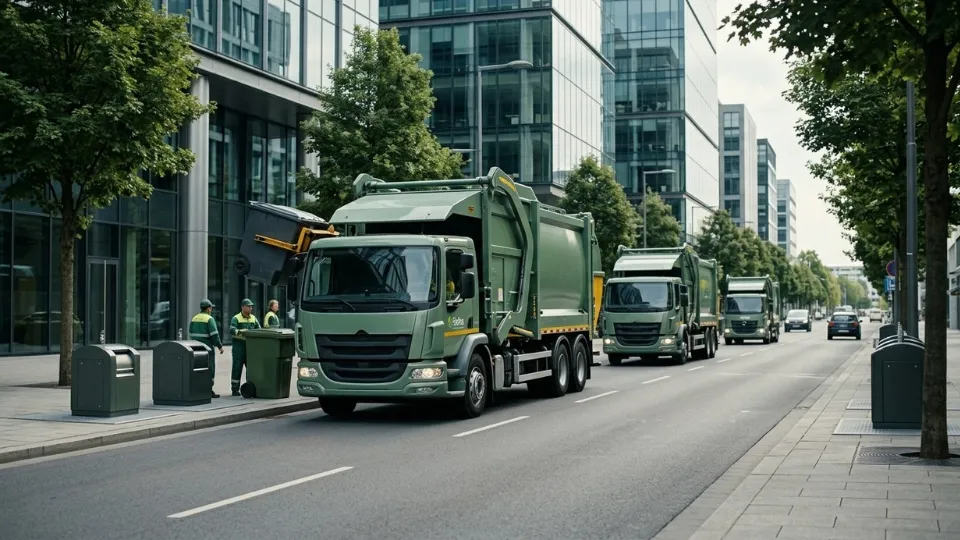
Waste fleets do not struggle because managers lack maps. They struggle when route deviations stay invisible, missed pickups turn into customer disputes, supervisors depend on calls instead of evidence, and reports arrive too late to fix what went wrong. That is why Waste Management Fleet Tracking now matters as an operating-control layer, not just a location tool.
In this guide, we explain what Waste Management Fleet Tracking actually means, how Recycling and Waste Management Fleet Tracking works in daily operations, where Waste Management Software differs from generic fleet tools, what features and cost drivers buyers should evaluate, and how we at Safee help operators turn collection data into faster action, cleaner reporting, and stronger accountability from route start to disposal confirmation.
What is waste management fleet tracking?
Recycling and Waste Management Fleet Tracking is the use of GPS, telematics, route visibility, alerts, geofences, proof-of-service inputs, and reporting to control how waste collection and hauling fleets perform in the field.
For B2B operators, the real question is not “Where is the truck?” It is “Did the truck serve the right zone, on time, with evidence, and can we prove it later?” That shift is what separates basic tracking from operational control.
In practice, a strong Waste Management Fleet Tracking workflow helps you answer the pain-point questions managers deal with every day:
- Did the vehicle actually follow the assigned collection zone?
- Where did route drift, excess dwell time, or long idling reduce shift productivity?
- When did the truck enter and leave the depot, transfer station, recycling site, or landfill?
- Which vehicles, routes, or drivers create the highest number of daily exceptions?
- Can we prove collection activity clearly enough to reduce disputes and tighten internal accountability?
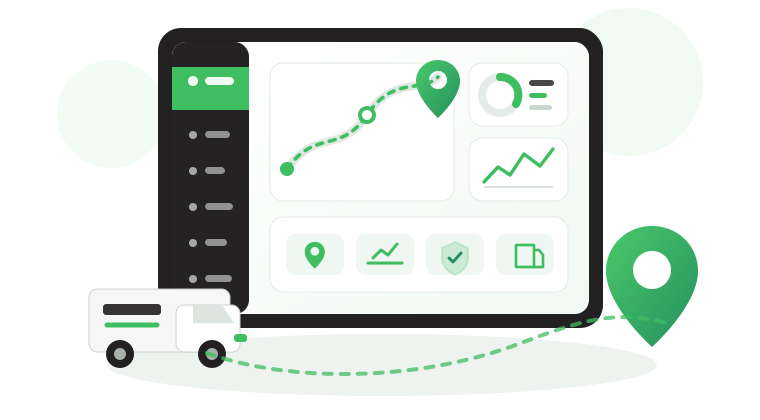
At Safee, we treat waste tracking as a governed workflow. Our fleet management solution for Waste is designed to make live container status, vehicle route adherence, collection confirmations, load weight, and collection history visible inside one operating environment instead of scattered across calls, spreadsheets, and disconnected reports.
If your operation needs more than map visibility, see how our waste management module works and then talk to us about the collection model, zones, and exception rules you want to manage.
Also read: Public Works Fleet Management: Keep Field Services Ready and Accountable
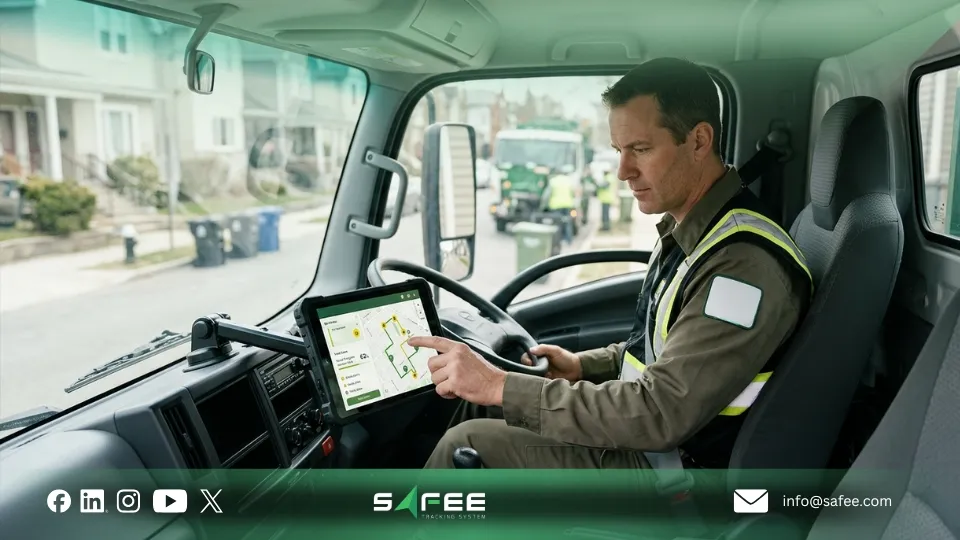
Waste management software vs. Traditional fleet management
Fleet software for waste management should be evaluated against the rhythm of collection work, not against generic fleet dashboards. Waste routes are stop-heavy, repetitive, zone-based, and exception-sensitive. That requires more contextual control than many general fleet tools are built to provide.
Comparison Area | Waste Management Software | Traditional Fleet Management |
Operational focus | Collection execution, proof of service, site visits, exceptions | Broad vehicle oversight across mixed fleet activities |
Route logic | Dense stop routes, recurring zones, disposal flows | General trip visibility and movement history |
Site control | Depot, landfill, transfer, recycling, customer geofences | Basic location awareness |
Daily review | Shift-level route compliance and service exceptions | Higher-level fleet review |
Management value | Helps supervisors act faster and prove what happened | Helps managers monitor movement and utilization |
This does not mean traditional fleet management has no value. It means waste operators should compare software against actual collection workflow, site movement, reporting pressure, and service-proof needs. A generic tool may show movement. A stronger waste-focused setup helps you govern movement.
Want to compare general tracking against a waste-specific operating model? Review our essential modules and our dedicated waste management solution to see where route control, alerts, and proof-of-service capabilities become more practical.
How does recycling and waste management fleet tracking work?
Fleet Software for Waste Management works by turning vehicle and service activity into operational records your team can act on quickly. The workflow is straightforward when the platform is configured correctly:
1) Vehicles and field assets generate data.
GPS devices capture location and movement, while connected inputs can add service context such as RFID-based container recognition, collection confirmation, or load-weight signals.
2) The platform receives and organizes the data.
Instead of raw pings, the system converts movement into trips, stops, idling periods, site visits, and route paths that supervisors can actually review.
3) Geofences add location meaning.
Depots, transfer stations, recycling centers, landfills, and customer zones become measurable events rather than vague map activity.
4) Alerts surface exceptions early.
Route deviation, unusual dwell time, after-hours movement, or excessive idling can be pushed to the right users so issues are handled during the shift, not after it.
5) Dashboards and reports support optimization.
Historical route review, exception trends, and area-level performance make it easier to improve recurring collection work instead of repeating the same blind spots.
At Safee, this workflow is strengthened through a mix of live monitoring, route review, alerts, and analytics. Our waste management module adds operational context through live container status, collection confirmations, load-weight visibility, and collection history, while our broader platform adds live vehicle tracking, map-based monitoring, and analytics for faster decision-making.
If you want to see how collection data becomes route control inside one platform, start with Live Vehicle Tracking, then review Fleet Monitoring & Insights, Alarms and Alerts, and Tracking Data Analyzer.
ِAlso read: Fleet Management Software Cost & Vehicle Tracking System Pricing
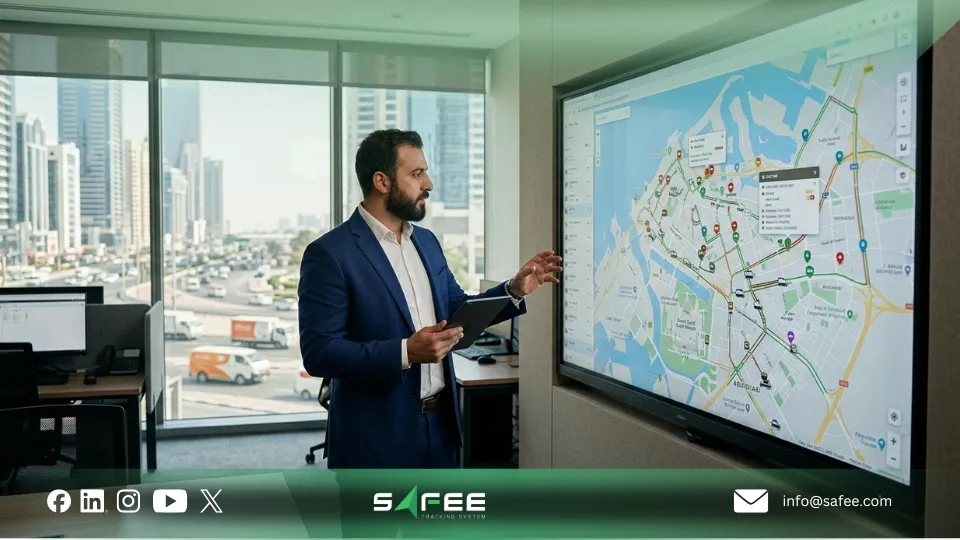
Different types of waste management and their fleet needs
Different types of waste management create different route logic, service promises, site behavior, and reporting requirements. That is why serious buyers should not evaluate Fleet Software for Waste Management as if every waste stream behaves the same way.
Municipal solid waste collection
High stop density, repetitive routes, and strong pressure on route completion. The fleet need is usually zone visibility, shift monitoring, idling control, and faster investigation of missed areas.
Recycling collection
Separate streams, different schedules, and different processing destinations. These operations often need stronger route discipline, service verification, and better visibility into area-level collection patterns.
Commercial and industrial waste
More site-based servicing, contract-specific pickup windows, and variable turnaround times. These fleets benefit from stronger customer-site geofences, cleaner trip records, and structured exception review.
Organic, bulk, and special collections
Less standard route behavior and more operational variation. These fleets need adaptable reporting, clearer dwell analysis, and better proof of what happened during irregular service cycles.
The better the platform fits the waste stream, the more useful the data becomes. A route with hundreds of household stops is not managed the same way as a recycling run, an industrial pickup loop, or a bulk collection round.
Need help mapping the right setup to your waste stream? Contact us, and we will walk through your collection model, route density, disposal flow, and reporting priorities.
Waste Management System: From Collection to Disposal
A good Fleet Management Solution for Waste should support the full operational chain, not just the moving vehicle. For B2B operators, that means creating one control layer from dispatch readiness to post-shift reporting.
Before the shift
Confirm active vehicles, drivers, zones, and route readiness. Managers need a quick, centralized view before trucks leave the yard.
During collection
See live route progress, spot delays, investigate route drift, and respond to issues while the shift is still in motion.
At transfer, recycling, and disposal sites
Use geofences and event history to validate entries, exits, dwell time, and operational flow between collection and final handling points.
After the shift
Review route history, service exceptions, idling patterns, repeated bottlenecks, and management KPIs so tomorrow’s run improves instead of repeating today’s problems.
This is where a waste management system becomes commercially valuable. It reduces dependence on informal updates, gives supervisors faster proof, and helps leadership review performance with less manual reconstruction.
If you want collection-to-disposal visibility instead of isolated tracking screens, review our Fleet Monitoring & Insights module, our Fleet Reporting module, and our waste management solution together.
Core features of fleet software for waste management
The strongest waste management system helps teams act, not just observe. When buyers compare Waste Management Software, these are the features that usually separate operational value from dashboard noise:
- Centralized live tracking so supervisors can monitor active routes from one place.
- Trip history and playback for investigating missed service, unexplained stops, and route drift.
- Geofence-based site monitoring around depots, customer sites, recycling centers, transfer stations, and landfills.
- Configurable alerts for route deviation, excessive idling, after-hours movement, unusual dwell, and other exceptions that matter to your policy.
- Reporting and dashboards that support daily supervision and management review, not only live map visibility.
- Role-based access so dispatchers, supervisors, managers, and leadership each get the right level of visibility.
- Auditability and administration controls that support cleaner governance as the operation grows.
- Integration readiness so the platform can connect to wider business workflows instead of becoming another silo.
Across Safee’s platform, these capabilities are supported through our essential modules for live tracking, monitoring, alarms, reporting, administration, and analytics, plus our specialized waste management module for collection-specific workflows.
To review the feature stack in the right order, start with Fleet Monitoring & Insights, then open Alarms and Alerts, Fleet Reporting, Administration Panel, and Tracking Data Analyzer.
Also read: Why GPS Vehicle Tracking Systems Are So Beneficial in 2026
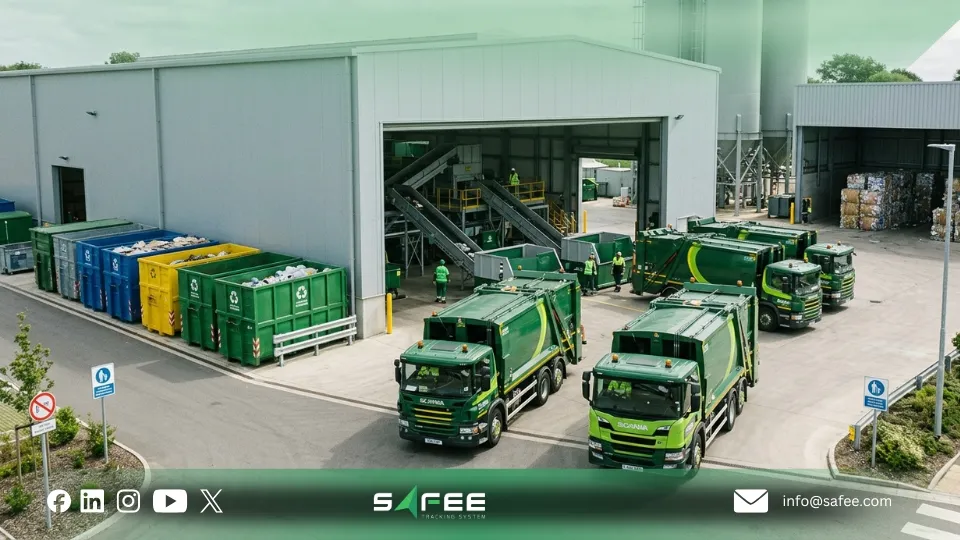
Cost of waste management fleet tracking system
The price of a recycling and waste management fleet tracking system should be evaluated as a deployment model, not as a single headline number. Waste operations vary too much in vehicle count, route density, service proof requirements, and reporting depth for one flat number to be meaningful.
What usually drives cost
- Number of vehicles, branches, and user roles in scope.
- Hardware or device requirements, including any sensor or RFID needs.
- How many zones, geofences, and sites must be configured and maintained.
- How much alert logic, exception workflow design, and reporting setup the business requires.
- Whether you need proof-of-service, collection-history, or load-related visibility beyond standard GPS data.
- Integration, onboarding, and post-launch support requirements.
- How quickly the operation is expected to scale into new routes, regions, or contracts.
Follow these steps to compare proposals
- Check what is included in implementation and what is charged later.
- Ask whether alerts, dashboards, and reports will be configured around your real collection workflow.
- Review how supervisors and leadership will consume the reporting output.
- Confirm how the platform scales when routes, users, or service areas grow.
- Assess post-go-live support, because wasted rollout is often more expensive than higher-quality deployment.
If you want a scoped answer instead of a generic quote, request a Safee demo and we will discuss fleet size, route density, service complexity, and reporting needs before recommending the right setup.
Key challenges in waste collection & waste hauling fleets
Waste collection and waste hauling fleets face a specific type of operational pressure: high stop density, repetitive routes, site movement complexity, and constant service exceptions. That combination creates the blind spots that most managers want to eliminate first.
Limited live visibility
Supervisors cannot always see which zones are falling behind or which vehicles have deviated until the shift is already affected.
Missed service and weak proof
Without clean route history and service confirmation, missed pickups become disputes instead of manageable exceptions.
Excessive idling and dwell
Stop-heavy routes make it harder to distinguish necessary stop time from avoidable waste unless the platform shows the pattern clearly.
Site movement complexity
Depots, transfer points, landfills, recycling centers, and customer sites all need validation. Without geofence logic, site behavior becomes hard to verify.
Alert fatigue
Badly configured systems flood teams with noise. Managers then ignore the alerts that actually matter.
Weak post-shift review
Many operations can see the trucks live but still cannot produce clean management review, trend analysis, or action plans afterward.
At Safee, our goal is to help you reduce blind spots, tighten route control, prove field activity more clearly, and make reporting usable enough for real operational follow-up.
If these are the exact issues your fleet is fighting, book a walkthrough with Safee so we can map the right alerts, geofences, dashboards, and review process to your waste operation.
How does Safee help you track and optimize your waste management fleet
We do not position Safee as a simple third-party tracker. We position Safee as the operating layer that helps waste fleets move from scattered visibility to controlled execution.
For waste operators, we combine our dedicated waste management solution with broader fleet modules that support live tracking, route review, alerts, reporting, analytics, and administration. That lets you manage trucks, zones, sites, exceptions, and management review inside one structure instead of forcing teams to patch the workflow together manually.
How we support waste fleets in practice
- We help you centralize live vehicle and route visibility across active collection work.
- We help you configure geofences around depots, transfer stations, recycling facilities, landfills, and customer sites.
- We help you design alert logic around route deviation, dwell, idling, unauthorized movement, and other exception triggers that matter to your operation.
- We help you create reporting views that supervisors can act on and leadership can trust.
- We help you add operational context through our waste management solution, including collection confirmations, load-related visibility, and collection history.
- We help you turn raw data into management intelligence through Monitoring, Fleet Reporting, Alarms and Alerts, Administration, and Tracking Data Analyzer.
This matters because waste operations do not gain long-term value from installation alone. They gain it when the platform is configured to match how collection really happens, how supervisors escalate issues, and how management reviews performance every week.
If you are evaluating Fleet Management Solutions for Waste, our advice is to choose the platform that helps your team see faster, react earlier, prove more clearly, and govern more consistently. That is the role we are built to play at Safee. Contact us to work together.
Also read: EV Fleet Management: The Future of Electric Fleet Solutions in 2026
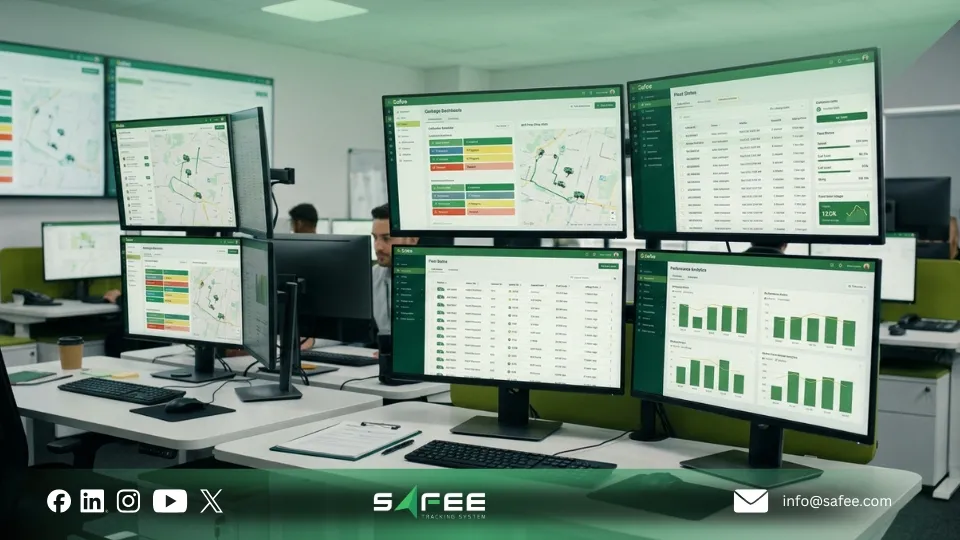
FAQs About waste management fleet tracking & software
What are the 4 types of waste management?
A practical fleet-operations view often includes municipal solid waste, recycling streams, organic or biodegradable waste, and industrial or specialized waste. Each one creates different route density, site behavior, service proof needs, and reporting priorities.
What is the waste management system?
A waste management system is the operational structure used to manage collection, transport, processing, recycling, treatment, or disposal. In fleet terms, it should connect vehicles, routes, service events, site monitoring, alerts, and reporting inside one controlled workflow.
What are the 5 ways of waste management?
A commonly used framework includes reduction, reuse, recycling, recovery, and disposal. For fleet managers, the practical relevance is that each approach changes how collection routes, site movements, service windows, and operational controls need to be managed.
What is a good waste management system?
A good waste management system does more than show location. It gives operators route visibility, site proof, configurable alerts, reliable reporting, and enough operational discipline to improve service, reduce disputes, and support management decisions with evidence
Ready to improve your fleet operations?
Tell us what you would like to improve. A Safee specialist will reply by email.
Usually replies within one business day • No sales spam
Your details are used only to respond to your request. Privacy Policy