

Fleet Management Fuel Monitoring: Weekly KPIs to Track Consumption and Cut Waste
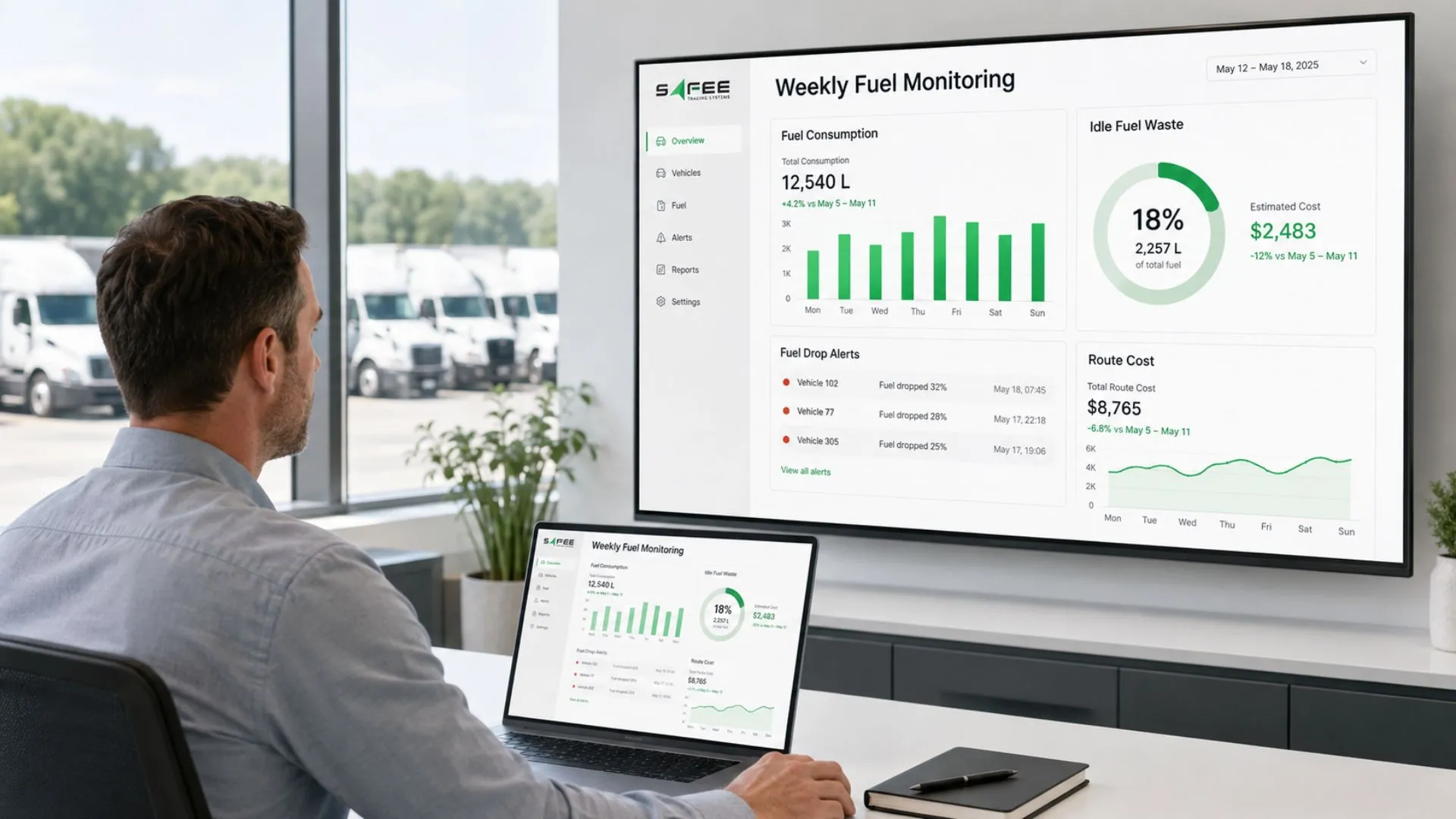
Fuel reports can contain plenty of numbers and still leave managers with the same problem: Which vehicle, driver, route, branch, or operating behavior is actually creating waste? Effective fleet management fuel monitoring should answer that question before fuel data becomes another spreadsheet reviewed only after costs have already accumulated.
For a fleet manager, the useful workflow is not to inspect every tank-level reading. It is to review a defined set of consumption KPIs, compare similar operating groups, isolate exceptions, verify those exceptions against vehicle activity, and assign the right corrective action.
This guide focuses on that weekly management process. It does not repeat technical guidance on fuel sensors, calibration, tank configuration, or reading quality.
What should fleet management fuel monitoring show every week?
Fleet management fuel monitoring is the recurring management process of reviewing fuel consumption, refueling activity, idling, operating context, anomalies, and trends so that exceptions can be investigated while the underlying trip and driver context is still relevant.
That makes it different from two related activities:
- Fleet management fuel tracking records fuel-related activity such as consumption, refueling, fuel changes, or related vehicle events.
- Fuel level monitoring focuses more narrowly on the technical signal that shows how fuel level changes over time.
- Management-level fuel reporting combines fuel information with mileage, routes, trips, stops, idling, driver assignments, vehicle type, location, and operating conditions to explain why performance changed.
The distinction matters. A record can tell you that fuel consumption increased. A management report should help you determine whether the increase is consistent with a longer route, heavier workload, increased idle time, a maintenance issue, different operating conditions, or an exception that needs investigation.
Our capability can provide views around fuel usage, idle consumption, refueling activity, sudden changes, historical fuel information, and report scheduling where compatible fuel data is available.
A useful weekly review should therefore answer questions such as:
- Which vehicles consumed materially more fuel than comparable vehicles?
- Which routes or trips show unusual consumption?
- Where is idling contributing to avoidable fuel use?
- Which vehicles are refueling more frequently than expected?
- Are there fuel changes that do not align with vehicle movement or operating context?
- Are the same drivers, vehicles, routes, sites, or branches appearing repeatedly in exception reports?
- Which previously identified exceptions have been investigated and closed?
Weekly review does not replace monthly finance reconciliation. Monthly invoices and cost reports remain important for budgeting and financial control. The advantage of reviewing operational fuel information every week is that the people involved are more likely to still have the route, driver, vehicle, maintenance, and refueling context needed to explain an exception.
If your fleet already collects fuel data but managers are unsure what should make the weekly review, contact us to map the right KPIs, report recipients, and exception workflow.
7 fleet management fuel consumption KPIs to track
A useful fleet management fuel consumption KPI needs more than a number. Each metric should have a comparison basis, responsible owner, data source, review frequency, and defined response when performance moves outside the expected range.
The objective is not to create the largest dashboard possible. It is to maintain a compact set of measurements that helps managers identify where investigation will have the greatest operational value.
1. Fuel consumption per vehicle
Start with the individual vehicle, but avoid comparing unlike assets. A delivery van operating short urban routes should not automatically be judged against a highway vehicle, heavy truck, or specialist asset.
The KPI becomes more useful when consumption is normalized against the workload that matters for that vehicle: distance travelled, operating hours, completed trips, or another operational unit.
Managers should then ask whether the difference is persistent. A single unusual week may reflect a legitimate route or workload change. A repeated variance across comparable operating periods deserves deeper review.
2. Fuel cost per trip or route
Fuel volume explains consumption. Fuel cost adds to the financial impact.
Where validated cost data is available, compare trips or route groups to see where operating cost is changing. Avoid interpreting this KPI without considering route length, traffic, stops, load, terrain, operating hours, and other factors that materially change fuel demand.
If cost data and operational data come from separate systems, preserve the distinction rather than creating an estimated cost that looks more precise than the underlying records.
3. Idle fuel waste
Idle fuel use is particularly actionable because the question is not simply how long a vehicle idled, but where, why, and whether that idle time was operationally necessary.
Our fuel capability includes idle fuel usage tracking where the relevant data is available. A manager can therefore review high idle consumption alongside location and trip context rather than treating every stationary engine period as driver waste.
For example, repeated idling may point to:
- Driver behavior that requires coaching.
- Queueing or loading delays at a specific site.
- Dispatch practices that create unnecessary waiting.
- Operational requirements that are legitimate but should be measured separately.
- Vehicle or equipment processes that require investigation.
4. Fuel used per driver or team
This KPI can support accountability, but only when driver assignment data is reliable.
A high result should not automatically be treated as evidence of poor driving. Driver comparisons should consider vehicle class, route, load, shift, operating conditions, and assignment history. The purpose is to identify a pattern that needs explanation, not to assign blame from one number.
Connecting fuel information with Driver Management makes the review more useful because the manager can examine fuel performance within the correct assignment context.
5. Refueling frequency and volume
Review how often each asset refuels and whether the amount added is consistent with its recent activity.
Repeated fills can be legitimate for high-utilization vehicles. The exception is when the frequency or volume becomes difficult to reconcile with mileage, operating time, route activity, or normal vehicle behavior.
This KPI is particularly useful when paired with refueling locations and trip records rather than evaluated as a standalone total.
6. Fuel drop or anomaly events
A sudden decrease in fuel level can be an important signal, but it is an exception to verify, not a completed investigation.
Review the event against:
- Vehicle location.
- Trip history.
- Whether the vehicle was moving or stopped.
- Recent refueling activity.
- Normal consumption.
- Driver assignment.
- Available fuel-data quality.
- Other operational records.
Our platform can surface sudden fuel changes and fuel-related event history where suitable data and configuration are available. The management value comes from combining that signal with operational context before deciding whether escalation is justified.
7. Consumption variance by vehicle type
A fleet-wide average can hide the most useful information.
Create peer groups so that similar vans are compared with similar vans, trucks with comparable trucks, and specialist vehicles with assets performing equivalent work. Then investigate the outliers within each group.
Variance can point managers toward different actions: maintenance review, driver coaching, route analysis, workload normalization, or further fuel-event validation.
How to build a weekly fuel monitoring workflow?
A weekly process turns individual fleet management fuel records into a repeatable control routine. The workflow should be simple enough to run consistently but disciplined enough to prevent every small variation from becoming an investigation.
1. Collect the relevant operating evidence
Bring together the data needed to explain consumption rather than looking at fuel in isolation.
Depending on fleet configuration, that can include:
- Fuel usage and fuel-change records.
- Refueling events.
- Mileage or distance.
- Trips and routes.
- Vehicle location.
- Idle time.
- Driver assignment.
- Vehicle type.
- Operating hours.
- Branch or site.
- Maintenance context where relevant.
Telematics is connected vehicle and operational data used to provide context around fleet activity. For fuel review, its value is that a manager can compare a fuel signal with where the vehicle travelled, how it operated, and what happened around the same period.
2. Create meaningful comparison groups
Do not build one benchmark for the entire fleet unless the assets genuinely perform comparable work.
Useful groups may be defined by:
- Vehicle type.
- Route type.
- Branch.
- Depot.
- Site.
- Operating team.
- Duty cycle.
- Similar workload.
The benchmark is there to surface exceptions. It should not force different operating environments into the same target.
3. Flag exceptions instead of every fluctuation
A weekly report becomes difficult to manage when every minor change generates attention.
The fleet team should define which deviations are material enough to review based on its own vehicle classes, data quality, operating model, fuel policy, and risk profile.
The report should help managers distinguish between:
- Normal operational variation.
- A one-time exception that can be explained.
- A repeated pattern requiring corrective action.
- An urgent event requiring prompt validation.
4. Assign each exception to an owner
A fuel report without ownership becomes an information archive.
Define who reviews different types of exceptions. Depending on the organization, responsibility may sit with Fleet, Operations, Finance, Maintenance, branch management, or another authorized team.
Role-based access should align visibility with operational responsibility rather than assuming every user requires the same data scope.
5. Schedule and distribute the management report
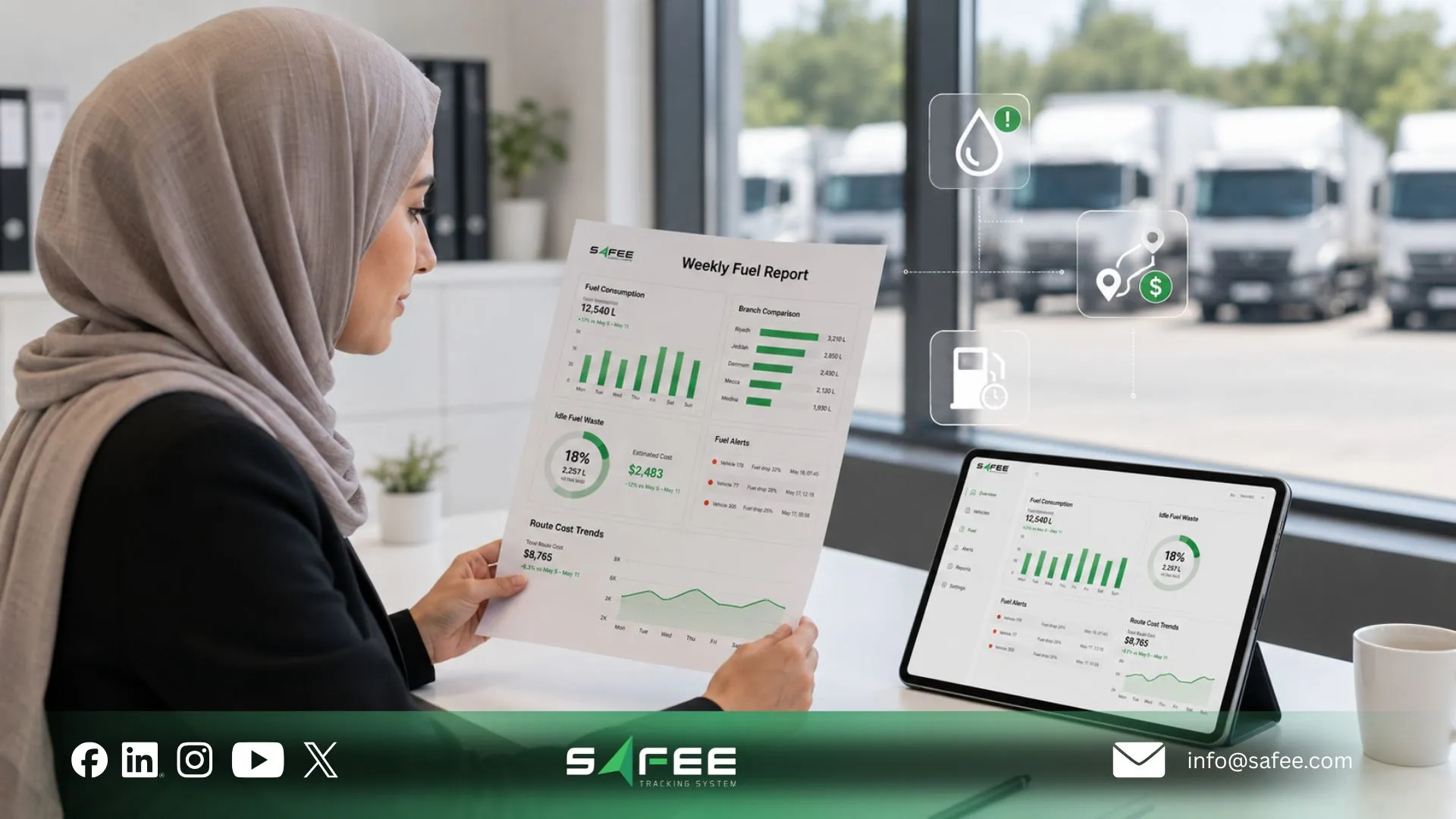
Safee’s Fleet Reporting supports customizable report parameters and scheduled report delivery, including daily, weekly, or monthly schedules. Reports can also be filtered around assets, drivers, time ranges, and relevant operating categories.
That enables different stakeholders to receive the view relevant to their responsibility:
- Fleet Managers: consumption, anomalies, open actions.
- Operations: routes, idle time, branch or site patterns.
- Finance: cost and refueling trends.
- Maintenance: vehicles whose consumption changes may require technical review.
- Leadership: summarized recurring trends and unresolved material exceptions.
Need to move from ad-hoc spreadsheets to a repeatable weekly process? Ask us to review how Fleet Reporting can connect fuel KPIs, report schedules, and responsible users around your current operating model.
5 Fuel waste patterns your reports should expose
KPIs become useful when they reveal patterns that a manager can investigate. One isolated event may have a valid explanation; recurring relationships between fuel, vehicle activity, location, routes, and assignments are more valuable for management review.
1- High idle time with high fuel use
High idling combined with high fuel consumption deserves attention because it links a behavior or operating condition directly to fuel use.
The next question is where the idling occurs. If several vehicles repeatedly idle at the same depot, customer site, border crossing, loading area, or dispatch point, the root cause may be operational rather than individual driver behavior.
The report should therefore connect idle fuel use with location and trip context before the fleet manager chooses an action.
2- Similar vehicles showing very different fuel consumption
Large differences inside a comparable vehicle group can expose issues that fleet-wide averages hide.
Investigate whether the difference follows:
- A particular route.
- One driver or team.
- A branch.
- Vehicle condition.
- Different utilization.
- Different loads or operating requirements.
A repeated unexplained difference may justify maintenance inspection, route review, or driver coaching.
3- Repeated refueling without matching route activity
Refueling frequency should make sense in relation to vehicle utilization.
If a vehicle records repeated fills while its mileage, trips, or operating hours do not show a corresponding level of activity, the discrepancy deserves validation.
That does not automatically establish misuse. The manager should compare the refueling event with fuel history, location, trip records, driver assignment, and available supporting records.
4- Unexpected fuel drops after stops or refueling
A fuel drop close to a stop or recent refueling can be operationally significant because the timing provides useful investigation context.
The correct workflow is:
- Confirm that the fuel event is sufficiently reliable to review.
- Check the vehicle location and movement history.
- Compare the event with the preceding refuel.
- Review driver and trip context.
- Determine whether the event has a reasonable explanation.
- Escalate only when the available evidence supports further investigation.
Our fuel-related views can expose sudden changes and fuel history, while our wider platform provides location and trip context for review.
5- Routes or branches with abnormal monthly fuel trends
Weekly monitoring should also roll upward into longer-term trend review.
If one branch, project, route group, or operating unit consistently consumes more fuel than comparable groups, management should investigate the operating model behind the difference rather than concentrating only on individual vehicles.
Possible causes may include route design, congestion, workload, excessive waiting, vehicle mix, maintenance condition, or differences in local operating practices.
The monthly view therefore answers a different question from the weekly report: Is this an isolated exception, or has it become a recurring operating pattern?

How Does Safee support fleet management fuel monitoring?
At Safee, we support fleet management fuel monitoring as part of a broader fleet management workflow, not simply as a standalone view of fuel readings.
We help Fleet Managers review fuel information alongside the operational context needed to understand it, including vehicle activity, location, routes, driver assignments, configured alerts, and historical reports. This connected approach helps teams move beyond identifying that “fuel changed” and toward understanding which vehicle was involved, what trip or location was relevant, which driver context applies, and whether the pattern requires further review.
Our Fuel Control capability supports fuel monitoring, fuel usage analysis, idle fuel usage, refueling-related information, fuel history, sudden-change review, and reporting workflows where the required fuel data is available.
Within our wider environment, we can connect:
- Fuel Control for fuel consumption and fuel-event visibility.
- Live Vehicle Tracking for vehicle movement and location context.
- Alarms and Alerts for configured exceptions that require attention.
- Driver Management for driver assignment and related operational context.
- Fleet Reporting for filtered, scheduled, and management-level reports.
- Telematics data for connecting vehicle activity with available fuel records.
Our Fleet Reporting capability can be customized and scheduled, while Fuel Control provides visibility into fuel usage, idle fuel usage, fuel-change history, and available reporting functions.
For us, the value of this connected workflow is that Fleet Managers do not have to treat every fuel-related data point as a separate investigation. Fuel performance can be reviewed alongside the operational evidence needed to explain why a change occurred and determine whether further action is required.
We also keep the technical fuel-data layer separate from the management review process. When the question is about tank readings, calibration, sensor sources, or fuel-level accuracy, our Fleet Fuel Level Monitoring guide covers that technical layer in more detail.
The focus here is the next step: how Fleet Managers use validated fuel information within a recurring monitoring and reporting workflow to identify exceptions, review context, and decide what requires action.
If your fuel dashboard already provides data but your team still spends time deciding which changes matter, request a Safee demo to see how Fuel Control, Alarms and Alerts, vehicle tracking context, and Fleet Reporting can work together within one fuel-monitoring review process.
When should fleet managers take action?
Not every fuel variation deserves the same response. A strong process distinguishes between urgent signals, recurring operational waste, and longer-term trends.
Abnormal fuel drops
An unexplained fuel drop should receive prompt attention when it is materially different from normal consumption and the event context cannot immediately explain it.
Review location, vehicle movement, nearby stops, refueling history, driver assignment, and the underlying data before deciding whether the event should be escalated.
A fuel-related alert is therefore the beginning of an investigation, not the conclusion.
Excessive idle fuel waste
Repeated idle-related fuel use normally calls for an operating review.
The appropriate response depends on the cause:
- Driver coaching when avoidable behavior is supported by repeated evidence.
- Site-process review when waiting occurs repeatedly at the same operating location.
- Route or dispatch review when scheduling generates unnecessary stationary time.
- Policy clarification where acceptable and unacceptable idling is not clearly defined.
Repeated exceptions
A single anomaly may be explainable. Repeated exceptions linked to the same asset, route, driver, branch, or operating period deserve a more structured investigation.
Managers should review whether previous actions were completed and whether the same pattern continued afterward. Otherwise, the organization risks generating the same alert repeatedly without actually closing the issue.
High consumption variance
When a vehicle repeatedly consumes more than comparable units, the correct response is not automatically driver coaching.
Work through the possible causes:
- Verify that the comparison group is valid.
- Review route and workload differences.
- Check idle behavior.
- Review driver assignment.
- Examine maintenance condition.
- Check whether repeated fuel anomalies exist.
- Document the conclusion and corrective action.
The likely outcomes can include driver coaching, route review, maintenance checks, operational-process changes, or fuel policy updates.
This closed-action approach is what turns fleet management fuel tracking into management control. Managers are no longer just collecting records; they are linking the exception to an owner, investigation, decision, and follow-up.
Why Choose Safee for Fuel Monitoring and Reporting?
At Safee, we support B2B fleet operations across the UAE, Saudi Arabia, the wider GCC, and international markets, where fuel monitoring and reporting can become more complex as fleets expand across multiple vehicle classes, branches, sites, routes, teams, and operating conditions.
Our approach is to connect fuel visibility with the wider fleet-management workflow. Within Safee, teams can review fuel information alongside vehicle tracking, Alarms and Alerts, dashboards, driver context, and scheduled reporting, while configuring comparisons and review rules around the way their own fleet operates.
We do not position fuel monitoring as a single dashboard that automatically eliminates fuel waste. Instead, we help teams build the operational evidence needed to understand:
- where fuel consumption changed;
- what happened around that change;
- which vehicle, route, trip, location, or driver context is relevant;
- who should review the exception;
- and whether the corrective action addressed the issue.
For Fleet Managers, Operations, Finance, HSE, Logistics, and regional management teams, this can support a more structured fuel-control process.
With Safee, teams can:
- compare similar vehicles instead of relying only on fleet-wide averages;
- review fuel consumption alongside route and idle behavior;
- examine fuel events with location and trip context;
- route important exceptions to the relevant users;
- schedule recurring management reports;
- and follow up on whether material issues receive corrective action.
The appropriate Safee configuration still depends on the fleet’s operating environment and requirements. Local transport, privacy, data, contractual, sector, and compliance-related obligations should therefore be verified for the applicable country, authority, and operating model rather than assumed from the software configuration itself.
At Safee, we see effective fleet management fuel monitoring as more than watching fuel readings. It is a recurring management process that helps teams identify where consumption is changing, isolate meaningful exceptions, review the operational context behind them, and connect those findings with driver, route, maintenance, policy, or operational decisions.
Book a Safee demo to review your current fuel-reporting workflow and see how Fuel Control, tracking, Alarms and Alerts, users, and Fleet Reporting can support a more connected monitoring and review process.

FAQs about fleet management fuel monitoring
What is fleet management fuel monitoring?
Fleet management fuel monitoring is the recurring review of fuel consumption, refueling activity, idling, vehicle activity, driver context, anomalies, and trends. Its purpose is to identify vehicles, drivers, routes, or operating groups that require investigation and then connect the finding to an appropriate action.
Which fleet management fuel consumption KPIs should managers track weekly?
Managers should review fuel consumption per vehicle, fuel cost per trip or route where validated cost data is available, idle fuel waste, fuel use by driver or team where assignments are reliable, refueling frequency and volume, fuel-drop or anomaly events, and consumption variance among comparable vehicle groups.
The KPI should always be reviewed with operating context rather than interpreted as an isolated number.
How is fleet management fuel tracking different from fuel reporting?
Fleet management fuel tracking records fuel-related activity. Fuel reporting adds the operating context needed to interpret those records, such as mileage, trips, routes, locations, idle time, driver assignments, vehicle type, costs, and exceptions.
Tracking answers what happened. Management reporting should help explain why it may have happened and what needs to happen next.
Can fuel monitoring reports help detect fuel theft or misuse?
They can help identify signals that require investigation, including unexpected fuel drops, unusual refueling patterns, repeated exceptions, or fuel activity that does not appear consistent with vehicle movement.
A report or alert should not automatically be treated as proof of theft or misuse. Managers should validate the signal against fuel-data quality, trip history, location, driver assignment, refueling records, and other available evidence before escalation.
How often should fleet management fuel reports be reviewed?
A weekly management review is useful for consumption, idling, refueling patterns, variance, and open exceptions because operating context is still relatively recent. Urgent abnormal fuel events may require earlier review, while monthly reporting remains useful for financial reconciliation, budgeting, branch comparison, and longer-term trends.
Ready to improve your fleet operations?
Tell us what you would like to improve. A Safee specialist will reply by email.
Usually replies within one business day • No sales spam
Your details are used only to respond to your request. Privacy Policy