
Fleet Risk Management Guide: Build a Register for Finance and HSE
Fleet risk management breaks down when Finance sees cost exposure, HSE sees safety exposure, and Operations sees isolated fleet events that never reach the same register. At Safee, we treat the register as the point where those views must converge: one material risk, one owner, one evidence trail, and one review method that shows whether the control actually reduced exposure.
In this guide, we show how to build that evidence-based register around probability x impact without confusing it with Safee’s Journey Risk Assessment. You will see how to assess insurance and renewal evidence, grey-fleet exposure, speed patterns, role-based review, motor and truck fleet scenarios, and 16 risk categories, then connect the register with Live Vehicle Tracking, Driver Management, Alarms and Alerts, Fleet Reporting, Journey Management System (JMS), Tracking Data Analyzer (TDA), and the Administration Panel.
What fleet risk management actually puts in the register
A useful fleet risk register should not become an inventory of every speeding alarm, maintenance reminder, or route deviation. Those are source events. The register should translate recurring or material exposure into risks that management can own.
A practical entry normally needs enough information to answer:
- What is the risk?
- Which vehicles, drivers, routes, sites, or activities are exposed?
- What evidence indicates the risk exists?
- How probable is the event?
- What operational, safety, financial, or service impact could follow?
- Which preventive and detective controls already exist?
- Who owns the response?
- What corrective action is required?
- What evidence will show whether the action worked?
- When should the risk be reviewed again?
Our fleet management policy guidance follows a similar governance logic: define the rule, identify the owner, establish the evidence, and define the response when an exception occurs. The Safee platform can then support observable controls through vehicle movement, driver records, journey data, alarms, reports, and historical analysis.
For Finance, that structure matters because a vague statement such as “drivers are speeding too often” is difficult to govern. A more useful register entry identifies the affected operating group, the recurring behavior, the evidence available, the potential financial exposure, the control owner, and the action being taken.
For HSE, the same entry creates a traceable connection between identified exposure and preventive control.
Request a Safee demo to see how operational fleet data, journey controls, alarms, and reports can provide the evidence behind a more structured risk register.
Fleet risk management vs fleet safety management
Fleet safety management focuses primarily on keeping drivers, vehicles, passengers, cargo, and road users safer through policies, preventive controls, monitoring, coaching, maintenance, and incident response.
Fleet risk management is broader. It considers safety exposure, but also asks how fleet activity can create financial loss, service disruption, asset loss, regulatory problems, reputational impact, operational downtime, or weak auditability.
A fleet-safety program therefore sits inside a wider risk-governance model rather than replacing it.
Consider repeated overspeeding. From a safety perspective, the concern is unsafe driving. From the risk-register perspective, management may also need to consider:
- Which routes or driver groups generate the exposure;
- Whether the exceptions are isolated or recurring;
- Whether existing controls are being followed;
- Whether coaching or escalation has occurred;
- Whether related maintenance, fuel, insurance, or service consequences require review.
Our Alarms and Alerts capability includes configurable speeding and harsh-driving events, while Driver Management and related reporting can connect driving behavior with identifiable drivers and performance patterns.
The distinction is important: safety data identifies the behavior; risk governance determines what the organization does about persistent exposure.
Fleet management risk assessment
A fleet management risk assessment needs a consistent way to move from “this could happen” to “this requires action.”
For the management register described in this article, that means assessing two dimensions:
- Probability reflects how likely the risk is to occur or recur based on the evidence available.
- Impact reflects the operational, financial, safety, asset, service, or governance consequence if it happens.
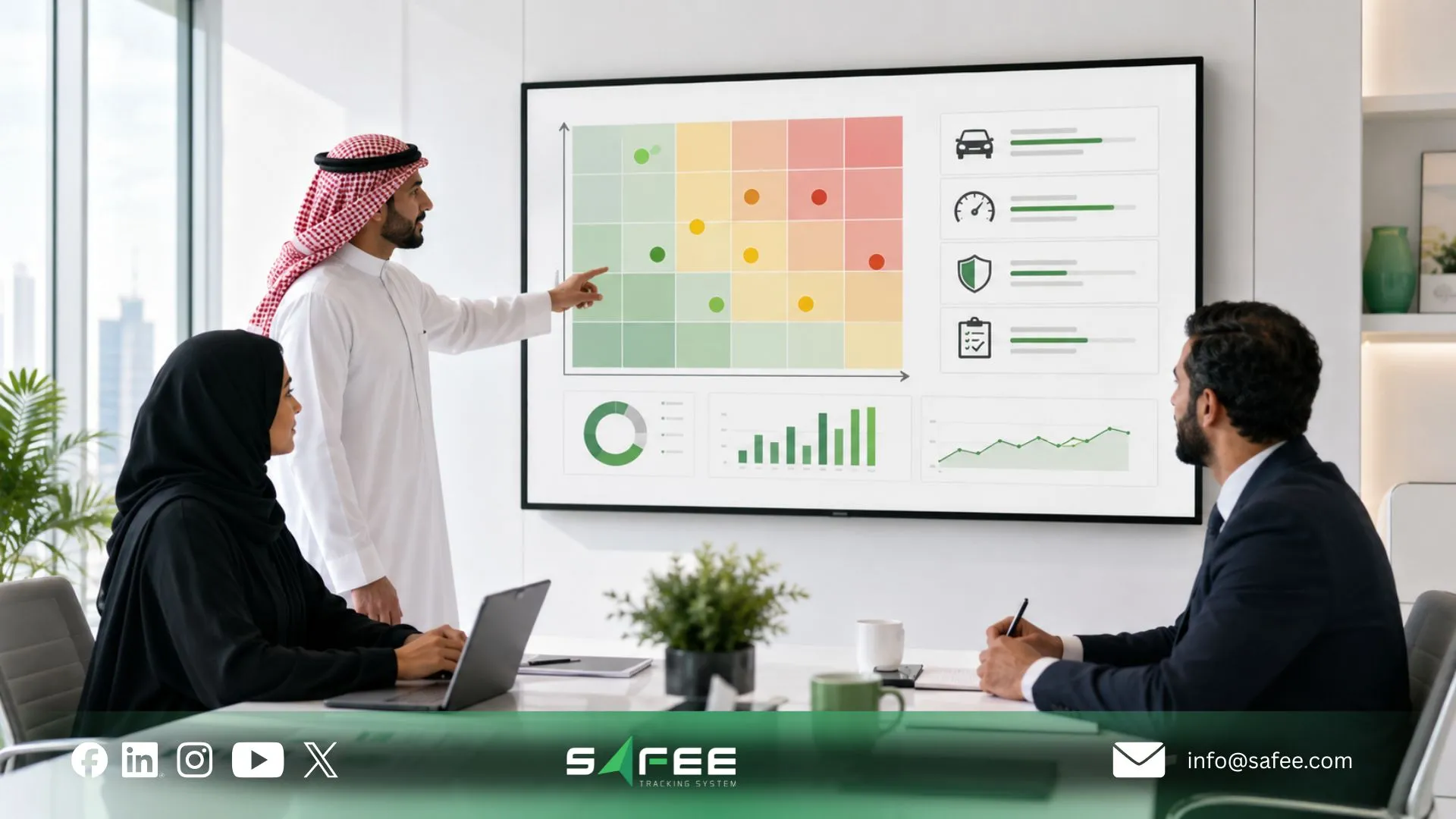
Probability × impact then gives Finance and HSE a common prioritization framework. The important point is consistency: similar risks should be assessed using the same internal definitions rather than whatever scale an individual manager happens to prefer.
The underlying evidence can come from several operational sources. A speeding risk might use alarm history and driver reports. A route risk might use journey records and route exceptions. A vehicle-readiness risk might use maintenance status. An unauthorized-use risk might rely on driver assignment, vehicle movement, and Geofence records.
Our Journey Management System (JMS) should be distinguished from the enterprise register methodology above. We document configurable journey risk assessment using driver readiness, vehicle condition, route and environmental factors, custom criteria, weighted scoring, risk scores, and approval workflows. It should not be described as a generic Probability × Impact corporate risk register.
This distinction prevents a common implementation mistake: forcing operational software to impersonate an enterprise risk register instead of using each system for the layer it handles best.

Fleet risk management solutions finance actually cares about
Finance does not need another dashboard simply because it contains more fleet data. The useful options are the ones that make exposure easier to quantify, investigate, assign, and review.
When evaluating a platform for this purpose, Finance and HSE should ask whether it can connect operational events with:
- Identifiable vehicles and drivers;
- Journey and route context;
- Recurring behavior;
- Corrective-action ownership;
- Scheduled management reporting;
- Historical evidence;
- Exportable records;
- Permissions appropriate to each function.
This distinction also matters when comparing providers and managed service models. A provider may offer consultancy, software, driver programs, insurance-oriented services, or a combination of these. Procurement should establish which part of the risk lifecycle each provider actually supports.
The same applies to driver-focused risk software. Driver monitoring is valuable only when the organization can move from an event to context, ownership, follow-up, and measurable review.
We connect several relevant operational layers. Fleet Reporting supports filters, scheduled reports, and PDF or Excel exports. Alarms and Alerts surfaces configured exceptions. Driver Management links behavior and violations to drivers. The Administration Panel supports role-based user permissions.
For Finance, that makes the platform useful as an evidence source for the register rather than simply another repository of GPS records. For a separate financial measurement framework, our Fleet Management ROI guide explains how to connect operational evidence with validated cost and savings inputs.
Fleet risk management insurance
Insurance-related fleet risk management should be approached carefully because software does not determine an insurance premium.
The useful question is whether fleet data can improve the evidence available during an underwriting, renewal, claims, or risk-review discussion.
For example, a fleet may be able to present:
- Journey exposure;
- Vehicle utilization;
- Incident context;
- Maintenance-related records;
- Corrective actions and follow-up;
- Speeding and harsh-driving trends;
- Driver performance information;
- Management reports showing whether identified patterns improved.
Our Fleet Reporting can produce customized reports and export information in PDF or Excel, while Driver Management provides behavior and violation-related reporting. Those capabilities can support an internal risk file or information requested during an insurance discussion.
However, the insurer or broker determines what information affects underwriting and how it is interpreted. Safee’s public documentation does not establish a formula linking a specific telematics event, driver score, or reporting improvement to a specific premium reduction.
That qualification becomes even more important in large fleet risk management insurance, where vehicle class, operating geography, claims experience, use case, contractual terms, and insurer-specific underwriting requirements may all affect the discussion.
Finance should therefore ask the insurer or broker:
- Which fleet-risk records are required at renewal?
- Which driver or incident metrics are considered?
- What reporting period is relevant?
- What evidence of corrective action is useful?
- Are different vehicle classes assessed differently?
- What format should loss, incident, or risk data be supplied in?
- Which factors are informational rather than premium-determining?
The objective is not to promise lower premiums. It is to make the risk conversation better evidenced.
Grey fleet risk management
For this article, grey fleet risk management refers to business journeys made in vehicles that sit outside the employer-managed core fleet.
The governance problem is straightforward: the business may still carry operational exposure while having less direct visibility into the vehicle, driver, journey, maintenance condition, or supporting evidence.
That creates questions that an owned-fleet telematics workflow may not automatically answer.
Key variables include:
- Which business journeys qualify as grey-fleet activity;
- Who is authorized to use a personal or externally managed vehicle;
- What driver and vehicle documents need verification;
- What journey data the business actually needs;
- Whether business and private activity can be separated appropriately;
- Who may access the records;
- How exceptions are escalated;
- Which retention and privacy requirements apply;
- What evidence Finance, HSE, or insurers require.
Teams comparing grey fleet management software should verify these requirements explicitly rather than assume that a standard fleet-tracking app covers them.
Our Mobile App provides managers and supervisors with access to fleet information such as live tracking, alerts, reports, Geofences, and driver information, while Safee’s platform supports role-based permission structures.
That capability should therefore be verified for the specific operating model rather than claimed by default.
Questions to ask Safee or any provider include:
- How would non-core or personally owned vehicles be represented in the platform?
- What tracking method would be required?
- Can business-use data be separated from private activity where required?
- Which users can see driver and journey information?
- Can access differ between Fleet, HSE, Finance, HR, and management?
- What data-retention rules can be supported?
- Which reports are available for these journeys?
- What integrations would be needed with HR, expenses, insurance, or travel workflows?
Contact us with your owned, leased, contractor, and grey-fleet operating model so the required data sources, permissions, privacy boundaries, and reporting workflow can be assessed before deployment.
Fleet speed management system
The system becomes useful to a risk register when it does more than tell a manager that a vehicle exceeded a configured threshold.
The risk team needs to understand exposure.
That may include:
- Which vehicles generated speed events;
- Which drivers were assigned;
- Where the events occurred;
- Whether the pattern repeats;
- Which routes or operating groups are affected;
- Whether the event coincides with other risky behavior;
- Whether coaching or escalation followed;
- Whether the pattern improved after intervention.
Our Alarms and Alerts capability includes speeding alarms, while Live Vehicle Tracking provides Speed Classification and visibility into overspeeding vehicles. Driver reporting can also analyze speeding alongside behaviors such as harsh braking, idling, and seat-belt use.
That is the practical difference between recording speeding and governing repeated speed exposure.
Finance can then treat repeated speed exposure as an operating pattern to investigate rather than a collection of disconnected alerts. HSE can assess whether existing controls are working. Fleet managers can identify the operational context and responsible drivers. Leadership can receive a summarized view rather than individual alarm noise.
No fixed threshold, financial consequence, or insurance result should be assumed across all fleets. The appropriate rules depend on the organization’s policy, vehicle type, routes, operating conditions, contractual requirements, and applicable regulations.

Fleet risk management analysis, training and follow-through
Creating the register is the beginning of the process. The value comes from repeatedly testing whether its risks, controls, owners, and actions still reflect what is happening in the fleet.
Fleet risk management analysis therefore needs two directions of movement.
First, operational data must move upward into management review: alarms, trips, driver behavior, maintenance records, route patterns, and recurring exceptions.
Second, management decisions must move downward into operational action: coaching, route controls, maintenance intervention, revised thresholds, additional monitoring, changed permissions, or another defined corrective action.
Without that loop, the risk register becomes an archive rather than a control process.
That review also provides a practical way to evaluate fleet risk management solutions. A fleet risk management solution should make evidence traceable from source event to owner and review. Whether the organization uses fleet risk management software, business driver fleet risk management software, external fleet risk management services, or a combination, the comparison should focus on the part of the risk lifecycle each option supports.
The same principle applies when comparing fleet risk management companies across operating models. In an enterprise risk management fleet model, motor fleet risk management and truck fleet risk management can carry different exposure patterns, while a risk management fleet safety program remains one control layer within the wider register.
Our Tracking Data Analyzer (TDA) turns tracking information into dashboards, visualization, analytics, and reporting, while Fleet Monitoring & Insights provides historical views of routes, alarms, Geofence events, violations, and vehicle activity. For a deeper treatment of patterns that may indicate future maintenance or downtime exposure, see our Predictive Analytics in Fleet Management guide.
Fleet risk management analysis
Start with the highest-priority register entries and ask what operational evidence would confirm, weaken, or change the current assessment.
For a repeated-speeding risk, analysis may review driver, vehicle, route, site, and time patterns.
For journey risk, management may review journey assessments, approvals, route deviations, restrictions, alarms, and post-trip information.
For unauthorized use, the evidence may include driver assignment, vehicle movement, Geofence activity, operating times, and related alarms.
For maintenance-related exposure, the risk owner needs vehicle-readiness and maintenance information rather than a generic safety score.
Our platform is useful here because different modules can provide different pieces of context rather than reducing fleet risk to one universal score. Our fleet management policy guidance connects policy controls with evidence from Driver Management, Alarms and Alerts, Journey Management System, Fleet Reporting, and Tracking Data Analyzer.
A disciplined review can follow five questions:
- What changed since the previous review?
- Did exposure increase, decrease, or move somewhere else?
- Did the assigned control operate as intended?
- Was the corrective action completed?
- Does the risk score or treatment now need to change?
This turns the register into a management process rather than a monthly spreadsheet ritual.
Fleet risk management training
Fleet risk management training should not mean sending the entire register to every employee.
Different roles need different views.
- Fleet Managers need operational risks, recurring driver and vehicle exceptions, journey exposure, and unresolved actions.
- HSE teams need safety-critical risks, control effectiveness, recurring behavior, journey risk, and escalation evidence.
- Finance needs the financial significance of material exposure, cost-related patterns, insurance information requirements, and evidence that controls are being followed.
- Operations and Dispatch need risks that affect route execution, vehicle availability, driver allocation, customer commitments, and daily decisions.
- Drivers need the policy, behaviors, restrictions, journey requirements, and coaching relevant to their work—not unrestricted access to the corporate risk register.
- System administrators need enough governance context to configure permissions, alerts, users, groups, sites, and system rules correctly.
Our Administration Panel supports role-based user permissions, while the wider platform can distribute operational information through alerts, reports, dashboards, and driver-specific workflows rather than giving every user the same level of access.
That matters because training and access are different things. A person may need to understand a risk without needing access to all supporting financial, driver, or management records.
Talk to Safee about configuring user roles, alarms, reports, driver workflows, and review responsibilities around the way your Fleet, HSE, Operations, and Finance teams actually work.
16 categories in any fleet management risk assessment
A structured assessment should force the organization to look beyond collision history. The following 16 categories provide a practical register starting point:
- Driver behavior — speeding, harsh driving, seat-belt behavior, repeated violations, and other observable driving exceptions.
- Driver readiness and authorization — license status, training status, driver assignment, authorization, and fit-for-duty controls relevant to the operation.
- Driver workload and fatigue exposure — driving hours, continuous workload, long journeys, missed rest expectations, or other fatigue-related indicators.
- Speed exposure — repeated overspeeding, recurring high-risk routes, driver-specific patterns, and weak follow-through on speed exceptions.
- Journey and route risk — route hazards, weather, restrictions, journey necessity, distance, approval requirements, and changing operating conditions.
- Vehicle readiness and maintenance — unresolved defects, overdue maintenance, inspection gaps, breakdown risk, and vehicle availability.
- Unauthorized vehicle use — unapproved drivers, out-of-policy movement, unexpected operating times, or other unauthorized activity.
- Geographic and site exposure — restricted areas, high-risk sites, Geofence breaches, route deviations, and unplanned location activity.
- Cargo, passenger, and load conditions — risks linked to the load, passenger requirements, equipment, securement, or journey-specific operating conditions.
- Cold-chain and environmental conditions — temperature, humidity, or other sensor-monitored conditions where product or operational integrity depends on them.
- Fuel-related exposure — abnormal fuel behavior, excessive consumption, suspected misuse, idling, and recurring fuel discrepancies.
- Tire and vehicle-component condition — tire pressure, component condition, and related warnings where appropriate hardware and monitoring are configured.
- Connectivity and remote-route exposure — tracking gaps, unreliable cellular coverage, loss of communication, and reduced visibility on remote journeys.
- Grey-fleet and external-vehicle exposure — business journeys conducted outside the fully controlled company-fleet environment.
- Data governance and access — inappropriate permissions, uncontrolled exports, unclear ownership, weak reporting governance, or poor data-quality controls.
- Incident evidence and corrective follow-through — incomplete event context, insufficient records, unresolved corrective actions, and recurring risks that remain open without effective treatment.
We can provide relevant evidence for many of these categories through Live Vehicle Tracking, Driver Management, Alarms and Alerts, Maintenance Module, Journey Management System, Fleet Reporting, Administration Panel, TDA, sensor integrations, and specialist capabilities such as SatComm where required. The exact configuration depends on the vehicle, data source, operating environment, and management decision being supported. Our fleet management policy guide shows how these register categories can be connected with enforceable controls, owners, evidence, and exception responses.
Safee: Fleet risk management software finance and HSE accept
The strongest way to position Safee in this role is not to claim that it replaces an enterprise risk-management system. Our value is more operational.
We can provide the live and historical evidence that helps Finance, HSE, Operations, and Fleet determine whether risk controls are working.
That evidence can include:
- Vehicle movement and operational status through Live Vehicle Tracking;
- Driver identity, assignment, violations, and performance through Driver Management;
- Configured safety and operating exceptions through Alarms and Alerts;
- Structured and scheduled management information through Fleet Reporting;
- Journey risk assessment and approval workflows through Journey Management System;
- Historical and analytical review through Tracking Data Analyzer;
- User, site, vehicle, driver, and permission governance through the Administration Panel.
Our policy guidance describes the operating model in this way: the policy defines what should happen, while Safee helps teams monitor supported operational data, detect configured exceptions, assign responsibility, and maintain records for management review.
That makes the system particularly useful when the risk register needs defensible operating evidence instead of subjective updates.
Safee vs a manually built fleet risk register
| Risk Register Task | Manual Spreadsheet Register | Safee |
| Probability x impact scoring | Scores depend on the methodology and discipline of the people maintaining the spreadsheet | Safee’s documented Journey Risk Assessment uses configurable criteria, weighted scoring, risk scores, and approval workflows. The enterprise Probability × Impact register can remain the management-governance layer rather than being misrepresented as a native Safee-wide scoring method. |
| Journey risk assessment | Journey information may be collected manually and can become disconnected from current operational data | Journey Management System (JMS) can evaluate driver readiness, vehicle condition, route hazards, weather and other configured journey factors, then apply risk scoring and approval workflows. |
| Speed exposure data | Speed information must be imported, summarized, or manually linked to the register | Safee can surface overspeeding through Alarms and Alerts, Speed Classification, driver reports, and historical operating data, giving teams evidence to review recurring exposure. |
| Grey fleet visibility | Often depends on expenses, declarations, mileage records, HR processes, or another separate source | Safee’s public documentation reviewed here does not establish automatic personal-vehicle grey-fleet tracking. The required vehicle, mobile, privacy, and integration model should be confirmed before treating the grey fleet as covered. |
| Insurance renewal reporting | Relevant information may need to be rebuilt from different operational files each renewal cycle | Fleet Reporting supports configurable reports, scheduled delivery, and PDF/Excel exports. The specific information accepted by an insurer or its effect on underwriting must still be verified with that insurer or broker. |
This distinction is important. Safee can strengthen the evidence layer of the register without pretending that every corporate-risk process belongs inside fleet software.
A manual register can still contain enterprise ownership, financial impact, residual risk, treatment decisions, and management acceptance. Safee can make many of the operational assumptions behind those entries easier to test.
How motor and truck fleet risk management teams use Safee’s risk data
Motor fleet risk management teams often need to govern mixed exposures across passenger vehicles, service vehicles, vans, operational fleets, and drivers working across different sites or departments.
Their workflow can use Safee data to move from:
event → context → pattern → owner → action → review
A speeding alarm, for example, can be linked with the driver, vehicle, route, historical behavior, and related reporting. The responsible manager can then determine whether it is an isolated exception or evidence of a wider register risk.
Truck operations add complexity because journeys may involve longer distances, remote areas, driver workload, route restrictions, high-risk sites, cargo conditions, connectivity gaps, and more demanding journey governance.
Our Journey Management System supports route planning, journey risk assessment, approvals, restrictions, driver and vehicle readiness, and journey monitoring. For remote operations, we also position SatComm as a way to maintain location visibility beyond conventional cellular coverage, although the precise data available depends on the selected devices and configuration.
Across both operating models, the objective is not to create more risk data. It is to make risk evidence traceable enough that Finance and HSE can challenge it.
A useful review might ask:
● Which risks are increasing?
- Which driver groups or routes contribute most to recurring exceptions?
- Are corrective actions reducing recurrence?
- Are high-risk journeys receiving the intended controls?
- Are reports reaching the responsible managers?
- Are unresolved events being carried forward rather than forgotten?
- Does the register still reflect the operation?
Our Fleet Reporting, Driver Management, Alarms and Alerts, Journey Management System, Live Vehicle Tracking, and Tracking Data Analyzer give different stakeholders the operational evidence required to answer those questions.
FAQs about fleet risk management
What is a fleet risk register and why does finance need one?
A fleet risk register records material fleet exposures, their probability and impact, existing controls, owners, corrective actions, and supporting evidence. Finance needs it to connect operational risks with potential cost, asset, insurance, service, and governance consequences instead of treating fleet safety as an isolated operational issue.
What is grey fleet risk and why is it often missed?
Grey fleet risk arises when business journeys occur outside the organization’s fully managed core fleet. It can be missed because vehicle condition, journey activity, driver information, documentation, and other evidence may sit outside the same tracking and reporting workflow used for company-controlled vehicles.
How does fleet speed management affect insurance premiums?
Speed-exposure data can provide insurers or brokers with evidence about overspeeding patterns, driver behavior, corrective actions, and risk controls, but it does not determine the premium by itself. Premium calculations and the evidence considered at renewal depend on the insurer’s underwriting criteria, so fleets should verify the required data directly with the insurer or broker.
Fleet risk management vs fleet safety management: What differs?
Fleet safety management concentrates on preventing harm through safer drivers, vehicles, journeys, and operating practices. Fleet risk management includes those safety exposures but also connects them with financial, operational, asset, insurance, service, governance, and audit consequences.
Ready to improve your fleet operations?
Tell us what you would like to improve. A Safee specialist will reply by email.
Usually replies within one business day • No sales spam
Your details are used only to respond to your request. Privacy Policy