



How to Compare Fleet Fuel Management Solutions Before Buying?
Choosing between fleet fuel management solutions is difficult when every provider appears to offer dashboards, fuel monitoring, alerts, and reports. The real buying decision is not whether a platform can display fuel data. It is whether the solution can collect the right data, connect it with operational context, surface meaningful exceptions, and give the people responsible for fuel control evidence they can actually review.
That distinction matters when a fleet is trying to investigate high fuel invoices, unexplained fuel drops, inconsistent consumption between similar vehicles, questionable refueling events, or excessive manual reporting. A standalone number rarely explains what happened. Fleet teams usually need vehicle location, trip activity, driver context, time, fuel readings, and reporting history to review an event properly.
This guide therefore focuses on how to compare solutions before buying: the fuel-data sources to verify, the alerts and reports to examine, the operational questions to ask providers, and the implementation conditions that determine whether the system will fit a real commercial fleet.
Why do fleet fuel management solutions need a clear evaluation checklist?
Fuel problems often appear first as a financial issue: invoices increase, a vehicle consumes more than expected, fuel-card transactions need verification, or managers suspect avoidable waste. But buying software only because fuel expenditure looks high can lead to another problem, selecting a system without defining what the fleet actually needs to verify.
A useful evaluation therefore starts with the decisions the organization expects the system to support.
For example:
- Does Operations need to investigate unusual consumption while a vehicle is still active?
- Does finance need structured evidence behind refueling transactions?
- Does management need branch-level fuel reports?
- Do fleet supervisors need to compare similar vehicles or routes?
- Does the organization need to investigate sudden fuel-level changes?
- Do different teams need different access, alerts, or scheduled reports?
- Does fuel information need to be connected with vehicle location or trip activity?
- Are there different vehicle types or fuel-data sources across the fleet?
Without that checklist, buyers can overvalue visible features such as a polished dashboard while underestimating data quality, hardware compatibility, reporting structure, alert governance, or integration requirements.
Why are basic fuel records not enough?
Receipts, spreadsheets, and fuel cards can still play a role in fleet administration, but they do not automatically provide full operational context.
A fuel-card transaction can record commercial information about a purchase, but determining whether that transaction aligns with the correct vehicle, location, trip, driver, or available fuel-level information requires additional connected data and correctly mapped records. Safee makes the same distinction in its Fleet Fuel Management System guidance.
Similarly, an Excel sheet can record liters or costs but cannot by itself determine why consumption changed. The fleet team may still have to compare the record manually against trip history, vehicle use, idle activity, route information, and other evidence.
That is why the buying question should move from:
“Can this system record fuel?”
to:
“Can this system help our team investigate and manage the fuel exceptions that matter to our operation?”
Before paying for any system, document the current workflow from fuel acquisition through review, escalation, reporting, and management action. The gaps in that workflow should become the evaluation criteria.

What to compare in fleet fuel management solutions?
The strongest comparison starts with data and moves outward toward alerts, reports, dashboards, workflows, and integrations. You should avoid evaluating each feature independently because a sophisticated report is not useful if its underlying fuel data is unreliable or poorly mapped.
Fuel data sources
Ask exactly how each proposed solution receives fuel information.
Depending on the vehicle and implementation, possible sources may include:
- compatible CANbus values;
- analog fuel sensors;
- digital fuel sensors;
- BLE fuel sensors;
- other compatible external fuel measurement devices;
- fuel-card transactions;
- supplier or approved fuel records;
- manual records;
- approved third-party integrations.
Our current fuel management guidance identifies compatible CANbus values, external sensors, Telematics data, fuel-card transactions, supplier records, and approved integrations as potential fuel-data inputs depending on the implementation. Our Fuel Control information also references CANbus, analog, digital, and BLE fuel sensor configurations.
The important purchasing point is compatibility. Do not assume that one fuel-data method will work identically across every vehicle in a mixed fleet. Tank design, vehicle electronics, installed equipment, available CANbus values, operating conditions, and the intended use of the data can affect the appropriate configuration. Safee specifically recommends verifying compatibility across representative vehicle groups rather than assuming fleet-wide uniformity.
Fuel alerts
A good alert system should help managers identify exceptions rather than simply generate more notifications.
Potential fuel-related review cases include:
- sudden fuel-level drops;
- detected refueling events;
- unexpected fuel changes;
- consumption outside an internally defined pattern;
- excessive idle-related fuel usage;
- fuel activity in an unexpected location;
- events that require comparison with trip or vehicle activity.
Our Alarms and Alerts system supports configurable fleet alerts, including fuel-level exceptions where the relevant devices and data are available. The exact alarms available depend on the connected devices, sensors, modules, and data fields included in the deployment.
Buyers should therefore ask more than “Does the platform have fuel alerts?”
You should ask:
- What triggers the alert?
- Which data source supports it?
- Can thresholds vary by vehicle group?
- Who receives the notification?
- Can different branches have different recipients?
- Can the manager review the event’s vehicle and location context?
- What happens after the alert is received?
- Can repeated exceptions be reviewed later through reports?
An alert is only useful when there is an operational response behind it.
Fuel reports
Reports turn individual events into patterns that managers, finance teams, and operations leaders can review.
Depending on fleet requirements, comparison should cover the ability to analyze fuel by:
- vehicle;
- driver;
- branch;
- depot;
- route;
- period;
- exception type;
- refueling activity;
- consumption trend;
- idle-related usage.
Our Fleet Reporting capability supports customizable reporting, filtering, scheduled email delivery, and PDF or Excel exports. Its reporting categories include fuel-related reporting as part of the broader fleet reporting environment.
For a buyer, scheduling is particularly important. A report that exists but must be manually rebuilt every week can preserve much of the administrative workload the organization intended to remove.
When reviewing providers, ask to see the exact report workflow, not only screenshots of sample charts.
Dashboards and operational visibility
Dashboards should support two different jobs:
- understanding what is happening now; and
- investigating what happened previously.
Real-time visibility is useful for active exceptions. Historical review is needed when management investigates a dispute, identifies a recurring pattern, compares periods, or prepares a management report.
Look for the ability to move from summary information into the relevant vehicle, time period, trip, fuel event, or historical trend without forcing the user to combine several disconnected systems manually.
Our Fuel Level Monitoring guidance, for example, describes Fuel Explorer and historical fuel information that can help teams review fuel usage, graphs, sudden changes, and fuel events in operational context.
Integration With the wider fleet workflow
Fuel data should not become another operational silo.
Before choosing a provider, identify the other records that may need to interact with the fuel workflow:
- vehicle identity;
- Live Vehicle Tracking;
- driver assignment;
- trip activity;
- branch or depot structure;
- Geofence information;
- Alarms and Alerts;
- Fleet Reporting;
- ERP or accounting processes;
- fuel-card or supplier systems;
- other approved integrations.
The exact boundaries will vary between organizations. In some fleets, Safee may provide the operational fleet layer while another enterprise system remains authoritative for purchasing, finance, or other records. Clear system boundaries, shared identifiers, data ownership, synchronization, error handling, and support responsibility should be agreed during evaluation. Safee uses the same integration-boundary approach in its fleet platform guidance.
| Feature to Compare | Why It Matters | Safee Angle |
| Fuel data sources | The usefulness of monitoring depends on how fuel data is collected, mapped, and validated. | Connect supported fuel visibility with vehicle activity using compatible data sources and integrations. |
| Alerts | Managers need meaningful exceptions rather than raw data or excessive notifications. | Alarms and Alerts can support configured fuel-related exception workflows where the required data is available. |
| Reports | Operations, finance, and management need structured evidence for recurring review. | Fleet Reporting supports configurable reports, filtering, scheduling, and export workflows. |
| Integration | Fuel information becomes more useful when it can be interpreted alongside fleet activity. | Safee places fuel information inside a wider Fleet Management and Telematics environment rather than treating it only as a standalone record. |
If fuel-data collection itself is the main technical question, review our Fuel Control and Fleet Fuel Level Monitoring resources rather than trying to solve sensor selection solely through a commercial feature checklist.
If your shortlist contains several providers with similar-looking dashboards, ask Safee for a workflow-based demo. Compare the same vehicle, event, alert, investigation, and report process across each platform rather than comparing feature names alone.
How commercial fleet fuel management differs by fleet type
There is no single commercial fleet fuel management configuration that is equally appropriate for every operating model. The same fuel event can have a different meaning depending on how vehicles are used, where they operate, who drives them, and how fuel is issued.
Logistics fleets
Logistics operations often need fuel information to be interpreted against routes, journeys, drivers, stops, and vehicle activity.
A useful comparison may therefore ask whether the solution can help supervisors investigate questions such as:
- Why did two similar vehicles on comparable work show different consumption patterns?
- Did an unusual fuel event occur during an active route?
- Was significant idling present?
- Did a refueling event align with the vehicle’s operational activity?
- Can recurring exceptions be analyzed by vehicle or driver?
The value comes from combining fuel information with fleet context rather than treating liters consumed as an isolated metric.
Construction and field service fleets
Construction, utilities, maintenance, and field-service operations may work across depots, customer locations, compounds, remote sites, or temporary project areas.
Fuel control may therefore need stronger location and site context.
Buyers should consider:
- vehicle and asset grouping;
- depot and project visibility;
- Geofence-based operational context;
- multiple operating locations;
- different fuel sources;
- vehicles that spend significant time idling or working on-site;
- reporting by branch, project, or asset group.
The system should allow the fleet structure to reflect how the business actually operates.
Government and municipal fleets
Government and municipal fleets may place greater emphasis on accountability, documented review, role separation, and consistent reporting.
That does not mean a software platform should be assumed to provide automatic regulatory compliance. Instead, the buyer should identify the organization’s actual reporting, audit, access, retention, approval, and governance requirements and verify how the proposed solution supports them.
Evaluation questions may include:
- Can user access be aligned with responsibilities?
- Can reporting be structured across departments or branches?
- Can historical records support internal review?
- Can reports be scheduled for relevant stakeholders?
- Can alert and exception workflows be assigned consistently?
- What records must remain in another official system?
- What local documents, reporting obligations, or integration requirements need independent verification?
This is where compliance-related governance matters: software should support the organization’s defined control and evidence processes, while legal and regulatory requirements still need to be validated against the relevant authority and operating context.
Mixed fleets
Mixed fleets create one of the strongest arguments for flexible vehicle fleet fuel management.
Passenger cars, vans, trucks, specialized vehicles, and equipment may not expose the same fuel information or require the same measurement method. The organization may also apply different alert rules, reporting expectations, or operating benchmarks to each group.
Instead of demanding one identical configuration for every asset, evaluate whether the platform can support:
- vehicle groups;
- different compatible data sources;
- different thresholds;
- different reporting logic;
- multiple sites;
- different users and permissions;
- varying operating patterns.
Our wider fleet architecture supports configurable vehicle groups, users, sites, roles, filters, and compatible specialist data sources, allowing the operating model to influence how fleet information is structured.

Questions to ask fleet fuel management companies
Comparing fleet fuel management companies should involve more than requesting a feature list and commercial quotation.
Use the following questions during provider demonstrations and technical evaluation.
Can the solution connect fuel data with vehicle location and trip activity?
Ask the provider to demonstrate the relationship between a fuel event and its surrounding operational context.
For example, can the user move from an unusual fuel reading to the corresponding vehicle, time, location, trip, or available driver information?
If the answer depends on an integration, identify:
- the source system;
- the required identifiers;
- data synchronization;
- mapping responsibility;
- failure handling;
- which system remains authoritative.
Can it detect suspicious refueling or fuel drops?
The better question is not simply whether “fuel theft detection” appears on the feature list.
Ask:
- Which data source is required?
- How is a fuel drop defined?
- How are normal fluctuations filtered?
- What conditions create an alert?
- Can the threshold vary by vehicle?
- Can managers review the underlying fuel history?
- Must the event be verified before it is treated as misuse?
Fuel changes should normally be investigated as exceptions rather than automatically treated as proof of theft or misconduct.
Can reports be customized and scheduled?
Ask the provider to demonstrate:
- available filters;
- report recipients;
- scheduling options;
- vehicle or driver selection;
- branch-level filtering;
- export formats;
- historical periods;
- exception-focused reports.
Our Fleet Reporting supports customizable templates, scheduled delivery, and PDF or Excel export capabilities.
Can it support multiple branches, depots, and user roles?
Multi-site organizations need structure, not just additional logins.
Verify:
- branch and depot organization;
- vehicle groups;
- user responsibilities;
- permission boundaries;
- report access;
- alert recipients;
- centralized versus local management visibility.
The exact configuration should reflect the organization’s operating model.
Does it integrate with the wider fleet management workflow?
Ask how fuel connects with:
- Live Vehicle Tracking;
- Alarms and Alerts;
- driver information;
- trip activity;
- Fleet Reporting;
- Geofences;
- maintenance or operational data where relevant;
- approved external business systems.
A standalone fuel system may be sufficient for a narrow use case. But companies seeking broader operational visibility should compare the additional effort required to move data between systems against the value of having fuel information within the wider fleet environment.
Additional provider questions worth asking
Before final selection, also confirm:
- Which vehicles and fuel-data sources are compatible?
- What validation is required before alerts are trusted?
- Who configures thresholds?
- Who is responsible for sensor or device issues?
- How are data gaps identified?
- What happens if connectivity is interrupted?
- Which integrations are available for the proposed deployment?
- What user-access controls are available?
- What data-retention and privacy requirements need to be configured or verified?
- How are configuration changes documented?
- What training and operational support are available for users?
A provider that can answer these questions clearly is easier to evaluate than one that relies on broad claims such as “AI-powered fuel savings” or “complete fuel control” without explaining the underlying workflow.
Bring your actual fleet scenarios into the demo. Contact us to review representative vehicles, branches, fuel sources, users, reports, and exception workflows instead of evaluating the platform through a generic presentation.
How to implement fleet and fuel management services effectively?
Even well-selected fleet and fuel management services can underperform if the implementation begins with hardware rather than operational requirements.
A practical rollout should begin with the problems the organization wants to control.
Start with current fuel pain points
Document the current issues without assuming their cause.
Examples include:
- high or inconsistent fuel invoices;
- suspected fuel misuse;
- unexplained fuel-level changes;
- repeated manual reconciliation;
- missing refueling context;
- excessive idling;
- differences between similar vehicles;
- branch-level reporting gaps;
- slow investigation of fuel exceptions.
This baseline helps the organization distinguish between problems that require better data, better operational controls, better reporting, or a combination of all three.
Define vehicles, drivers, fuel sources, and approval rules
Create an implementation inventory covering:
- vehicle groups;
- vehicle types;
- tank configurations where relevant;
- current tracking devices;
- available CANbus data;
- external fuel sensors;
- fuel cards;
- supplier records;
- driver assignment methods;
- depots and sites;
- user roles;
- existing reporting responsibilities.
Do not assume that every vehicle should use the same configuration.
Representative vehicles from each important fleet group should be evaluated before a wider rollout because compatible fuel-data methods can vary between assets. Safee’s Fleet Fuel Management System guidance makes the same recommendation.
Connect fuel data with operational context
Once the data sources are understood, define how fuel information will interact with the wider Fleet Management and Telematics workflow.
That may include:
- Fuel data
- vehicle
- trip
- location
- alert
- investigation
- report
- management review
The objective is not merely to collect more information. It is to shorten the path from an exception to a justified operational decision.
Define alert governance
Every important alert should have an owner and a response rule.
For each fuel alert, define:
- trigger
- affected vehicle group
- recipient
- expected review
- escalation condition
- evidence required
- closure method;
- recurring-report treatment.
This prevents an alert system from becoming a stream of notifications that managers gradually ignore.
Establish reporting cadence
Different stakeholders may need different views.
For example:
- supervisors may review current exceptions;
- Fleet Managers may review recurring vehicle or driver patterns;
- Operations may compare branches or routes;
- finance may need structured fuel information alongside commercial records;
- leadership may need periodic trend reporting.
Our Fleet Reporting supports scheduled reporting workflows that can help distribute relevant information to defined recipients.
Track whether the workflow is improving
Avoid evaluating success only through a promised percentage of fuel savings.
Instead, measure operational indicators relevant to the original problem, such as:
- number of fuel exceptions requiring review;
- recurring exceptions by vehicle or operational group;
- idle-related fuel patterns;
- consumption trends;
- unexplained refueling events;
- time spent preparing manual reports;
- time required to investigate an exception;
- percentage of relevant alerts that receive documented review.
These measures tell management whether the organization is gaining better control over fuel information and response processes.
They also help separate software performance from unrelated influences such as route changes, vehicle condition, load, seasonality, fuel price, or operating environment.
Why does Safee fit commercial fleet fuel management?
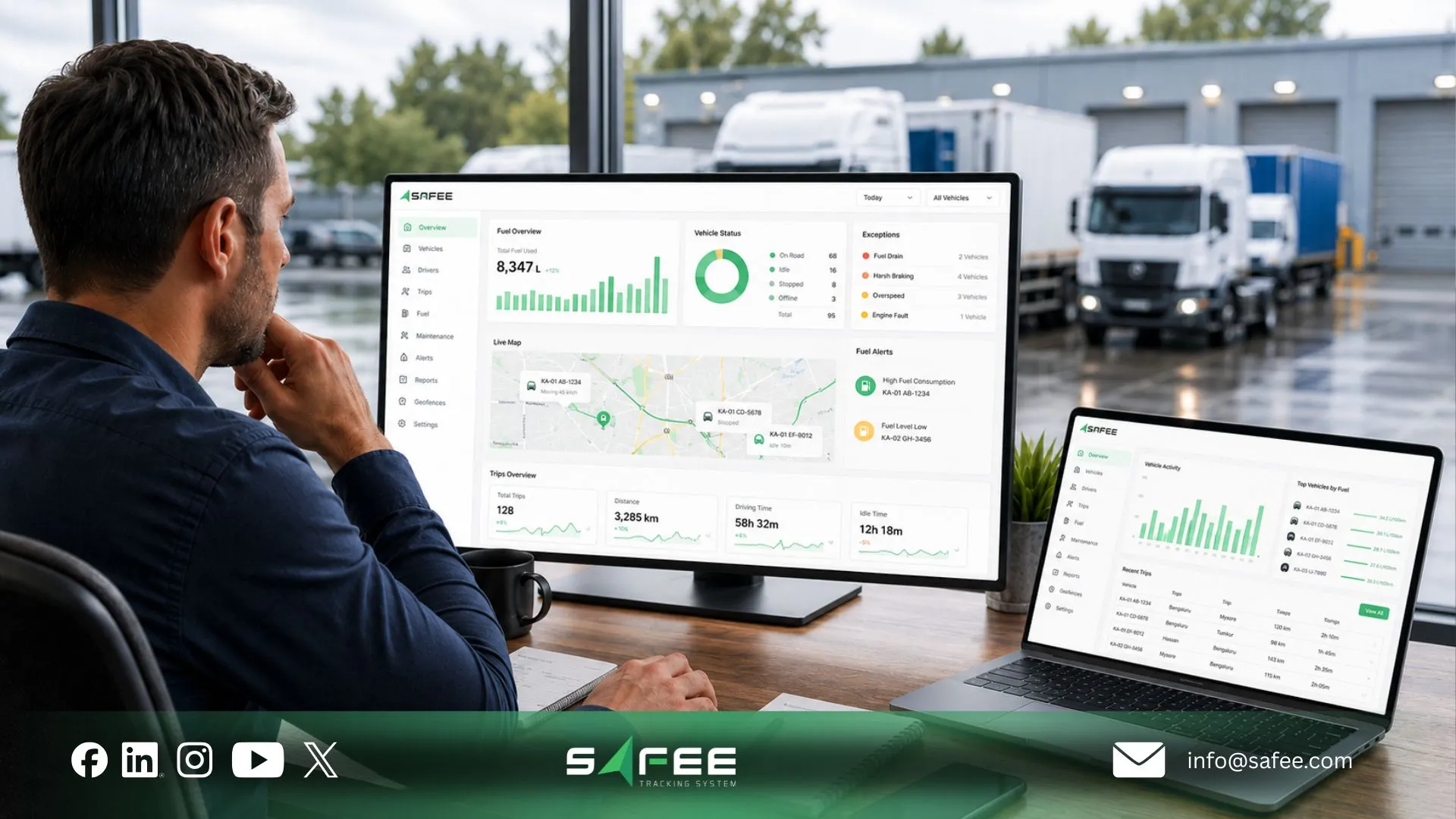
At Safee, we help commercial fleets bring fuel visibility into a broader fleet-management workflow rather than managing fuel information through an isolated spreadsheet, standalone monitoring screen, or separate fuel tool.
Within our platform, fuel-related information can be reviewed alongside core Safee capabilities such as Live Vehicle Tracking, Alarms and Alerts, Fleet Reporting, Administration Panel, CANbus Integration, and supported fuel-monitoring functions.
For fuel operations, we support compatible data sources including CANbus and external sensor configurations. Where the required data and deployment configuration are available, our fuel-monitoring capabilities help teams review fuel levels, consumption information, refueling activity, and unusual fuel changes within the wider operational context of the fleet.
Fuel information gains vehicle context
At Safee, we connect supported fuel information with vehicle activity and location so Fleet Managers can review fuel events with additional operational context.
Instead of looking at a fuel reading or refueling event on its own, teams can evaluate it alongside relevant vehicle activity and determine whether the event appears consistent with operations or deserves further investigation.
Alerts become part of a wider exception workflow
With Safee’s Alarms and Alerts, relevant users can receive notifications when configured conditions occur.
This allows fuel-related exceptions to become part of the same operational alerting environment used across the fleet, rather than requiring a completely separate fuel-monitoring process.
Reports support recurring management review
Our Fleet Reporting capability supports filtering, customization, scheduling, and export.
This enables fuel-related and wider operational information to move beyond individual dashboard sessions and into recurring reviews for Fleet Managers, Operations teams, and other authorized stakeholders.
Fleet structure can extend beyond a single site
At Safee, we support fleet environments that include multiple vehicles, users, configurations, groups, branches, and operational structures.
For organizations managing several sites or vehicle categories, this broader structure allows fuel visibility and reporting to be organized around the way the fleet itself is managed.
We do not assume that every fleet requires every Safee capability. The appropriate setup depends on the organization’s operating model, available data sources, devices, integrations, user structure, and reporting requirements.
For more detail on fuel visibility, explore our Fuel Control capabilities. You can also read What Is a Fleet Fuel Management System and How Does It Work? for a broader view of the fuel-management workflow.
Safee for UAE and Saudi Arabia fleet operations
At Safee, we support commercial fleet operations in the UAE, Saudi Arabia, and the wider GCC, where organizations may operate across multiple branches, depots, projects, customer locations, and long-distance routes while managing different vehicle types and operational responsibilities.
In these environments, fuel management often needs to work as part of the broader fleet operation rather than as a separate monitoring activity.
With Safee, organizations can bring together fuel-related visibility with vehicle tracking, operational alerts, reporting, user structures, and other connected fleet information within the same fleet-management environment.
When working with UAE and Saudi fleets, we consider the actual operating structure of the organization, including:
- multiple branches and operating locations;
- different reporting responsibilities across teams or sites;
- mixed vehicle and tank types;
- available fuel data across representative vehicles;
- different user visibility requirements;
- high-utilization vehicles that may require closer exception review;
- the relationship between fuel information, trips, and vehicle location;
- consolidated and branch-specific reporting needs;
- and deployment-specific privacy, data, integration, contractual, and reporting requirements.
Our fuel-monitoring capabilities can support GCC and wider international fleet operations, but the appropriate Safee configuration still depends on the fleet’s vehicles, sensors, available data, operating environment, integrations, and reporting requirements.
For Saudi Arabia operations in particular, we work from the fleet’s actual operational requirements while organizations remain responsible for verifying the local contractual, data, regulatory, and compliance requirements that apply to their deployment.
At Safee, we believe the strongest way to evaluate a fuel-management setup is to start with the fleet’s real operating scenario: actual branches, representative vehicles, existing fuel records, expected alerts, reporting recipients, and the systems that need to exchange information.
Request a Safee demo to compare your current UAE or Saudi fleet fuel workflow with Safee and see how fuel visibility, tracking, alerts, and reporting can support a more connected fleet fuel-management process.
FAQs about fleet fuel management solutions
What should fleet managers compare before choosing fleet fuel management solutions?
Fleet managers should compare five areas first: fuel-data sources, vehicle compatibility, alerts, reporting, and integration with wider fleet activity.
They should then evaluate how those capabilities fit their actual operating structure—vehicles, drivers, branches, depots, fuel sources, user roles, and management reporting.
A feature should not receive a high score simply because it exists. Buyers should ask whether the feature is supported by reliable data and whether their teams can use it in a repeatable operational workflow.
How do commercial fleet fuel management solutions reduce fuel waste?
Commercial fleet fuel management solutions can support fuel-waste reduction by making consumption patterns and exceptions easier to identify and investigate.
Depending on the available data, teams may review excessive idling, unexpected fuel changes, unusual consumption, refueling activity, or differences between vehicles and operating groups.
The software does not eliminate waste automatically. Results depend on suitable data, correct configuration, investigation procedures, driver and operational controls, vehicle condition, and management follow-up.
Can vehicle fleet fuel management work across different vehicle types?
Yes, but fleets should not assume that every vehicle supports the same fuel-data source or configuration.
Different vehicles may expose different CANbus information or require different compatible sensor arrangements. Tank design, vehicle electronics, body configuration, asset type, and operational environment can also affect deployment.
The appropriate approach is to group vehicles by relevant characteristics, validate representative assets, and then configure the vehicle fleet fuel management workflow accordingly. Safee also recommends compatibility validation across representative vehicle groups.
Do fleet and fuel management services require new hardware?
Not always.
The answer depends on what data is already available and what the organization needs the system to do. A deployment may use compatible existing Telematics data, CANbus information, external fuel sensors, fuel-card records, supplier information, or approved integrations. Some use cases may require additional compatible hardware, while others may rely partly on existing sources.
Before buying hardware, ask the provider to map:
- the required decision;
- the data needed to support that decision;
- the available source;
- vehicle compatibility;
- installation requirements;
- validation process;
- ownership of maintenance and support.
This prevents hardware selection from driving the project before the operational requirement is understood.
How can companies know if a fuel management solution is working?
Start with the operational problems defined before implementation and measure whether the new workflow improves the organization’s ability to review them.
Useful indicators may include:
- recurring fuel exceptions;
- unexplained fuel events;
- idle-related fuel patterns;
- consumption trends;
- exception-review time;
- manual reporting effort;
- alert follow-up;
- branch-level visibility;
- consistency of management review.
A solution is providing value when it gives the relevant teams better evidence, clearer exceptions, and a more repeatable process for deciding what requires action.
Ready to improve your fleet operations?
Tell us what you would like to improve. A Safee specialist will reply by email.
Usually replies within one business day • No sales spam
Your details are used only to respond to your request. Privacy Policy