


Smart Fleet Management in 2026: What GCC Fleets Can Deploy Now
Smart fleet management in 2026 is not a race to add AI, 5G, or autonomy labels to a GPS platform. For GCC fleets, the real test is whether a technology can use reliable vehicle and operational data, fit a governed workflow, and produce a decision your team can act on today.
In this guide, we separate deployable technology from pilot-stage capability and marketing hype across autonomous vehicles, data-driven operations, 5G connectivity, analytics, sensors, maintenance, and integrations. We also show where Safee’s Fleet Management and Telematics environment fits today, which claims require separate validation, and what Fleet Managers, Operations, HSE, and technology buyers should verify before rollout.
What ‘smart fleet management’ actually means in 2026
A smart fleet is not defined by one device or one algorithm. It is an operating environment in which vehicle, driver, journey, maintenance, sensor, exception, and business-system data can support decisions rather than remain isolated records.
In practice, smart fleet management combines several layers:
- Connected data: vehicle position, movement, diagnostic signals, driver context, maintenance records, sensor information, and other supported operational data.
- Operational visibility: interfaces such as Live Vehicle Tracking and Fleet Monitoring & Insights that help authorized users understand what is happening.
- Exception management: Alarms and Alerts that surface configured events requiring attention.
- Analysis: Fleet Reporting and Tracking Data Analyzer (TDA) for recurring review, comparison, trends, anomalies, and predictive analysis where the available data supports it.
- Governance: users, groups, permissions, ownership, escalation, and review responsibilities managed through a structured operating model.
- Integration: APIs and compatible hardware that allow the fleet platform to exchange information with a wider enterprise environment.
At Safee, our current platform reflects this layered model rather than treating GPS coordinates as the whole fleet-management problem. We connect tracking, alerts, drivers, journeys, maintenance, reporting, analytics, video, sensors, and mobile access within a broader operating environment.
See our Fleet Management Platform guide for the connected architecture behind these layers.
Smart fleet management system vs smart fleet management software
A smart fleet management system is the complete operating setup. It can include software, compatible Telematics devices, connectivity, vehicle or equipment data, sensors, integrations, user permissions, alert logic, reports, and the people responsible for acting on the information.
The software layer within that wider system receives and organizes available information so Fleet, Operations, HSE, Maintenance, Logistics, and management teams can monitor activity, investigate exceptions, analyze performance, and complete defined workflows.
The distinction matters during procurement. Buying software does not automatically create a functioning smart-fleet environment. A fleet still needs to validate:
- Which vehicles and assets will connect.
- Which data each vehicle or device can provide.
- Which hardware and protocols are compatible.
- Which alerts need operational owners.
- Which reports support recurring management reviews.
- Which users require which permissions.
- Which business systems need integration.
- Which connectivity path is appropriate for each operating area.
- Which regional reporting or compliance-related requirements need validation.
Our Hardware Agnostic approach supports diverse compatible hardware and sensors, while our Business Integration capability uses APIs for systems including ERP, waybill, and asset-management environments. Compatibility and individual data fields still need validation for each deployment.
For buyers comparing GPS-enabled fleet platforms, this is the more useful evaluation standard: do not compare map screens alone. Compare the entire path from data capture to operational action.
Request a Safee demo to map your vehicles, devices, users, alerts, reports, integrations, and operating requirements before selecting the modules that belong in your smart-fleet deployment.
Smart fleet management market
The smart fleet management market is difficult to describe responsibly with one number unless the underlying market definition is also stated. A forecast may include basic GPS tracking, full Telematics platforms, connected-vehicle hardware, AI, IoT sensors, route optimization, video systems, or autonomous technologies in different combinations.
For that reason, we do not publish an exact smart fleet management market size or a smart fleet management market share percentage here. Our published sources do not provide a vendor-neutral, auditable global forecast that would justify presenting a precise figure as fact.
When assessing a market-size claim, verify:
- What the report includes under “smart fleet management.”
- Whether hardware, software, connectivity, and services are counted together.
- The geographic scope.
- The base year and forecast period.
- Whether revenue or installed vehicles are being measured.
- Whether autonomous technologies are included.
- Whether commercial, government, logistics, and passenger fleets are grouped together.
- Whether the source uses primary market data or secondary estimates.
For GCC fleets, the operational picture is more useful than an unsupported headline number. We are UAE-based and support B2B fleets across the GCC and international markets. Our platform includes regional workflows and integrations relevant to Gulf operations, including WASL and Madinati-related capabilities. Exact regulatory requirements still need validation for the fleet, jurisdiction, activity, and approved deployment scope.
The more useful GCC market question is therefore not only how large the market becomes. It is which connected-fleet capabilities can be implemented across logistics, delivery, construction, government, cold chain, and Oil & Gas operations without building separate systems for every operational problem.
Smart fleet management system claims
Smart-fleet technology creates a vocabulary problem. “AI,” “autonomous,” “predictive,” “real-time,” and “5G” can describe genuine capabilities, but those labels do not prove that a feature is production-ready for a particular fleet.
A practical readiness test asks five questions:
- Is the required data available?
- Can that data be connected reliably?
- Is the capability available in the production platform rather than only demonstrated conceptually?
- Does somebody own the resulting alert, recommendation, or workflow?
- Can the fleet verify whether using it improved an operational result?
A capability that fails one of those tests may still be valuable. It simply should not be purchased as though the operational outcome already exists.
Where autonomous vehicle fleet management really stands
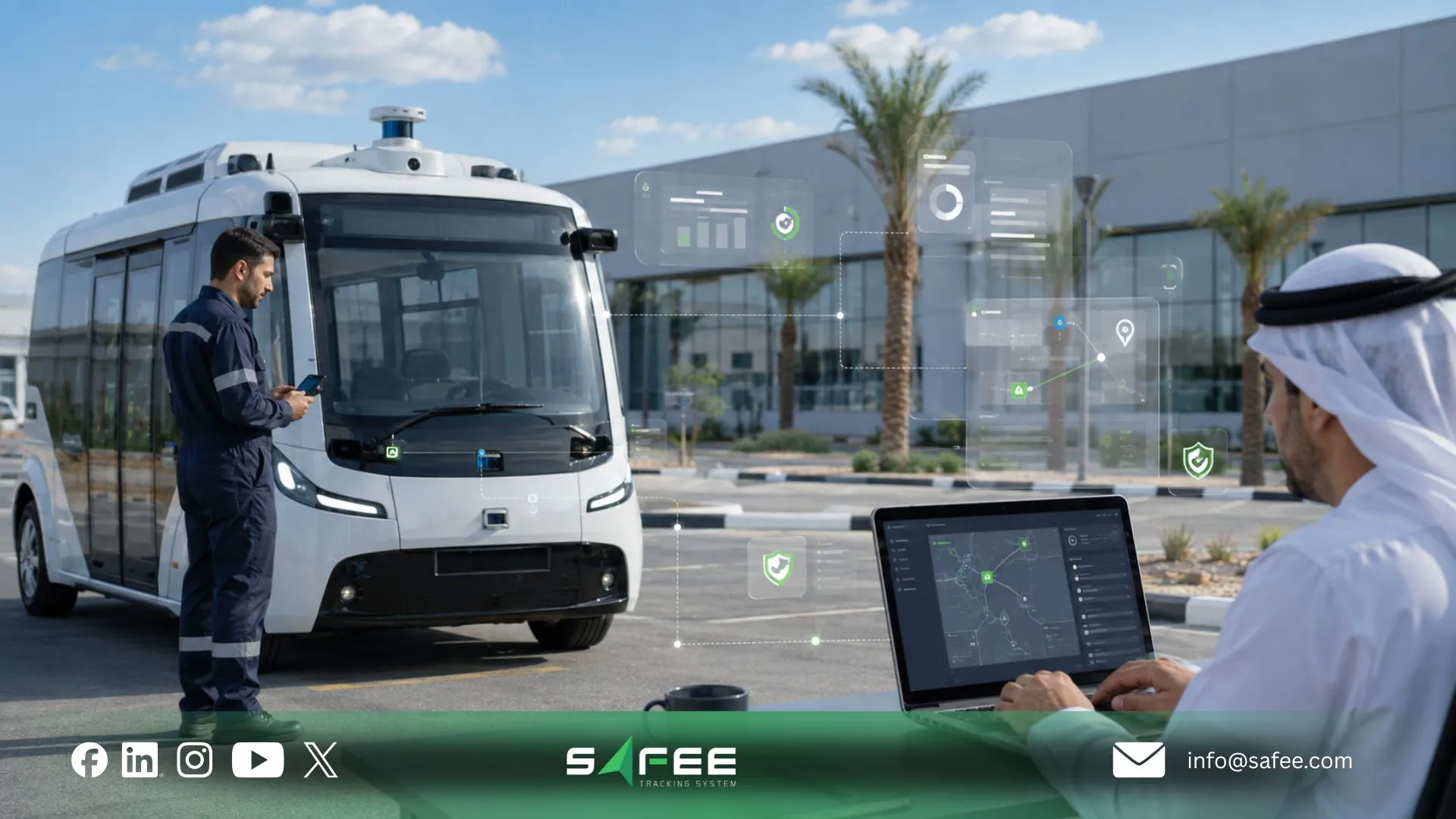
Autonomous vehicle fleet management and conventional Telematics overlap in areas such as vehicle status, location, maintenance context, connectivity, alerts, reporting, and operational oversight. They diverge when the fleet-management platform is expected to control the autonomous driving stack itself.
That distinction is critical.
Our published materials document vehicle monitoring, connected data, analytics, maintenance, journey workflows, driver management, sensors, AI-supported investigation, reporting, and integrations. We do not present driverless vehicle control or autonomous dispatch as a core Safee product capability.
Accordingly, autonomous fleet control should not be assumed to exist merely because conventional fleet software can monitor connected vehicle data.
For a proposed fleet management autonomous vehicles deployment, buyers should separate at least four layers:
- Vehicle autonomy: the vehicle’s own perception, planning, and driving capabilities.
- Fleet supervision: location, operating status, exceptions, vehicle readiness, and utilization.
- Operational orchestration: assignment, routing, dispatch, charging or fueling, maintenance, and service planning.
- Enterprise governance: users, permissions, reporting, incident review, integrations, and accountability.
An autonomous vehicle fleet management project may therefore use familiar fleet-management functions while requiring an entirely separate integration with the autonomous vehicle platform.
Search terminology can blur this distinction. Phrases such as fleet management autonomous vehicle may imply that one application controls both fleet operations and the vehicle’s driving behavior. Buyers should require providers to state exactly which layer they control.
Questions to ask a provider include:
- Does the platform only monitor autonomous vehicles or issue commands to them?
- Which vehicle APIs are supported?
- Which vehicle states are available in real time?
- Who owns dispatch decisions?
- What happens when connectivity degrades?
- Which actions require human authorization?
- How are operational events preserved for investigation?
- How are maintenance and readiness states exchanged?
- Which integrations are production-supported?
- Which capabilities remain pilot-specific?
This is also the right framework for evaluating autonomous fleet management software instead of accepting “autonomous-ready” as a complete technical description.
Data-driven fleet management
Data driven fleet management is the much more immediate smart-fleet opportunity because the required operational model already exists: collect trustworthy fleet data, connect it to context, surface exceptions, investigate patterns, take action, and review whether the action changed the result.
Our platform supports this workflow through several connected capabilities.
Live Vehicle Tracking provides current fleet visibility and operational context. Alarms and Alerts can surface configured exceptions. Fleet Reporting supports structured and scheduled review. Tracking Data Analyzer (TDA) adds dashboards, deeper analytical views, recurring-pattern review, anomaly detection, and predictive analysis where supported data is available. The Administration Panel helps structure users, vehicles, sites, groups, configurations, and permissions.
A useful data-driven fleet management workflow looks like this:
- Capture the relevant vehicle, driver, journey, maintenance, or sensor data.
- Validate whether the data is current and complete enough for the decision.
- Detect an exception or pattern.
- Add vehicle, driver, route, maintenance, or operating context.
- Assign the review to the responsible team.
- Record the operational response.
- Use reporting or analysis to determine whether the problem recurred.
- Adjust thresholds, policy, training, maintenance, or workflow when evidence supports a change.
That turns connected data into governance.
For example, maintenance teams do not need a generic “AI says this vehicle may fail” message. They need the vehicle identity, relevant operating signal, historical pattern, maintenance history, comparison context, inspection finding, corrective action, and subsequent evidence. Our Maintenance Module, supported CAN-BUS Integration, TDA, Fleet Reporting, and other connected records can support that process where the required data is available.
Explore our Tracking Data Analyzer (TDA) to see how connected tracking data can support deeper analytical investigation.
Talk to us about the decisions your fleet needs to improve first, then map the required data sources, modules, alerts, reports, and review owners around those decisions.
Where 5G fleet management adds value beyond 4G
5G fleet management should not be treated as though every existing fleet must replace 4G connectivity to become “smart.”
Our published Telematics architecture describes vehicle data being transmitted using 4G, 5G, or satellite connectivity where needed. That is the relevant design principle: connectivity should match the use case and operating environment rather than become the purpose of the deployment.
For a fleet evaluating 5G, the useful questions are:
- Is 5G available across the actual operating routes?
- Do the selected tracking devices support it?
- Which application requires the additional network capability?
- Does the fleet rely on video, high-volume sensor streams, or other data-intensive workloads?
- What is the 4G fallback behavior?
- Is satellite connectivity required in remote areas?
- How does loss of connectivity affect alerts or operational workflows?
- What information is buffered and transmitted when communication resumes?
- Does the benefit justify device and connectivity changes?
We also offer SatComm for GPS tracking in remote regions, reinforcing the broader point that a smart fleet should be designed around connectivity resilience rather than one network label.
Without an identified operational requirement, upgrading connectivity alone does not make fleet management smarter.

Smart fleet management solutions
The strongest smart fleet management solutions are technologies that already connect to a defined operating problem: finding vehicles, detecting risk, reviewing patterns, keeping vehicles ready, protecting temperature-sensitive cargo, controlling journeys, managing driver context, or moving data between fleet and enterprise systems. When comparing smart fleet management software—or even a product described as a smart fleet gps fleet management system—the useful test is whether the underlying data, integration, ownership, and workflow are genuinely deployable.
The weakest claims are those that jump directly from a technology label to an operational outcome without explaining the data, integration, ownership, and deployment conditions in between.
Autonomous fleet management software: Deployable or pilot?
For autonomous fleet management software—or any autonomous fleet management system—”deployable” needs a precise definition.
If the requirement is to monitor a connected autonomous vehicle’s location, status, maintenance-related information, or other exposed operational data, an existing Fleet Management and Telematics platform may be able to participate where compatible data and APIs are available.
If the requirement is for the fleet platform to control autonomous driving, execute driverless dispatch, manage perception systems, or make safety-critical driving decisions, that is a different product category and should not be inferred from our documented fleet-management capabilities.
An autonomous deployment should therefore be evaluated through a controlled integration framework:
- Define exactly what the autonomous vehicle exposes.
- Identify which data our fleet layer or another fleet layer needs.
- Validate compatible APIs and protocols.
- Separate monitoring from command authority.
- Define exception ownership.
- Establish fallback procedures.
- Validate vehicle readiness and maintenance workflows.
- Test reporting and investigation records.
- Confirm network requirements.
- Expand only after the production workflow is proven.
We describe our platform as Hardware Agnostic and capable of integrating diverse compatible devices and sensors, while our APIs support Business Integration. That creates integration flexibility, but it does not imply automatic compatibility with every autonomous vehicle or driving stack.
Smart fleet management market trends worth tracking into 2027
The most useful smart fleet management market trends are not necessarily the technologies generating the largest headlines. They are the shifts that change how fleet data becomes operational control.
Based on capabilities already present in our current architecture, fleet teams should watch several directions into 2027.
AI-assisted fleet investigation is moving closer to day-to-day fleet workflows. Our AI Fleet Assistant allows authorized users to query connected fleet information and continue an investigation conversationally while supporting records remain available for review. It complements rather than replaces dashboards, configured alerts, reports, and responsible managers.
Predictive analytics and predictive maintenance are becoming more operational when they connect to real maintenance records and vehicle signals. We combine Maintenance Module records, supported CAN-BUS data, and TDA’s analytical layer rather than treating prediction as an isolated score.
Mixed-fleet visibility matters as electric vehicles join conventional vehicles. Our Electric Vehicle Monitoring can be connected with Live Vehicle Tracking, Alarms and Alerts, Fleet Reporting, Driver Management, Maintenance Module, and JMS according to the available vehicle and integration data.
Specialized sensor data is broadening the fleet-data model. Weight Sensors, Tire Pressure Monitoring System (TPMS), Cold Chain Solution, fuel information, CAN-BUS data, and other supported sources can answer different operational questions when correctly deployed.
Integration readiness will remain a selection criterion. Fleet platforms increasingly need to exchange information with ERP, waybill, asset-management, regulatory, and other operational environments rather than remain isolated tracking systems.
Hardware flexibility will also matter as organizations add new devices and sensors over time. Our Hardware Agnostic approach is relevant here, subject to technical validation of protocols and data fields.
These trends are more useful than an unsupported market forecast because each can be tied to a deployment decision and measurable operating process. For the budget and investment lens, use our Fleet Management Trends guide rather than treating this technology-readiness article as a budget forecast.
See how our AI Fleet Assistant connects conversational investigation with authorized fleet records and supporting views.
15 smart fleet management solutions rated real or hype
For this list, Real means we currently document a deployable capability or operating model. Real with dependencies means the capability is available but depends on compatible vehicles, devices, connectivity, integrations, or data. Pilot/validate separately means we do not document it as a core production capability. “Hype” applies when a broader marketing claim promises an outcome without the underlying operational conditions.
- Live vehicle Telematics — Real. Live Vehicle Tracking, vehicle status, GPS context, movement information, geofences, driver context, and communication health are documented current capabilities in our platform.
- Fleet analytics — Real. Tracking Data Analyzer (TDA), Fleet Reporting, dashboards, filtering, recurring review, and analytical investigation already provide a practical data-to-decision layer.
- Configurable operational alerts — Real. Alarms and Alerts can connect defined fleet exceptions to users and workflows instead of requiring managers to watch every vehicle manually.
- AI fleet investigation — Real. AI Fleet Assistant provides a conversational route into connected fleet records while leaving dashboards, reports, alerts, and responsible managers in the operating loop.
- Predictive maintenance — Real with dependencies. We document predictive analysis, Maintenance Module workflows, and supported CAN-BUS vehicle signals. Results depend on the available vehicle, maintenance, sensor, and historical data.
- CAN-BUS vehicle intelligence — Real with dependencies. Supported CAN-BUS Integration can expose diagnostic and operating parameters, but available fields depend on vehicle and integration compatibility.
- 5G fleet connectivity — Real with infrastructure dependencies. We document 4G, 5G, and satellite connectivity where needed; the correct choice depends on coverage, devices, and the application.
- Satellite fleet connectivity — Real. SatComm is documented as an added-value capability for maintaining GPS tracking connectivity in remote operating environments.
- Video-supported safety workflows — Real with deployment dependencies. Video iVMS adds live-streaming, AI alerts, and video-backed incident context where the required equipment and configuration are deployed.
- Electric Vehicle Monitoring — Real with vehicle-data dependencies. EV-related visibility depends on compatible vehicles, protocols, APIs, devices, and available battery or charging data.
- Connected tire monitoring — Real with hardware dependencies. Tire Pressure Monitoring System (TPMS) adds tire-pressure and temperature information to supported fleet configurations.
- Cold-chain monitoring — Real with sensor dependencies. Cold Chain Solution can bring temperature-related information into fleet workflows where compatible monitoring equipment is installed.
- API-connected fleet operations — Real. We document Business Integration through APIs for ERP, waybill, asset-management, and related enterprise environments.
- Autonomous fleet supervision — Validate separately. Existing Telematics functions may support exposed vehicle-status or operational data, but we do not document autonomous driving control as a core capability.
- Full driverless dispatch from a conventional fleet platform — Hype unless technically proven. Do not equate tracking, AI, routing, or API integration with authority over the autonomous driving system. Require explicit production evidence, interfaces, fallback logic, and command ownership.
That distinction is the core lesson behind modern smart-fleet procurement: a feature is only “real” for your fleet when the supporting data, vehicle, hardware, connectivity, integrations, users, and operating process are also real.
Contact Safee to review which of these capabilities can be deployed against your current fleet architecture and which require additional devices, integrations, or validation.
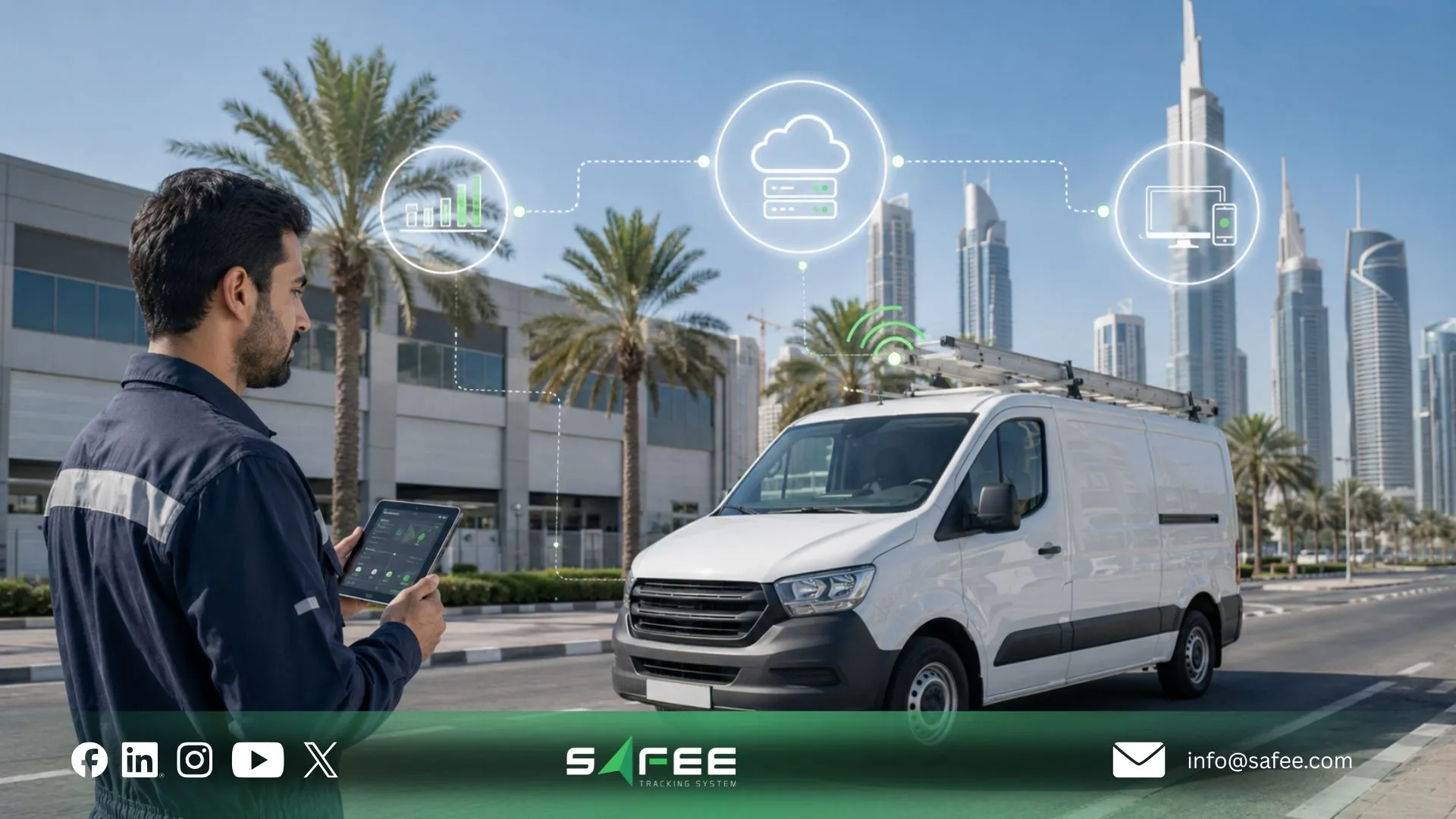
Safee: Smart fleet management capabilities available today
At Safee, our position in smart fleet management software is strongest where smart means connected, measurable, and operational.
Our current platform brings together Live Vehicle Tracking, Fleet Monitoring & Insights, Alarms and Alerts, Fleet Reporting, Administration Panel, Driver Management, Maintenance Module, Journey Management System (JMS), Tracking Data Analyzer (TDA), AI-supported capabilities, specialized sensors, video, mobile access, and Business Integration according to the approved deployment scope.
That architecture matters because a Fleet Manager does not need technology in isolation. The manager needs a workflow such as:
vehicle data, exception, investigation, owner, action, report, and finally review
Our published architecture supports those connections without claiming that every smart-fleet technology belongs in every deployment.
Review our Essential Modules to compare the operational modules available in the platform today.
Safee’s smart fleet capabilities vs pilot and hype tech
| Technology | Deployment Status | Safee’s Position |
| Data-driven operations (telematics-based decisions) | Mainstream and deployable within Safee’s documented platform | Core to our current workflows through tracking, monitoring, alerts, reporting, analytics, and operational modules |
| 5G connectivity | Deployable where the required infrastructure and compatible equipment are available | We document 4G, 5G, or satellite connectivity where needed |
| Autonomous vehicle fleets | Requires separate capability and integration validation | We do not document autonomous driving or driverless fleet control as a core Safee feature |
| Predictive maintenance | Deployable with suitable operational and vehicle data | Supported through our Maintenance Module workflows, CAN-BUS data where available, and TDA predictive analysis |
| Full driverless dispatch | Not established as a Safee production capability | We do not claim autonomous driving control as a core platform function |
This distinction protects technology buyers from two opposite mistakes.
The first is dismissing mature Telematics, connected analytics, alerts, maintenance intelligence, or sensor workflows as “ordinary” because newer technologies sound more futuristic. The second is purchasing a futuristic label before the underlying data and operational workflow are ready.
Our current strength is in the first category: connecting available fleet data to operational visibility, analytics, alerts, maintenance, journey management, reporting, sensors, integrations, and governance today.
FAQs about smart and autonomous fleet management
Is autonomous fleet management actually deployable today?
Parts of autonomous fleet management—such as connected vehicle monitoring, readiness information, maintenance context, reporting, and fleet-level oversight—can be deployable where compatible data is available. Full autonomous driving control or driverless dispatch is a separate capability and should not be inferred from conventional fleet-management software; we do not document it as a core production feature.
What does 5G actually change for fleet management?
We document fleet data transmission through 4G, 5G, or satellite connectivity where needed. For 5G fleet management, the decision should therefore be use-case driven: validate network coverage, compatible hardware, required data workloads, fallback behavior, and whether 5G solves an identified operational requirement rather than upgrading solely for the technology label.
What is data-driven fleet management in practice?
Data-driven fleet management means turning connected fleet records into a repeatable decision process: capture reliable data, identify an exception or pattern, add context, assign action, and measure the result. We support this through capabilities including Live Vehicle Tracking, Alarms and Alerts, Fleet Reporting, Tracking Data Analyzer (TDA), Administration Panel, Maintenance Module, and other configured data sources.
How big is the smart fleet management market expected to get?
We do not publish a market-size figure here as an audited global forecast. Any smart fleet management market size estimate should be checked for geography, included technologies, base year, forecast period, hardware/software scope, and methodology before it is used for investment or procurement decisions.
Ready to improve your fleet operations?
Tell us what you would like to improve. A Safee specialist will reply by email.
Usually replies within one business day • No sales spam
Your details are used only to respond to your request. Privacy Policy