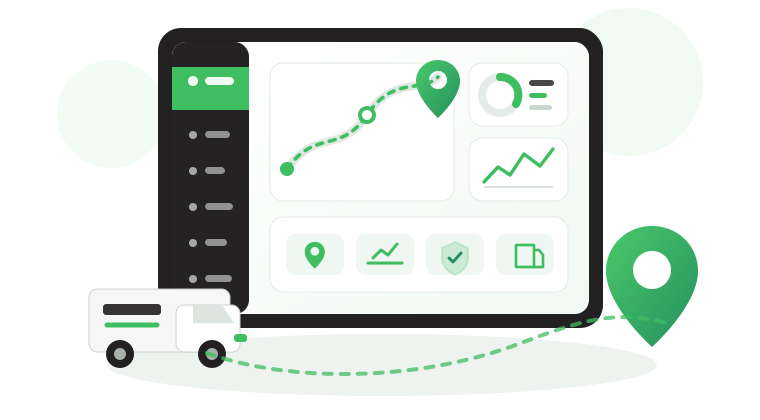

5 Steps for Reliable Fleet Fuel Theft Detection

A suspicious fuel drop is not proof of theft—but it is too important to ignore. Without a structured fleet fuel theft detection process, your team may either escalate an unreliable alert and risk a false accusation or dismiss genuine fuel loss that continues across vehicles, locations, and shifts.
This article explains how to turn a fuel alert into a verified, reviewable case. You will learn which events require investigation, how to validate the reading, connect it with GPS, trip, stop, driver, and business records, reduce false alerts, classify the cause, assign responsibility, and use Safee to support faster, evidence-based case closure.
What must fleet fuel theft detection verify
A useful fuel theft detection system should help reviewers answer four questions before a case is escalated:
- Is the fuel reading reliable and assigned to the correct vehicle and tank?
- What was the vehicle doing at the exact time of the change?
- Does the event match an approved trip, refueling, workshop, transfer, or maintenance activity?
- Is there enough evidence to close the case, correct the process, or begin a formal investigation?
The terminology should also remain precise. Fuel anomaly detection flags a reading or pattern outside an expected range. Fuel drain detection identifies a rapid or unusual tank-level reduction. Fuel loss monitoring follows unexplained variance over time. Fleet fuel theft should describe verified unauthorized removal, diversion, or use—not the first alert generated by the system.

Which fuel events should enter the investigation queue
Fuel theft monitoring should be exception-based. Your team does not need to inspect every normal tank movement; it needs a short queue of events whose timing, location, volume, or repeated pattern conflicts with the approved operating model.
Event | Possible Explanations | What to Verify |
Drop while parked | Possible draining, leakage, tank work, sensor fluctuation, or delayed data. | Location, geofence, ignition or engine state, stop duration, schedule, maintenance activity, and reading stability. |
Transaction mismatch | Wrong vehicle, delayed record, card misuse, incorrect quantity, or an unrecorded fill-up. | Vehicle, driver, supplier, time, quantity, location, and the measured tank-level increase. |
Repeated unexplained variance | Idling, route mix, load, driving behavior, maintenance condition, off-route use, or gradual fuel loss. | Comparable routes and vehicles, driver assignment, distance, idling, load, service history, and recurrence. |
Out-of-hours or restricted-location event | Approved overnight work, workshop activity, unauthorized use, leakage, or possible draining. | Operating schedule, trip status, depot or site access, assigned driver, location history, and approvals. |
Bring one anonymized or representative fuel-loss event to a Safee demo. We can map the available fuel signal to its location, trip, stop, driver, alert, and reporting context so you can test the investigation workflow with a realistic case.
How to investigate a suspicious fuel drop
The following five-stage workflow turns fleet fuel monitoring alerts into reviewable cases. It also reduces the risk of treating technical noise or incomplete records as employee misconduct.
1. Validate the fuel reading
Confirm that the data source is present, mapped to the correct vehicle and tank, and stable around the event. Review missing packets, duplicated values, sudden recovery, recent sensor work, and known calibration issues. Our Fuel Control module can display supported fuel-level, fill, consumption, and drop information, but the alert logic is only as reliable as the source data and configuration. When the issue is calibration or filtering, return to the technical fuel-level workflow rather than escalating the case.
2. Reconstruct the vehicle context
Open the exact time window in Live Vehicle Tracking and review the location, route, movement, stop duration, geofence status, and trip activity. A drop at an approved workshop is different from the same change at an unexplained roadside stop. Fleet Monitoring and Insights can help operators isolate the relevant vehicle or group instead of searching across the full fleet.
3. Verify the driver and approved activity
Check who was responsible for the vehicle at the event time and whether the assignment changed during the shift. Shared vehicles and delayed manual assignments can create false conclusions. We can support this review through Driver Management and, where deployed, our Driver Identification System using compatible identifiers such as RFID, iButton, or Bluetooth Low Energy (BLE). Then reconcile the event with authorized refueling, depot logs, invoices, fuel-card data, reported leakage, tank repair, or workshop activity.
4. Compare the event and classify the cause
One isolated reading may remain inconclusive. Compare the same vehicle, driver, route, branch, supplier, shift, and location with relevant history. Our Interactive Grid helps authorized users group and filter operational records, while the Tracking Data Analyzer supports deeper comparison of repeated patterns. Classify the result with controlled labels such as approved activity, record mismatch, sensor issue, suspected leakage, operational misuse, unresolved anomaly, or possible theft requiring formal review.
5. Assign ownership and record closure
Every material case needs an owner, evidence reviewed, action taken, closure reason, and follow-up date. Operations may correct a route or assignment; Maintenance may inspect a leak; Finance may reconcile a transaction; Security or HR may handle a formally escalated case. Use Fleet Reporting to review recurrence by vehicle, driver, location, branch, event type, or period. The goal is not simply to dismiss or confirm one alert, but to reduce unresolved variance and repeated loss.
Also read: How AI Fleet Anomaly Detection Finds What Fixed Alerts Miss?
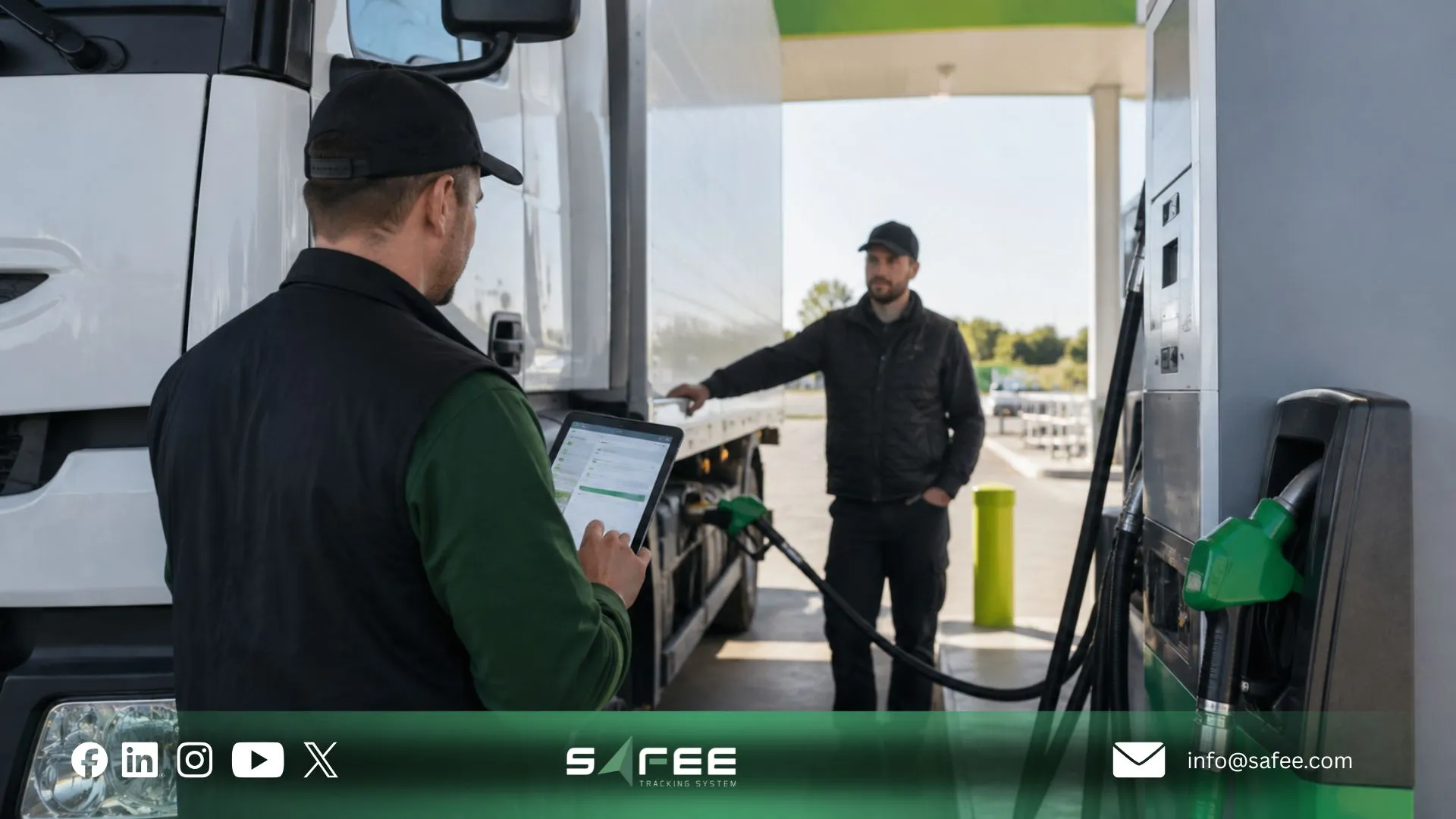
How a fuel theft detection system connects the evidence
A fuel theft detection system becomes operationally useful when each alert opens the records needed for review. The most important evidence layers are:
- Fuel event: time, magnitude, duration, stability, and available tank or consumption data.
- Vehicle context: location, route, movement, stops, geofences, and trip status.
- Responsibility context: vehicle, tank, branch, shift, driver, operator, and user access.
- Business records: fuel-card transactions, supplier invoices, depot logs, work orders, and maintenance records.
- Alert workflow: recipient, acknowledgement, owner, classification, action, and closure.
- Historical pattern: similar events by vehicle, driver, route, site, supplier, or operating period.
We can route supported exceptions through Alarms and Alerts and extend urgent visibility to authorized supervisors through the Mobile App. The app can help teams review fuel-related alerts and vehicle context while the operational details are still recent, rather than waiting for a monthly reconciliation.
How to reduce false fleet fuel monitoring alerts
False fleet fuel monitoring alerts weaken trust and slow genuine investigations. Keep the controls practical:
- Validate the source and tank mapping before alerts are used for financial or disciplinary action.
- Set thresholds by vehicle and tank type rather than applying one rule to the full fleet.
- Use magnitude and duration together so short fuel movement is not treated like a sustained drain.
- Add location, schedule, ignition, movement, and geofence context to the alert condition where the deployment supports it.
- Review transmission gaps and delayed records that may make a gradual change appear sudden.
- Test fuel drain detection rules during a controlled validation period and tune recipients before formal escalation.
This section is intentionally concise because detailed sensor setup, tank geometry, calibration, and filtering belong in our fuel-level guide. Here, the objective is to keep the investigation queue credible.
Fleet management controls that reduce recurring fuel theft
A practical fuel theft prevention fleet management process uses investigation outcomes to strengthen the operating model. Detection alone does not prevent recurrence.
- Define approved stations, depots, workshops, geofences, schedules, and fuel-authorisation rules.
- Keep vehicle, tank, driver, branch, supplier, and cost-centre assignments accurate.
- Use the Administration Panel to structure users, vehicles, sites, and role-based permissions so sensitive fuel, driver, and financial records are available only to the right teams.
- Use mobile notifications for material events, but avoid sending every low-value fluctuation to senior managers.
- For vehicles operating beyond reliable cellular coverage, consider SatComm for location continuity and accountability; fuel-data availability must still be validated for the selected device and integration.
- Review repeated anomalies and closure rates through the weekly operating process described in our fleet fuel monitoring KPI guide.
Technology cannot guarantee that every misuse event will be prevented. It can make unusual activity easier to isolate, preserve more context, and help responsible teams respond before the discrepancy disappears inside monthly totals.
Why is Safee the best choice for fleet fuel theft detection
At Safee, we do not leave a fuel exception isolated in a sensor screen. We connect compatible fuel data with vehicle tracking, geofences, stops, driver identity, alert delivery, user permissions, comparative analysis, and reporting inside one configurable fleet platform.
That connected approach helps your team move through the full review chain: detect the anomaly, verify the reading, reconstruct the vehicle context, confirm responsibility, compare history, classify the cause, assign action, and record closure. It supports faster fuel loss monitoring without presenting an alert as proof of theft.
For fleets in the UAE, Saudi Arabia, the wider GCC, and international operations, we configure the workflow around the actual vehicles, tanks, routes, users, branches, data sources, and escalation responsibilities. Your organisation remains responsible for its evidence standards, employment procedures, access policies, and final conclusions.
Book a Safee demo to review one real fuel event and see how our platform can connect the alert with the evidence your teams need to verify and act.
FAQs about fleet fuel theft detection
What is fleet fuel theft detection?
Fleet fuel theft detection is the process of identifying a possible fuel-loss event, validating the reading, connecting it with GPS, trip, driver, location, and business records, and deciding whether the case should be closed, corrected, or escalated.
How does a fuel theft detection system work?
A fuel theft detection system receives compatible tank-level or consumption data, applies configured conditions, and connects the event with vehicle and operational context. The responsible team then reviews the evidence and records the outcome.
Is every suspicious fuel drop evidence of theft?
No. A suspicious fuel drop may result from normal consumption, leakage, maintenance, tank movement, parking angle, sensor noise, calibration issues, delayed data, an approved transfer, or unauthorized removal. It must be verified before escalation.
What is the difference between fuel anomaly detection and fuel drain detection?
Fuel anomaly detection covers any reading or pattern outside the expected range. Fuel drain detection is narrower and focuses on a rapid or unusual tank-level reduction. Neither confirms theft on its own.
How does Safee support fuel theft monitoring?
At Safee, we connect compatible fuel data with tracking, trips, stops, geofences, driver information, alerts, mobile access, permissions, analytics, and reports. Available functions depend on the devices, sensors, integrations, connectivity, and modules included in the deployment.
Ready to improve your fleet operations?
Tell us what you would like to improve. A Safee specialist will reply by email.
Usually replies within one business day • No sales spam
Your details are used only to respond to your request. Privacy Policy