
What Should a Vehicle Tracking System in Abu Dhabi Deliver?


Choosing a vehicle tracking system in Abu Dhabi is no longer just about tracking vehicles on a map. Fleet managers and fleet owners need a platform that helps them reduce delays, control idle time, detect route deviations early, improve driver accountability, and make faster decisions with less manual follow-up. At Safee, we build for that operational reality.
In this article, we explain what businesses should look for in a gps vehicle tracking system in Abu Dhabi, which features matter most for daily fleet control, and how Safee helps turn location data into Monitoring, alerts, reporting, and scalable operational visibility.
What should a vehicle tracking system solve for fleet managers
A GPS professional vehicle tracking system in Abu Dhabi should help a manager answer six operational questions quickly:
- Where are my vehicles now?
- Which vehicles need attention first?
- Which trips are running off plan?
- What happened on a specific route?
- Which exceptions should be escalated during the shift?
- What patterns should be reviewed at the end of the day?
That is the difference between a basic GPS tracker and an operations-ready platform. At Safee, we design the system around fleet control, not only visibility. That means live Monitoring, alarms, dashboards, reports, and modules that let managers move from reaction to control without jumping between separate tools.
If your current setup still leaves dispatchers chasing drivers for updates, review our Essential Modules, our Live Vehicle Tracking, and our Alarms and Alerts pages, then talk to us about the control gaps you want to close.
GPS vehicle tracking system vs basic tracker tools in Abu Dhabi
A gps vehicle tracking system in Abu Dhabi should be compared on workflow depth, not only on whether it shows a location. For business fleets, the platform has to support decisions before, during, and after the trip.
Capability | Basic tracker | Professional Safee workflow | Why it matters |
Live visibility | Usually yes | Yes, with monitoring views and filters | Dispatch can spot what needs attention now |
Alerts | Simple notifications | Configurable alarms and exception logic | Issues are surfaced early instead of after service fails |
History review | Limited | Route review, map history, and event follow-up | Managers can investigate what happened with confidence |
Reporting | Minimal | Operational reports and analytics through TDA | Raw data becomes management insight |
Growth path | Weak | Can expand into JMS, Video-iVMS, SatComm, and Cold Chain | You scale without replacing the platform |
If you want the platform layer that sits above tracking hardware, explore how we position Safee as a fleet management and vehicle tracking platform and how our GPS Vehicle Tracking System in the UAE guide explains the move from visibility to control.
How does a vehicle tracking system work in daily operations?
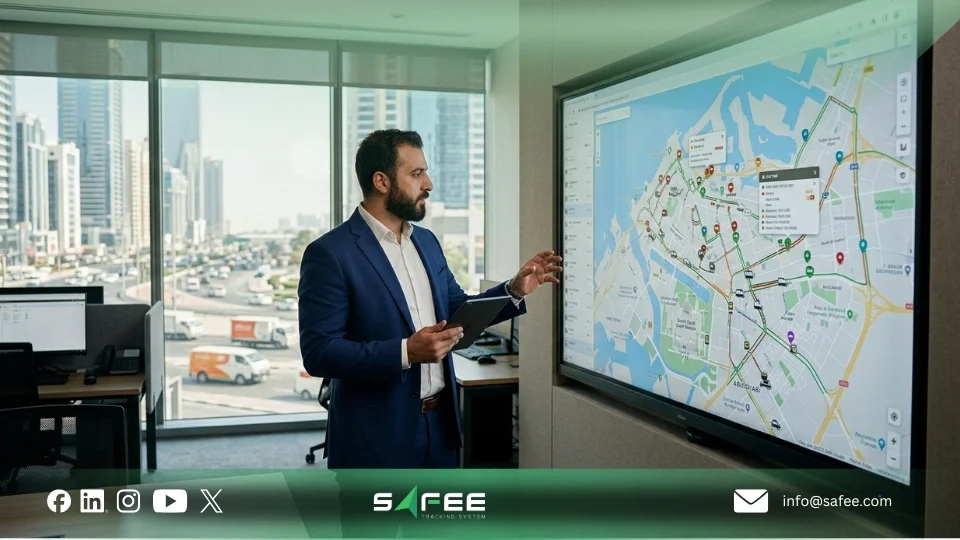
At Safee, the workflow starts with vehicle and device data flowing into one centralized platform. But the real value starts after the signal arrives. We transform live movement into actionable monitoring screens, alerts, searchable records, trip reviews, and management reports that supervisors can utilize during the shift.
In practical terms, a fleet supervisor may start the day on Monitoring, filter the active vehicles that matter most, respond to an alert for idling or route deviation, check a route on the map, and then close the day with reports and dashboard review. That is how a gps vehicle tracking system in Abu Dhabi becomes a management system instead of a map-only tool.
What managers actually use during the shift
- Fleet Monitoring and Insights for centralized real-time map visibility, searchable asset views, and integrated applications
- Live Vehicle Tracking for second-by-second fleet awareness and immediate oversight
- Alarms and Alerts for exception handling, safety events, unauthorized movement, and faster response
- Administration Panel for user, vehicle, and configuration control across growing operations
- Tracking Data Analyzer for turning trip, utilization, and geofence data into usable reports
Key vehicle tracking features for B2B fleets
Real-Time Monitoring
Our live visibility layer starts with Fleet Monitoring and Insights and Live Vehicle Tracking so supervisors can see movement, vehicle status, driver context, and route progress as work happens. This is essential for fleets that cannot afford blind spots during the shift.
Alerts and alarm control
At Safee, Alarms and Alerts add the control layer fleet teams need when they want more than passive tracking. More than 50 alarm types, custom notifications, and geofence-based triggers help you act on problems while they are still fixable.
Dashboards and reporting
A fleet cannot improve what it cannot review. Our Tracking Data Analyzer and reporting workflows help fleet managers convert location and event data into trend analysis, utilization review, and operational follow-up that leadership can actually use.
Route discipline and journey control
For operations that need stronger trip structure, Journey Management System (JMS) and Google Directions help turn planned routes, geofences, and approvals into a more controlled journey workflow.
Remote coverage and specialized monitoring
If your operation extends beyond dense coverage zones or into desert, border, or long-haul routes, SatComm adds continuity. If you run temperature-sensitive transport, Cold Chain Solution gives you integrated environmental monitoring within the broader fleet workflow.
Why does it matter for cost, control, and accountability?
For most B2B fleets, the biggest losses do not come from one dramatic failure. They come from repeated small leaks: extra idle time, route drift, late discovery of issues, weak dispatch visibility, and poor follow-up after the shift. A vehicle tracking system in Abu Dhabi matters because it gives managers a control layer that reduces guesswork and improves response speed.
At Safee, we position that control around measurable outcomes: better route discipline, stronger driver accountability, clearer reporting, less wasted time, and more confidence when supervisors have to make decisions fast. When the platform is configured correctly, the team stops reacting late and starts seeing problems while there is still time to act.
- Better live visibility across active vehicles, drivers, and routes
- Stronger exception handling through alerts, geofences, and escalation logic
- Less manual coordination through centralized monitoring and searchable asset views
- More credible management follow-up through route history, dashboards, and reports
- A cleaner path from core tracking into safety, video, remote coverage, and cold-chain control
If your team is still depending on calls and assumptions to manage exceptions, read our Real-Time GPS Fleet Tracking guide, then contact us for a workflow discussion focused on your actual cost leaks and service risks.
Also read: Real-Time GPS Fleet Tracking: Benefits, Challenges & Best Practices
Which industries need a GPS vehicle tracking system in Abu Dhabi most
Logistics and delivery fleets
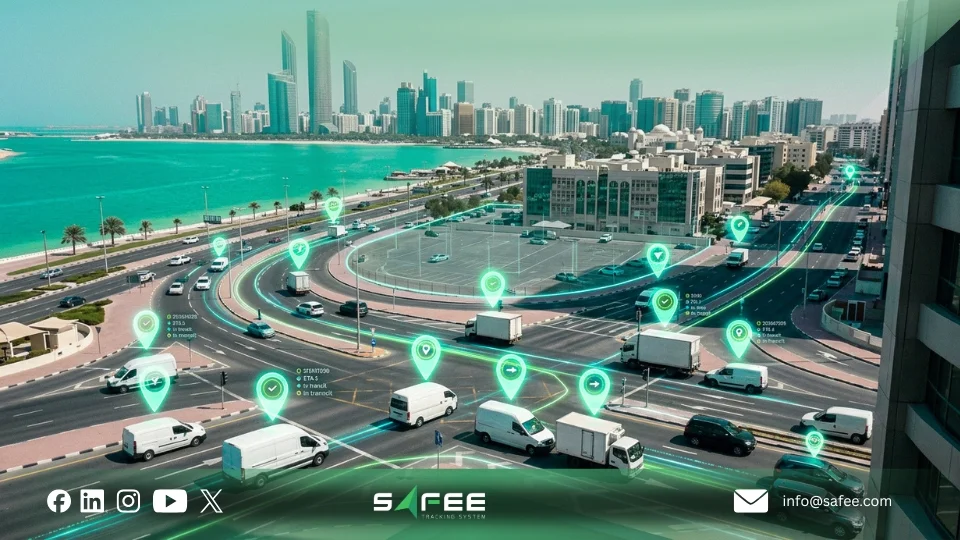
need live visibility, fast exception response, and route discipline across high daily stop volumes. Safee’s monitoring, alarms, and map workflows help dispatch teams act earlier and reduce manual follow-up.
Construction and heavy equipment fleets
need better control over site movement, utilization, and downtime risk. A platform view is more useful than simple location because managers need to understand what moved, when, and for how long.
Oil and gas and remote operations
need stronger continuity, workforce visibility, and coverage resilience. SatComm and JMS become especially relevant when safety, journey approvals, and remote visibility matter.
Government and transportation fleets
usually prioritize accountability, route consistency, reporting discipline, and policy-based oversight. Safee’s dashboards, controls, and reporting structure are well suited to that environment.
Cold-chain and sensitive cargo fleets
need monitoring that connects vehicle movement with environmental conditions. This is where Cold Chain Solution helps integrate temperature and humidity control with the wider fleet workflow.
Also read: Why GPS Vehicle Tracking Systems Are So Beneficial in 2026
How to choose the right vehicle tracking provider in Abu Dhabi?
The best provider is not the one with the loudest sales claim. It is the one that can show how live visibility, alerts, dashboards, user control, and future modules work together for your operation. At Safee, we recommend comparing providers against one real workflow instead of one feature list.
- Can the platform show live Monitoring that dispatchers can actually use during the shift?
- Can you configure alerts for route deviation, idling, unauthorized movement, and other operational exceptions?
- Does it include usable dashboard and reporting logic, not just raw location history?
- Can it support route planning and controlled trip workflows if your fleet grows into that need?
- Does it offer continuity for remote or low-coverage operations?
- Can it expand into video safety, cold-chain control, or analytics without forcing a platform replacement?
- Are user, vehicle, and configuration controls clear enough for multi-team B2B operations?
Before you make a decision, compare our Journey Management System, and SatComm. Then ask us for a demo built around your routes, users, and daily management questions.
Why does Safee support fleet growth in Abu Dhabi?
At Safee, we do not treat tracking as an isolated tool. We build it as a fleet operating layer that can start with live visibility and grow into deeper control. That matters for B2B fleet managers and owners because operational needs usually expand: first tracking, then alerts, then reporting, then trip discipline, then specialized modules such as video, remote coverage, or cold-chain monitoring.
We are also built for scale. Our official platform positioning emphasizes business integration, hardware flexibility, real-time tracking, alerts, reporting, added-value modules, and industry-specific workflows across logistics, transportation, delivery, oil and gas, construction, government, retail, and hospitality. That breadth matters because your platform choice should not become a limitation one year after rollout.
Request our Demo today. Show us your fleet size, your operating model, and the control gaps you want to fix. We will map the right mix of Monitoring, alerts, reports, route control, and advanced modules for your operation.
FAQs About Vehicle Tracking System in Abu Dhabi
What is the difference between a GPS tracker and a vehicle tracking system?
A basic GPS tracker usually shows location. A professional vehicle tracking system adds Monitoring, alerts, reports, dashboards, route history, and management workflows that help supervisors act during the shift and review performance afterward.
What should I prioritize when choosing a vehicle tracking system in Abu Dhabi?
Start with live visibility, alert logic, route history, reporting quality, usability for dispatchers, and the ability to scale into added-value modules such as JMS, Video-iVMS, SatComm, or Cold Chain when your operation needs more control.
Can a gps vehicle tracking system in Abu Dhabi work for small and large fleets?
Yes. Smaller fleets usually benefit first from visibility and alerts. Larger fleets need stronger filters, user control, dashboards, reports, and integration into broader workflows. The right platform should support both stages without forcing a replacement later.
Why should I request a demo before choosing a provider?
Because feature lists do not show you how the workflow actually feels. A demo lets you test Monitoring, alerts, route review, dashboards, and reporting against your real fleet structure instead of buying based on assumptions.
Ready to improve your fleet operations?
Tell us what you would like to improve. A Safee specialist will reply by email.
Usually replies within one business day • No sales spam
Your details are used only to respond to your request. Privacy Policy