
How Fleet Maintenance Management Prevents Costly Downtime

A vehicle misses dispatch because a service reminder was buried in a spreadsheet. A driver reports the same fault twice, but no one closes the loop. Operations only notice the risk when the route is already delayed. This is the daily pain that turns maintenance from a controlled process into a business interruption.
This guide explains how fleet maintenance management helps B2B fleets replace reactive repairs with schedules, inspections, alerts, reporting, and predictive insight. It also shows how Safee can support more reliable vehicle fleet maintenance management with a connected platform for maintenance, tracking, alerts, reports, diagnostics, and operational control.
What does preventive fleet maintenance management mean?
Fleet maintenance management is the system a business uses to plan, track, assign, and improve maintenance across its vehicles. It includes service schedules, inspections, repair records, fault escalation, vehicle status, driver-reported defects, alerts, and management reports.
For operations teams, the goal is not to collect maintenance data for its own sake. The goal is to keep vehicles safe, available, and ready for work while reducing avoidable disruption. A strong program gives managers one reliable view of what is due, what is overdue, what is recurring, and what needs immediate action.
At Safee, we support this operating model through our Maintenance Module, which helps you teams create maintenance tasks, automate service alerts, and connect maintenance activity with wider fleet operations.
fleet maintenance management vs. reactive repairs
Reactive repairs will always exist. Tires fail, batteries die, and unexpected issues happen. The risk starts when reactive work becomes the normal way of running the fleet. Preventive fleet maintenance management gives teams a structure before the failure happens.
Area | Preventive Fleet Maintenance Management | Reactive Repairs |
Timing | Planned before failure through schedules, inspections, and alerts. | Triggered after a breakdown, complaint, or operational disruption. |
Visibility | Managers see upcoming service, open tasks, and recurring issues. | Visibility often depends on calls, messages, or workshop updates. |
Operational impact | Helps protect routes, asset availability, and customer commitments. | Can remove vehicles from service at the worst time. |
Cost control | Easier to forecast, prioritize, and document. | Harder to control because work is urgent. |
Accountability | Tasks have owners, status, and closure rules. | Follow-up can be fragmented across teams. |
Why does vehicle fleet maintenance management save more than it costs?
Vehicle fleet maintenance management protects more than workshop budgets. It protects asset availability, route reliability, driver productivity, safety discipline, and customer commitments. A vehicle that fails during dispatch can affect drivers, customers, operations, compliance records, and replacement planning at the same time.
Preventive maintenance helps teams control missed service intervals, repeated defects, emergency repair pressure, inspection gaps, and unclear repair ownership. It also gives operations leaders better evidence for decisions about utilization, replacement timing, vendor performance, and asset criticality.
When maintenance data is connected with Fleet Reporting, managers can review overdue work, repeated faults, downtime patterns, and performance trends instead of relying on scattered updates.
Also read: Truck Fleet Management Services in the GCC: How to Choose the Right Setup?

Core guidelines for effective fleet maintenance management
Strong fleet maintenance management depends on clear rules, reliable inputs, and disciplined follow-through. Software improves the workflow, but the maintenance logic must be defined first.
- Set service schedules by vehicle type, age, operating conditions, and criticality.
- Use daily or pre-trip inspections to catch visible defects early.
- Define which defects require immediate escalation and which can be monitored.
- Assign every open issue to an owner with a status and expected closure path.
- Review overdue work, recurring defects, and downtime trends every week.
- Connect maintenance planning with operations so service does not surprise dispatch.
Request a Safee demo to review your maintenance schedules, service alerts, team roles, and reporting workflow in one connected fleet maintenance management setup.
Service intervals that anchor vehicle fleet maintenance management
Service intervals are the foundation of vehicle fleet maintenance management. They define when a vehicle should be inspected, serviced, or reviewed based on usage or time. The best interval is not one generic rule for the entire fleet. It depends on real operating conditions.
Common service triggers include mileage, engine hours, calendar time, vehicle category, manufacturer guidance, route severity, climate, load profile, and asset criticality. In GCC operations, heat, dust, long idle periods, heavy loads, and cross-border routes can make usage-based maintenance more important than a simple calendar reminder.
Our Maintenance Module can support odometer-based, date-based, combined, periodic time/distance-based, and ignition-time-based maintenance alerts, helping teams match service logic to actual vehicle usage.
Inspection standards inside fleet management maintenance programs
These programs need inspection standards that are easy to complete and hard to ignore. Drivers and inspectors should know what to check, when to check it, how to report it, and what happens next.
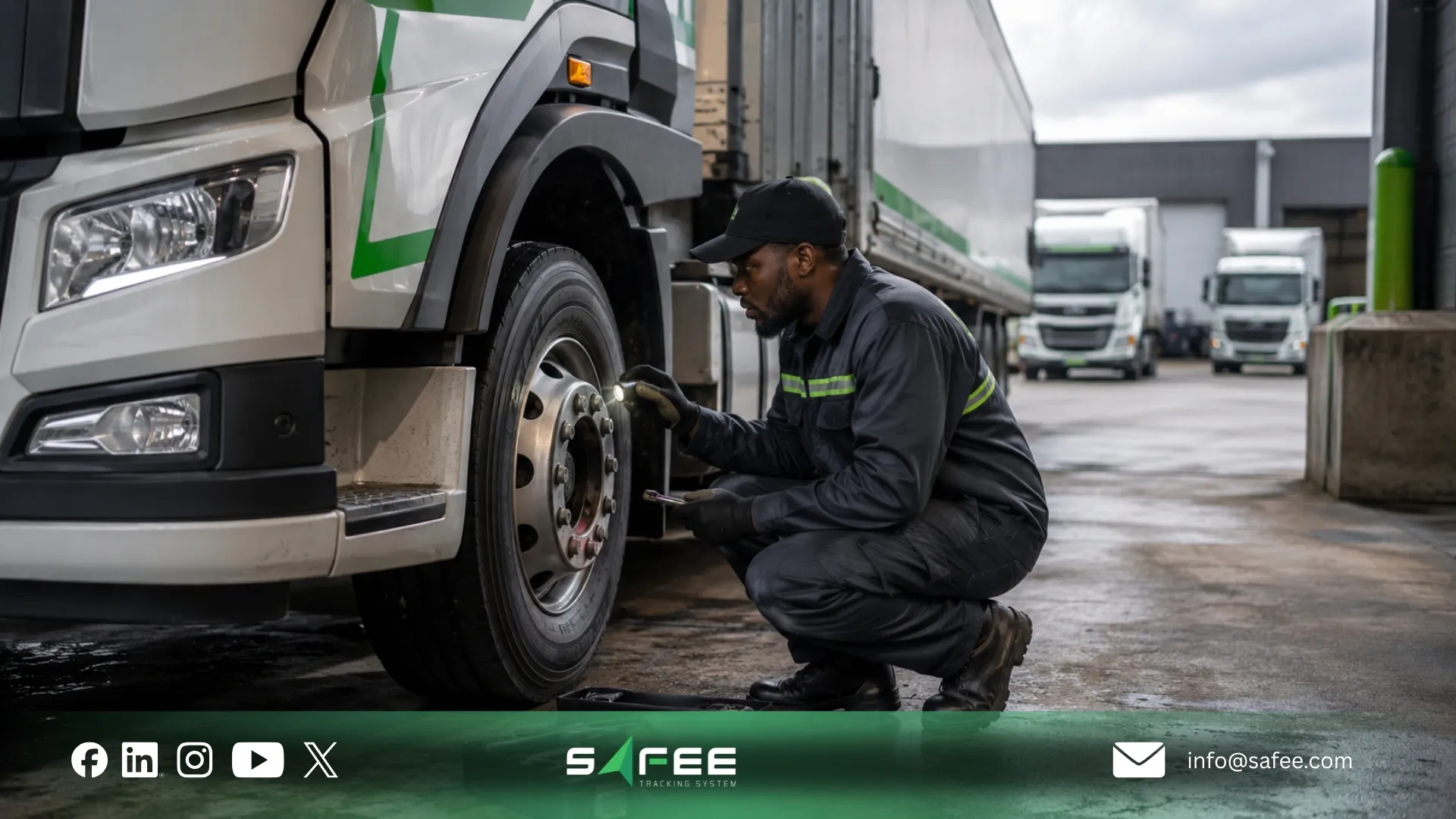
Useful inspection categories include tires, brakes, lights, fluids, dashboard warnings, body damage, battery condition, safety equipment, load-related equipment, and refrigeration or cooling equipment where relevant. For construction, logistics, oil and gas, delivery, and cold chain fleets, inspection priorities may differ by vehicle group.
The most important rule is closure. A defect should not stay in a chat thread. It should become a tracked task with a clear status: open, assigned, in progress, completed, or monitored.
When does basic fleet maintenance management need predictive data?
Scheduled maintenance is the foundation of fleet maintenance management. It helps teams plan service by mileage, engine hours, calendar dates, vehicle type, and operating conditions. But as fleets grow, schedules alone may not give maintenance managers enough visibility into risk.
This is where fleet management predictive maintenance software becomes useful. It can help teams use vehicle data, diagnostics, alerts, and historical maintenance trends to identify early warning signs before they become downtime.
A fleet may need predictive data when manual reminders are causing missed service tasks, the same faults appear repeatedly, vehicle usage varies by route or region, or downtime directly affects customer commitments. This is especially important for high-utilization fleets, harsh GCC operating conditions, cold chain fleets, construction fleets, logistics operations, and field service teams.
Our CANbus Integration can support this approach by helping teams access useful vehicle signals such as engine health, RPM, fuel level, brake usage, battery voltage, and other diagnostic data. The goal is not to react to every signal. The goal is to validate the context, assign the right maintenance action, confirm the repair, and review whether the issue returns.
Predictive data should strengthen fleet maintenance management, not complicate it. When alerts, diagnostics, service schedules, and reports work together, teams can make better decisions about which vehicles need attention now, which can remain in service, and which assets may require deeper review.
Connect maintenance with fuel and utilization data
Maintenance decisions become more accurate when teams understand usage and operating cost. Safee Fuel Tracking can support this broader view by helping managers review fuel usage, idle consumption, anomalies, and trends that may point to inefficient operation or maintenance-related issues.
For example, repeated fuel anomalies, excessive idling, abnormal engine data, or recurring alerts should not be reviewed in isolation. They should feed into the broader fleet management maintenance process so managers can see whether the issue is operational, mechanical, behavioural, or route-related.
Talk to Safee about using maintenance alerts, CANbus diagnostics, fleet reports, and operational dashboards to support smarter fleet maintenance management.
Also read: Fleet Management Audit Checklist for GCC Long-Haul Trips
How to run preventive fleet maintenance management day-to-day?
Day-to-day fleet maintenance management works when planned service, condition-based inputs, and management review are connected. The process should be simple enough for daily use and structured enough for managers to audit.
Build a calendar in your fleet maintenance management software
A maintenance calendar inside your fleet maintenance management software helps managers see upcoming service, overdue work, workshop windows, follow-up checks, and vehicle availability impact. The calendar should not sit apart from operations. It should align with routes, shifts, asset criticality, and dispatch needs.
Step | Action | Owner |
1 | Define service rules by vehicle category. | Fleet maintenance manager |
2 | Add schedules and triggers to the system. | Maintenance admin or fleet team |
3 | Review upcoming work weekly. | Maintenance and operations leads |
4 | Prioritize critical vehicles and high-risk routes. | Operations lead |
5 | Assign workshop, driver, or internal team actions. | Maintenance coordinator |
6 | Confirm completion and update records. | Maintenance team |
7 | Review overdue tasks and recurring issues. | Fleet manager |
Use daily checks tied to vehicle fleet maintenance management
A vehicle may not be due for scheduled service but may still show signs of wear, damage, overheating, warning indicators, or equipment risk. Daily checks keep vehicle fleet maintenance management connected to real operating conditions.
When daily checks are combined with Live Vehicle Tracking, managers can connect vehicle status, route activity, alerts, and operational context before deciding what action is needed.
The best daily check process is short, consistent, and action-oriented. If a driver reports a defect, the system should make it visible, assignable, and trackable until closure.
Turn fleet reporting into maintenance decisions
Reports should not be a monthly archive. They should guide action. Our Fleet Reporting helps teams turn fleet data into structured reports that can support maintenance planning, recurring issue analysis, utilization review, and management decisions.
Useful maintenance reports include overdue service tasks, completed repairs, repeated faults by vehicle, downtime by category, alert frequency, inspection compliance, high-cost vehicles, and repair closure time. For operations leads, these reports make it easier to decide which vehicles can remain in service, which need immediate attention, and which assets may require replacement planning.
Why choose Safee for fleet maintenance management?
Choosing a fleet maintenance management software platform is not only a technical decision. It is an operating decision. The platform should help maintenance managers, operations leads, drivers, and leadership work from the same version of truth.
At Safee, we support fleets from our UAE base with a platform designed for GCC, MENA, and global operations. Our role is to help teams connect vehicle visibility, maintenance schedules, service alerts, reporting, diagnostics, and operational workflows in one practical management environment.
All-in-one fleet maintenance management software for modern fleets
Modern fleets need more than reminders. They need all-in-one fleet maintenance management software that reduces fragmentation without adding unnecessary complexity. Here is exactly what our platform provides; it includes several different types of modules in one place, including:
- Maintenance Module for tasks, service triggers, and maintenance alerts.
- Alarms and Alerts for faster response to critical exceptions.
- Fleet Reporting for scheduled reports and management review.
- Live Vehicle Tracking for real-time operational visibility.
- CANbus Integration for vehicle diagnostics and maintenance intelligence.
- Fuel Tracking for cost and utilization context.
Less downtime, lower costs, stronger fleet management maintenance
The business case for stronger fleet management maintenance is control. When teams see maintenance needs earlier, assign responsibility clearly, and confirm completion, vehicles become easier to keep ready for work.
For logistics and delivery fleets, that may mean better readiness before morning dispatch. For construction fleets, it may mean fewer idle assets on site. For oil and gas operations, it may mean stronger control over vehicles working in demanding or remote conditions. For cold chain fleets, it may mean closer attention to route-critical equipment and vehicle availability.
Safee helps teams move from scattered updates to a structured workflow: schedule, alert, inspect, assign, close, report, and improve.
Ready to build a clearer maintenance workflow? Request a demo and discuss fleet maintenance management for your operating model.
Is Safee suitable for GCC and global B2B fleets?
Yes. Safee supports B2B fleet teams from its UAE base and is positioned for operations across the GCC, MENA, and global markets with modules for maintenance, tracking, alerts, reporting, diagnostics, and operational control.
Preventive fleet maintenance management keeps vehicles running by replacing guesswork with schedules, inspections, alerts, diagnostics, reports, and accountable follow-up. For B2B fleets, the real value is not only lower repair pressure. It is stronger vehicle availability, safer operations, clearer ownership, and better decisions across the business.
Talk to Safee about building a preventive maintenance workflow for your fleet size, vehicle types, operating regions, service rules, and reporting needs.
FAQs About Fleet Maintenance Management
What is fleet maintenance management?
Fleet maintenance management is the process of planning, tracking, assigning, and improving vehicle maintenance across a fleet. It covers schedules, inspections, faults, repairs, alerts, reporting, and follow-up.
How does fleet maintenance management software reduce downtime?
Fleet maintenance management software reduces downtime risk by making service tasks, inspections, alerts, open defects, and repair closure visible in one system. It helps teams act before small issues disrupt operations.
What is the best service interval in vehicle fleet maintenance management?
The best service interval depends on vehicle type, manufacturer guidance, mileage, engine hours, route conditions, climate, load profile, and asset criticality. Fleets should define service rules by vehicle category rather than using one generic interval.
When should I use fleet management predictive maintenance software?
Use fleet management predictive maintenance software when schedules alone are not enough. This is common in large fleets, harsh operating conditions, high-utilization vehicles, or businesses where downtime directly affects service commitments.
What should a fleet management maintenance report include?
A fleet management maintenance report should show upcoming service, overdue tasks, recurring issues, completed repairs, inspection compliance, alert history, downtime trends, and high-risk vehicles.
How Do I Track Vehicle Fleet Maintenance Management at Scale?
To track vehicle fleet maintenance management at scale, centralize schedules, inspections, vehicle records, alerts, repair status, and reports in one system. Assign clear owners for each maintenance task, define escalation rules, review overdue work regularly, and monitor recurring issues by vehicle or vehicle group. At scale, consistency matters as much as visibility.
Ready to improve your fleet operations?
Tell us what you would like to improve. A Safee specialist will reply by email.
Usually replies within one business day • No sales spam
Your details are used only to respond to your request. Privacy Policy