
Which Truck Fleet Management Services Does Your Fleet Need?

A truck fleet can look busy while still losing control. Trucks are moving, drivers are on the road, and deliveries are active, but managers may still face late updates, idle time, risky driving, missed maintenance, and reports that arrive too late to support decisions. For GCC commercial fleets, basic tracking is no longer enough.
This guide explains how to choose the right Truck Fleet Management Services for your operation. You will learn what these services include, how they differ from basic GPS tracking, which features matter for commercial truck fleet management, heavy truck fleet management, semi truck fleet management, tow truck fleet management, and how Safee helps connect live tracking, driver safety, alerts, maintenance, sensors, and reports in one workflow.
What are truck fleet management services?
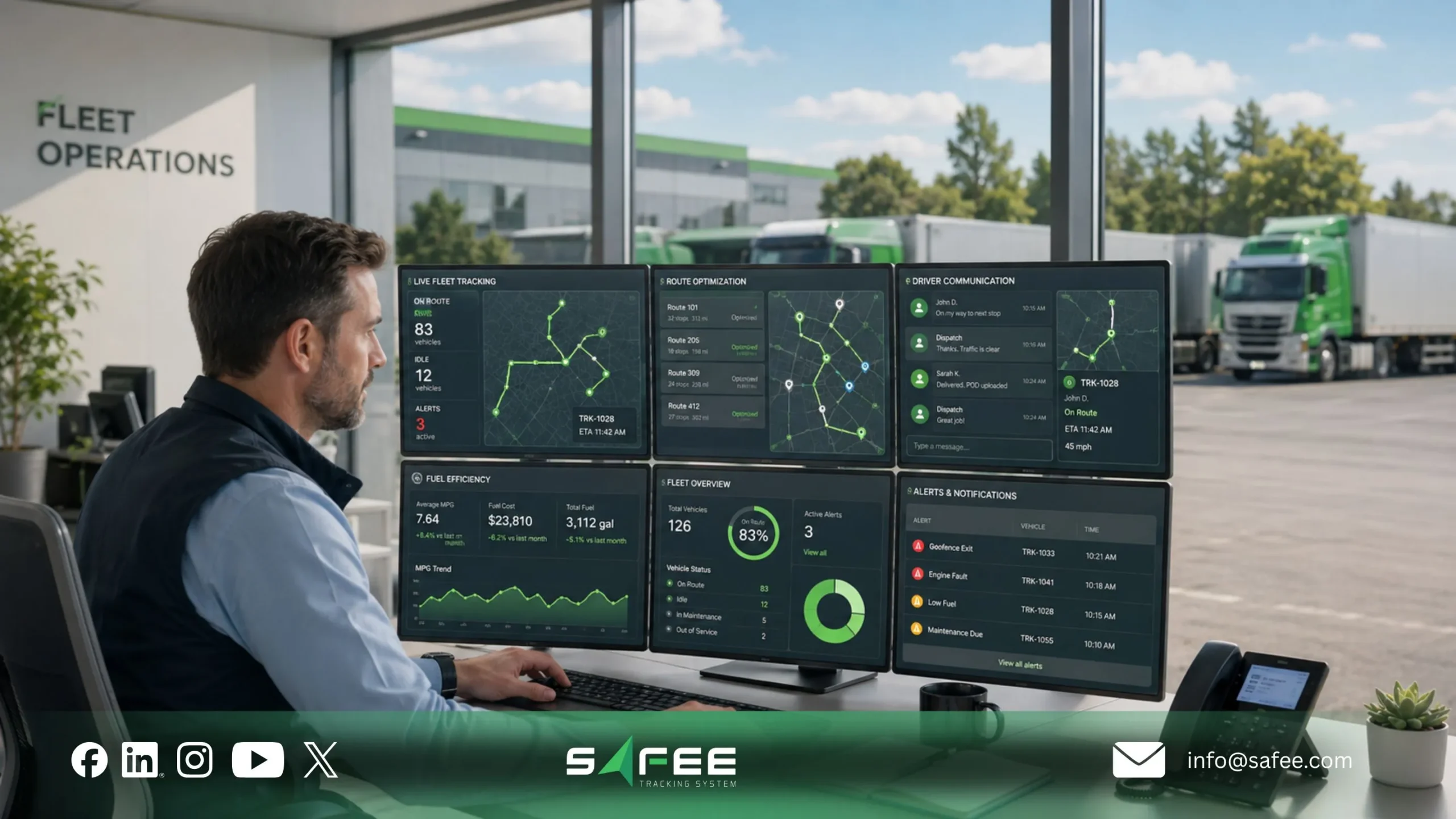
Truck fleet management services are the tools and workflows that help companies control trucks, drivers, routes, maintenance, safety, alerts, and reports from one connected system. For fleet managers, the value is not just knowing where a truck is; it is knowing what needs action now, who should handle it, and how the issue affects delivery, safety, cost, or uptime.
In GCC truck operations, this matters because vehicles often move between depots, ports, industrial zones, construction sites, customer locations, and long intercity routes. A strong fleet management for trucks setup should help teams spot delayed routes, risky driving, idle time, missed maintenance, fuel issues, and repeated exceptions before they turn into bigger operational problems.
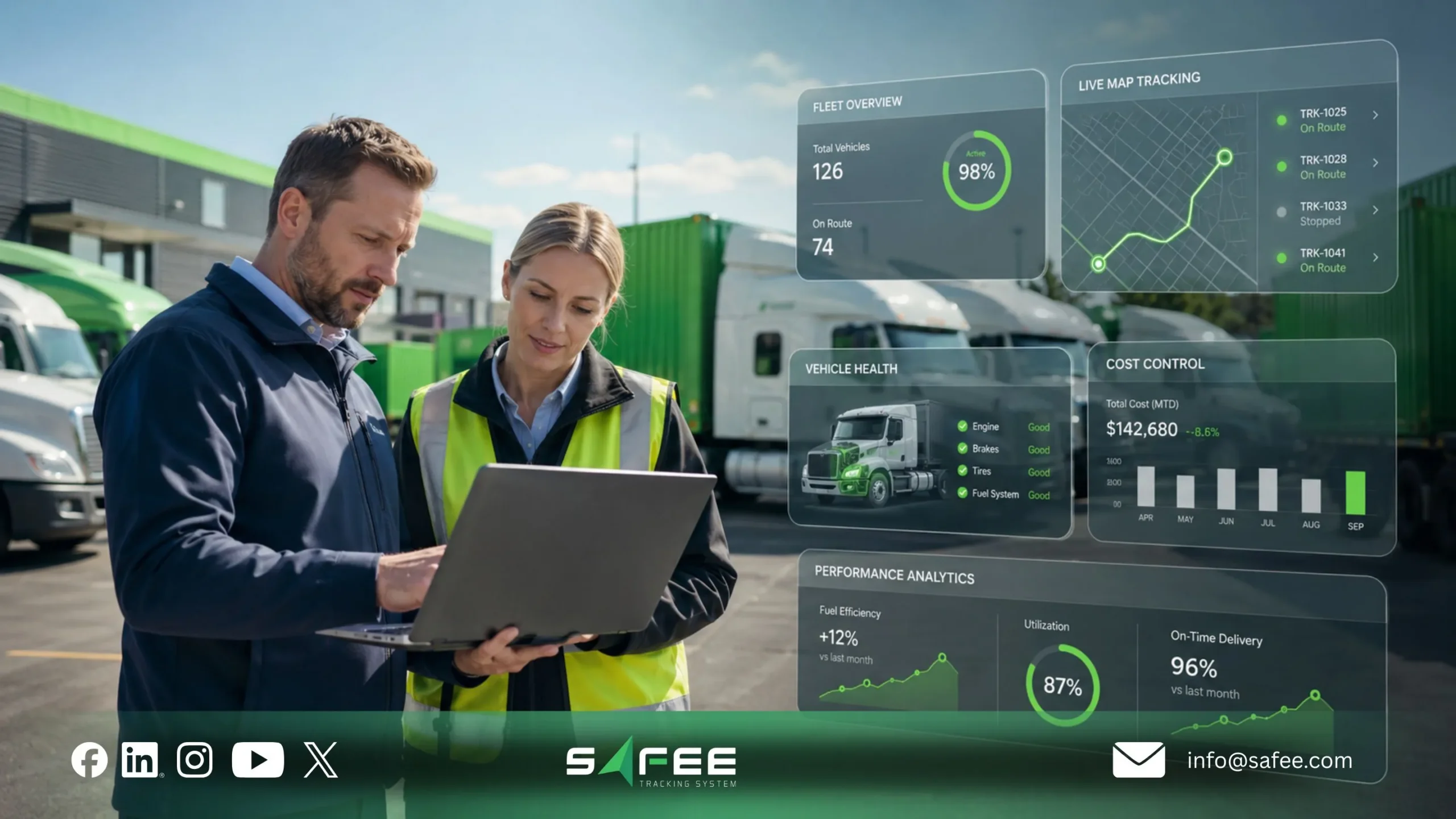
At Safee, we help commercial truck fleets connect live tracking, driver safety, maintenance alerts, route visibility, sensor data, and Fleet Reporting in one workflow. This gives managers a clearer view of daily operations and helps teams move from reactive follow-up to better control.
Truck fleet management services vs basic GPS tracking
Basic GPS tracking tells you where the truck is. Truck fleet management services tell you what is happening, what needs action, and who should respond. This is the real difference for growing commercial truck fleets.
Location alone may be enough for a very small fleet, but it is not enough when your trucks run across depots, ports, industrial zones, construction sites, customer locations, and long GCC routes. Fleet managers need more than a map; they need alerts, trip history, driver behavior data, maintenance signals, route exceptions, reports, and clear workflow ownership.
A basic tracker may show that a truck is delayed. A full fleet truck management platform helps your team understand why: route deviation, long stop, driver behavior, maintenance issue, customer-site delay, or weak dispatch planning. This turns visibility into action.
At Safee, we help truck fleets move beyond basic tracking by connecting live vehicle visibility with alerts, driver safety, maintenance follow-up, route monitoring, sensors, and Fleet Reporting in one workflow.
Still relying on tracking only? Talk to Safee about building a truck fleet management setup that helps your team act faster, reduce blind spots, and review performance with clearer data.
Also read: Truck Fleet Management in the GCC: Why Weight Monitoring Matters
Who does need fleet management for trucks in the GCC?
Fleet management for trucks is needed by any GCC company where truck availability, driver safety, route control, and service reliability directly affect revenue. It becomes especially important when the fleet grows across multiple depots, routes, customer sites, or truck types that are difficult to manage manually.
Companies that benefit most include:
- Logistics and distribution fleets that need live route visibility, delivery status, driver accountability, and clearer reports for customers and operations teams.
- Construction and infrastructure fleets that need to control truck movement between project sites, monitor utilization, reduce idle time, and follow up on maintenance and safety alerts.
- Oil and gas support fleets that need journey visibility, driver monitoring, harsh-route controls, remote-route awareness, and structured HSE reporting.
- Heavy truck fleet management teams that need stronger maintenance discipline, tire or weight-related visibility where relevant, route control, driver behavior monitoring, and alert ownership.
- Semi truck fleet management teams running long-haul or tractor-trailer operations where route visibility, trailer context, driver assignment, and trip history must stay connected.
- Tow truck fleet management teams that need live dispatch visibility, faster response coordination, driver accountability, and clearer service records.
- Companies starting fleet management with new commercial vehicles that want every new truck onboarded correctly from day one with vehicle profiles, driver assignments, alerts, service schedules, and reporting access.
Our platform helps these truck fleets connect live tracking, alerts, driver safety, maintenance follow-up, route monitoring, sensors, and Fleet Reporting in one workflow, so managers can control daily operations instead of reacting after problems happen.
So do not hesitate to book a consultation with our experts to manage your mixed truck operations across the GCC and structure your fleet visibility, alerts, reports, and maintenance workflows around your actual truck types and routes.
Core features to compare in truck fleet management services
The right truck fleet management services should help your team control what happens before, during, and after every trip. Do not compare providers by hardware alone; compare how well the system helps you manage visibility, safety, maintenance, routes, reports, alerts, and specialized truck needs.
Real-time truck visibility
Real-time visibility helps dispatchers and fleet managers see where each truck is, whether it is moving, delayed, idle, off-route, or close to a customer site. For GCC fleets moving between depots, ports, industrial zones, construction sites, and long intercity routes, this is the base layer of control.
For this part, review our Live Vehicle Tracking module because it supports real-time location, driver identity, alarm status, geofence compliance, and fleet performance visibility.
Driver safety and video IVMS
Driver safety is a core part of fleet management for trucks because one risky event can affect people, cargo, service continuity, and customer trust. A strong setup should help teams monitor speeding, harsh braking, harsh acceleration, idling, route deviation, and repeated driver-risk patterns.
Where visual context is needed, our Video IVMS can support event review and driver coaching. For driver assignment and behavior visibility, check our Driver Management module.
Maintenance, TPMS, and uptime control
Truck downtime is not only a maintenance issue; it can delay deliveries, disrupt projects, and increase pressure on dispatch teams. Truck fleet management services should help managers track service schedules, open defects, maintenance alerts, tire-related risks, and roadworthiness before trucks are assigned to work.
It is recommended to explore our Maintenance Module for service tasks and alerts, and to the TPMS Guide where tire pressure monitoring is relevant to truck operations.
Fuel, route, and utilization reports
Reports should help leaders understand whether trucks are being used efficiently. The most useful reports show idle time, trip history, route behavior, recurring delays, underused trucks, fuel-related patterns, maintenance status, and driver performance trends.
For services that can turn daily fleet data into management decisions, check our Fleet Reporting module and Fuel Control
Alerts, sensors, and compliance workflows
Alerts should not go to everyone for everything. Good truck fleet management services let teams define alert owners, urgency levels, escalation rules, and closure actions. For specialized fleets, sensors may also support cold chain, tire pressure, weight visibility, door status, fuel level, or cargo condition monitoring.
Keep compliance wording careful: the platform can support compliance workflows through data, alerts, reports, and documentation visibility, while exact requirements should be verified by country, industry, vehicle type, and operating model. Here are our Alarms and Alerts and Advanced Modules pages.
Not sure which features your truck fleet actually needs? Talk to Safee about all our modules and learn more about what feature your team needs more for better fleet performance
Also read: Fleet Management Audit Checklist for GCC Long-Haul Trips
Truck fleet management services by fleet type
Different truck fleets need different configurations. The platform may be shared, but dashboards, alerts, sensors, reports, and governance rules should match the operating model.
Fleet type | What matters most | Safee-fit workflow |
Commercial truck fleet management | Delivery visibility, route discipline, driver safety, customer service reporting, utilization. | Live tracking, geofences, driver events, Fleet Reporting, route review. |
Heavy truck fleet management | Maintenance discipline, high-load routes, tire condition, driver behavior, operational risk. | Maintenance Module, TPMS, alerts, driver monitoring, weight-related visibility where applicable. |
Semi truck fleet management | Long-haul visibility, tractor-trailer movement, route history, stop patterns, driver accountability. | Journey Management, route alerts, trip history, driver reports, management dashboards. |
Tow truck fleet management | Fast dispatch, live truck availability, response coordination, driver assignment, service records. | Live Vehicle Tracking, driver assignment, alerts, mobile visibility, reporting. |
Fleet management with new commercial vehicles | Clean onboarding, vehicle profiles, service schedules, driver assignment, baseline reports. | Vehicle setup, driver records, maintenance schedules, alerts, reporting cadence from day one. |
The goal is not to buy the most complex setup; it is to build the simplest setup that gives managers enough control to make better daily decisions.
How to choose truck fleet management services for GCC operations?
Choosing a provider should feel like choosing an operating partner, not just choosing hardware. Start with the work your trucks do every day and the decisions your managers need to make faster.
- Map your truck types: light trucks, commercial vehicles, heavy trucks, semi trucks, tow trucks, refrigerated trucks, or specialized vehicles.
- Define your biggest operating gaps: delayed updates, weak driver visibility, missed maintenance, fuel waste, route deviation, customer complaints, or poor reporting.
- List the alerts that matter: speeding, harsh driving, long stops, geofence breaches, unauthorized use, temperature, tire pressure, or maintenance events.
- Decide who owns each workflow: dispatch, HSE, maintenance, operations, finance, or senior management.
- Confirm reporting needs: daily operations, weekly reviews, monthly leadership reports, customer evidence, or compliance support.
- Check integration and scalability needs before the fleet grows across depots, regions, or business units.
Questions to ask before you choose a provider?
- Can the platform support our truck types and use cases?
- Can alerts be configured by route, depot, vehicle group, driver group, severity, or operating team?
- Can we review driver behavior, route history, maintenance, fuel, and reports in one workflow?
- Which sensors and modules can be added later without rebuilding the whole system?
- Can reports be scheduled and exported for operations, HSE, finance, and leadership?
- Can the provider support GCC operating conditions and multi-site fleet growth?
How Safee supports truck fleet management services?
At Safee, we support GCC commercial truck fleets by connecting vehicles, drivers, routes, alerts, maintenance, sensors, and reports into a practical operating workflow.
Our value is not only showing truck location. It is helping teams move from scattered follow-up to clearer control through:
- Live Vehicle Tracking for real-time location, route visibility, geofences, alarm status, and performance data.
- Alarms and Alerts for speeding, geofence breaches, unauthorized use, maintenance events, harsh driving, and other configurable exceptions.
- Fleet Reporting for scheduled reports, performance reviews, utilization analysis, and management visibility.
- Maintenance Module for service schedules, maintenance alerts, and roadworthiness follow-up.
- Driver Management for driver records, assignment visibility, behavior monitoring, and accountability.
- Journey Management System for trip planning, route monitoring, journey controls, and post-journey review.
- Video IVMS for camera-based event context and driver safety workflows where needed.
For a related truck-specific topic, read our guide on Truck Fleet Management in the GCC, which explains how weight monitoring can improve safety, compliance workflows, and risk control for truck fleets.
Talk to a fleet expert to evaluate your truck fleet management services requirements and build a GCC-ready setup for visibility, safety, alerts, reports, and scalable operations.
Implementation plan for truck fleet management services
A strong rollout should be treated as a fleet operations project. Do not install devices first and define the workflow later. Set the rules, owners, alerts, and reports before the system goes live.
- Audit current gaps: Review fleet size, truck types, routes, driver risks, maintenance gaps, reporting issues, and compliance support needs.
- Select modules and hardware: Match GPS, telematics, Video IVMS, sensors, TPMS, cold chain tools, alerts, and reports to real decisions.
- Pilot before scaling: Test the platform with selected trucks, routes, depots, and teams before expanding across the fleet.
- Train managers and drivers: Explain what is monitored, why it matters, who reviews alerts, and how coaching or corrective action works.
- Review KPIs monthly: Track utilization, downtime, driver behavior, route performance, alert volume, maintenance adherence, and reporting quality.
This staged approach keeps the program practical. It gives teams enough structure to improve operations without overwhelming dispatchers or drivers with unnecessary data.

FAQs about truck fleet management services
What Do Truck Fleet Management Services Include?
Truck fleet management services usually include GPS tracking, telematics, driver behavior monitoring, configurable alerts, maintenance workflows, fleet reports, dashboards, optional sensors, and operational support for commercial truck fleets.
How Are Truck Fleet Management Services Different From GPS Tracking?
GPS tracking shows vehicle location. A full truck fleet management service supports decisions through alerts, reports, driver safety visibility, maintenance follow-up, sensor data, route history, and management dashboards.
What Should Fleet Management for Trucks Include?
Fleet management for trucks should include live tracking, driver safety monitoring, maintenance alerts, fuel and utilization reporting, route visibility, geofencing, scalable dashboards, and compliance support workflows where applicable.
Is Safee Suitable for Commercial Truck Fleet Management?
Yes. Safee is suitable for commercial truck fleet management use cases across logistics, construction, oil and gas, government, heavy transport, tow operations, and specialized commercial fleets in the GCC.
Do Heavy Trucks Need Different Fleet Management Features?
Heavy truck fleet management often needs stronger focus on uptime, maintenance, driver risk, tire conditions, route control, load-related visibility where applicable, and escalation workflows for operational exceptions.
Can Truck Fleet Management Services Support GCC Compliance?
They can support compliance workflows by organizing data, alerts, reports, documents, and integrations. Specific requirements should still be verified by country, industry, vehicle type, and operating model.
Ready to improve your fleet operations?
Tell us what you would like to improve. A Safee specialist will reply by email.
Usually replies within one business day • No sales spam
Your details are used only to respond to your request. Privacy Policy