

5 Steps to Set Up Fleet Management in UAE for Logistics

A new logistics company in the UAE can win customers quickly and still lose control before the fleet reaches scale. One expired vehicle document, one unassigned driver, one weak route rule, one missed maintenance alert, or one unclear reporting process can turn daily deliveries into delays, fines, fuel waste, and customer complaints. For founders and fleet managers, fleet management in UAE should be treated as a launch system, not an afterthought.
This guide shows what to set up before vehicles start moving: vehicle and driver records, dispatch rules, route visibility, fleet management requirements, maintenance workflows, alert ownership, reporting cadence, and a practical fleet management policy. It also explains how we at Safee support logistics fleet management new logistics companies building fleet management in the UAE.
Why does fleet management in UAE shape a logistics launch?
Fleet management in the UAE shapes a logistics launch because it decides how vehicles, drivers, documents, routes, alerts, and reports work together from day one. A company may begin with a small number of vans, trucks, motorcycles, or delivery vehicles, but the operating complexity increases quickly once orders, branches, drivers, and customer locations grow.
For a new logistics business, the first mistake is to think that tracking vehicles is enough. Tracking is useful, but launch control needs more than a map. The fleet team must know which vehicle is allowed to operate, which driver is eligible, which route is approved, which document is valid, which alert needs action, and which report proves the operation is improving.
A strong launch setup helps answer practical questions:
- Which vehicles are active, unavailable, delayed, or blocked from dispatch?
- Which drivers are approved for each vehicle type and delivery route?
- Which documents, permits, or customer access rules must be checked before dispatch?
- Which alerts require immediate response from dispatch, operations, HSE, or maintenance?
- Which reports should founders and fleet managers review daily, weekly, and monthly?
For a related compliance view, read our Fleet Management Regulations in the GCC guide to understand how operational controls, document checks, and fleet safety workflows connect across Gulf markets.
What does fleet management in UAE mean before first dispatch?
Fleet management in the UAE means building a controlled workflow before the first trip leaves the yard. The launch workflow should connect vehicles, drivers, routes, documents, safety checks, maintenance tasks, customer commitments, alerts, and reporting in one operating rhythm.
In practical terms, a UAE logistics company should not ask only, “Where is the vehicle?” It should ask, “Is this vehicle ready, is the driver approved, is the route controlled, and can the team prove what happened if something goes wrong?”
The first launch model should include:
- Vehicle master records: Plate number, vehicle class, registration, insurance, branch, assigned driver, and operating purpose.
- Driver master records: Driver identity, license category, contact details, assigned vehicles, policy acknowledgement, and training status.
- Trip and route controls: Approved zones, delivery windows, geofences, customer sites, and escalation contacts.
- Maintenance workflow: Service schedules, open defects, inspection records, and unresolved issue follow-up.
- Alert governance: Which alerts matter, who receives them, how fast they respond, and what closes the issue.
- Reporting cadence: Daily operations view, weekly fleet review, and monthly management reporting.
Our Live Vehicle Tracking module supports real-time visibility and connects live data with operational tools such as alerts, reporting, driver monitoring, fuel management, and maintenance workflows.
Starting a logistics fleet in the UAE? Request a Safee demo to map your vehicle records, driver setup, route controls, alerts, and fleet reports before launch.

How does logistics fleet management protect profitability?
Logistics fleet management protects profitability because most fleet costs are created by daily operating decisions. Poor dispatching, idle time, duplicated routes, weak maintenance follow-up, fuel waste, unsafe driving, missed delivery windows, and manual reporting can all reduce margin even when order volume is growing.
At launch, founders often solve problems manually. That works for a few vehicles, but it becomes fragile when the business operates across Dubai, Abu Dhabi, Sharjah, warehouses, ports, free zones, customer sites, and intercity routes.
Reliable logistics fleet management should help teams:
- Assign the right vehicle to the right delivery route.
- Keep maintenance issues visible before defects create downtime.
- Keep documents, approvals, alerts, and corrective actions traceable.
- Reduce unnecessary mileage, idle time, and repeated failed trips.
- Detect unsafe driving before it becomes a repeated behavior pattern.
- Review route completion, customer delays, missed jobs, and service performance.
- Match drivers to license category, route type, workload, and customer expectations.
A logistics company becomes scalable when every vehicle, driver, route, and delivery produces usable evidence. That evidence helps managers reduce waste, improve service quality, and make cost decisions based on what actually happens in the fleet.
Fleet management in Dubai setup before launch
Fleet management Dubai setup should be ready before the first operational day if the company will serve dense urban zones, customer sites, ports, warehouses, industrial areas, or multi-emirate routes. Dubai operations can move fast, but speed without control creates avoidable risk.
The launch setup should include people, policy, data, tools, and review routines. A founder should not wait for the first missed delivery, expired document, driver complaint, or maintenance issue before building the process.
Setup area | What to define before launch | Why it matters |
Vehicle file | Vehicle type, plate, ownership or lease status, registration, insurance, inspection status, branch | Prevents uncontrolled dispatch and document gaps |
Driver file | Driver identity, license category, contact details, assigned vehicle, training, policy acknowledgement | Supports eligibility and accountability |
Dispatch rules | Who assigns trips, who approves changes, what blocks dispatch | Reduces last-minute confusion |
Route controls | Approved zones, customer locations, restricted areas, geofences, route deviation rules | Improves route discipline and visibility |
Maintenance workflow | Service schedules, open defects, inspection records, escalation rules | Protects uptime and roadworthiness |
Alert governance | Alert types, recipients, severity levels, response ownership | Prevents alert noise and missed exceptions |
Reporting cadence | Daily dashboard, weekly operations review, monthly management review | Turns data into decisions |
Our Alarms and Alerts module helps fleet managers receive instant notifications and organize exception handling across different alert types.
Fleet management requirements for UAE logistics companies
Fleet management requirements in the UAE should be treated as a compliance matrix, not a generic checklist. Requirements may vary by emirate, business activity, vehicle class, cargo type, customer site, and whether the company operates across borders.
For a new logistics company, the operational foundation should verify both legal readiness and internal control. This article is not legal advice, so fleet managers should confirm activity-specific requirements with the relevant authority, legal advisor, or compliance owner before launch.
A practical UAE launch matrix should include:
- Business activity and transport-related permissions.
- Vehicle registration, insurance, and inspection status.
- Driver license category and assignment eligibility.
- Vehicle class, permitted use, and route suitability.
- Cargo documents, waybills, delivery notes, or customer-specific paperwork.
- Load securing, load covering, and vehicle condition checks where relevant.
- Special requirements for refrigerated, hazardous, heavy, industrial, or specialized transport.
- Data privacy and role-based access for driver, vehicle, and customer information.
- Customer, HSE, or management reporting obligations.
The strongest setup converts each requirement into an operational rule. For example, document expiry becomes an alert. The driver license category becomes an assignment rule. Route restrictions become geofences and route deviation alerts. Maintenance readiness becomes a no-dispatch control.
For additional context on moving away from manual control, see our article on Excel Fleet Management, which explains where spreadsheets can work and where they become limiting for growing fleets.
Need a UAE-specific launch review? Talk to us about aligning driver records, vehicle documents, alerts, reports, and fleet management requirements around your logistics operation.
A fleet management policy for logistics operations
A fleet management policy is the written rulebook that turns leadership expectations into daily action. It should be practical enough for dispatchers, drivers, supervisors, and maintenance teams to use under operating pressure.
For a UAE logistics company, a strong fleet management policy should define:
- Maintenance reporting and defect escalation.
- Fuel use, refueling, idling, and misuse escalation.
- Driver eligibility, license rules, and training expectations.
- Accident, breakdown, delay, and emergency procedures.
- Data access, reporting cadence, and management review.
- Vehicle assignment, authorized use, and no-dispatch conditions.
- Speeding, harsh driving, fatigue, seat belt, and mobile phone rules.
- Corrective actions, driver coaching, and repeat exception handling.
- Route adherence, geofence, stop-point, and customer-site expectations.
- Rules for missing documents, unresolved critical defects, and unapproved routes.
The policy should also define alert governance. Alert governance decides which alerts matter, who receives them, how quickly they should respond, and how the issue is closed. Without alert governance, fleet software can become noisy. With alert governance, alerts become a daily control tool.
Our Fleet Reporting can support the review side of this policy by helping teams organize performance, compliance, and operational reports.
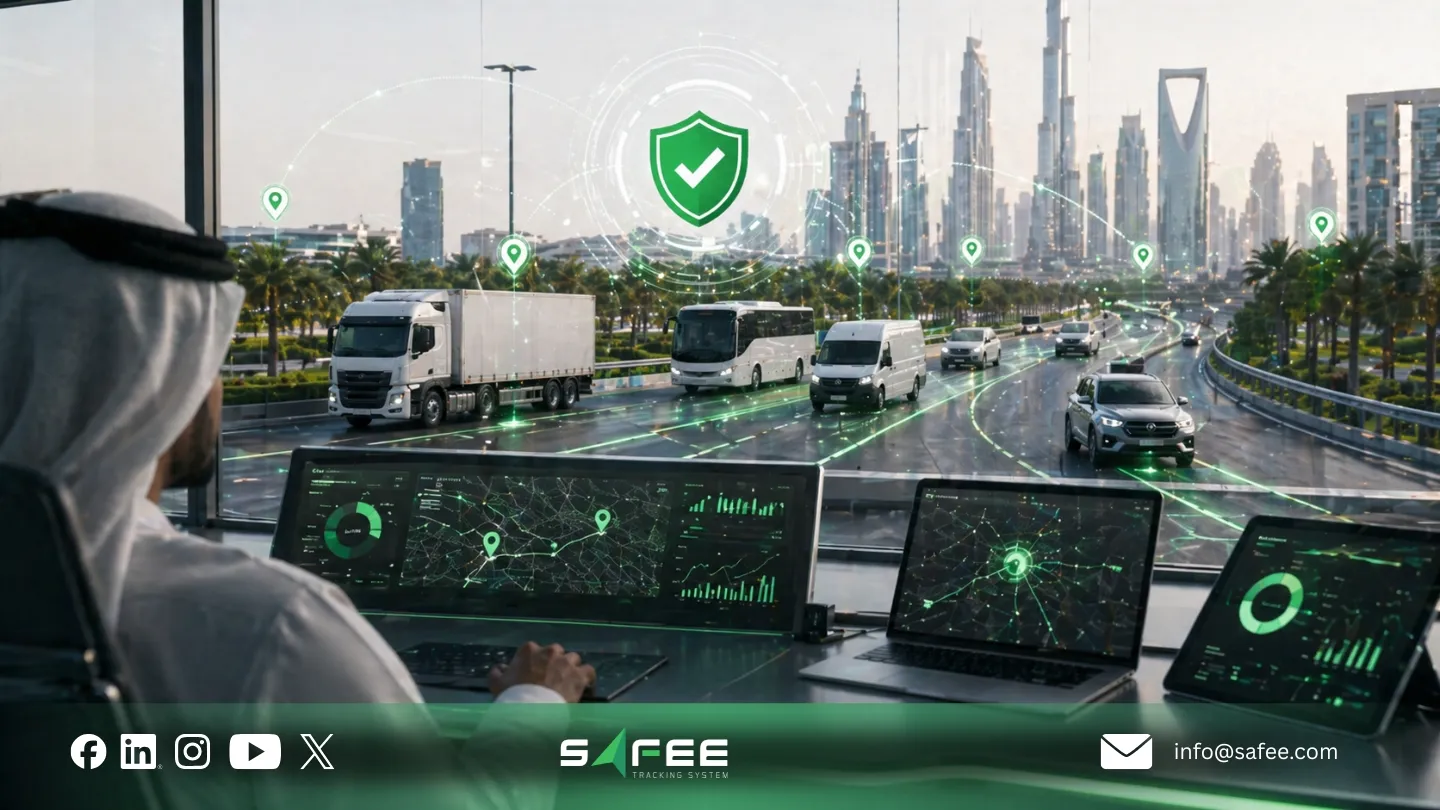
How to activate fleet management in the UAE in 5 practical stages
Activating logistics fleet management should happen in stages. A new company does not need every advanced workflow on day one, but the first version must be strong enough to control vehicles, drivers, documents, routes, alerts, and reports.
1. Vehicle onboarding under fleet management requirements
Vehicle onboarding should create a complete profile before the vehicle enters active dispatch. This prevents new fleets from running vehicles that are technically available but operationally incomplete.
- Plate number and vehicle identification.
- Vehicle type, class, capacity, and operating purpose.
- Registration, insurance, and inspection dates.
- Branch, depot, or operating zone.
- Assigned driver or eligible driver pool.
- Fuel type and fuel reporting needs.
- Maintenance schedule and service history.
- Installed tracking device or telematics source.
- Cold chain, weight, tire pressure, or other sensor needs where relevant.
Our Maintenance Module can help connect vehicle setup with service schedules, maintenance alerts, and follow-up tasks.
2. Driver compliance and fleet management policy enforcement
Driver setup should support assignment, coaching, review, and accountability. Drivers should not be managed only through phone calls and informal messages once the fleet starts scaling.
- License category and validity.
- Driver behavior review history.
- Training or onboarding completion.
- Coaching notes and corrective actions.
- Assigned vehicle or eligible vehicle types.
- Fleet management policy acknowledgement.
- Customer-site or route-specific approval where required.
- Driver name, ID reference, contact method, and emergency contact.
Policy enforcement should be visible. If speeding, harsh braking, harsh acceleration, route deviation, unauthorized stops, or long idle time occurs, supervisors should be able to see the event, assign follow-up, and review repeat behavior.
For stronger driver assignment control, our Driver Identification System blog explains how trips and violations can be connected to the correct driver in real time.
Want to turn your fleet management policy into daily control? Book a Safee implementation consultation to configure driver rules, alerts, escalation owners, and reporting for your UAE logistics team.
3. Route control and fleet management Dubai reporting
Daily fleet management Dubai operations should be built around live control, not delayed problem solving. Dispatchers and fleet managers should know what to review every day before customers begin chasing updates.
A useful daily operations view should include:
- Vehicles active, parked, delayed, or unavailable.
- Trips in progress and completed.
- Route deviations and geofence events.
- Overspeeding, harsh driving, and long stops.
- Missing documents or open dispatch exceptions.
- Maintenance alerts and unresolved defects.
- Fuel or idling exceptions where configured.
- Customer delays and missed delivery windows.
- Alerts acknowledged, closed, or still open.
If trips need formal planning and monitoring, our Journey Management System can support route approval, active journey monitoring, driver behavior visibility, and delay detection.
4. Reporting cadence for UAE logistics managers
Reports should be grouped by audience. A founder does not need the same report as a dispatcher, and a dispatcher does not need the same view as finance or HSE.
Team | What they need to review | Why it matters |
Dispatch | Live trips, route deviations, late arrivals, open alerts | Improves same-day control |
Fleet manager | Vehicle use, driver behavior, maintenance, routes, exceptions | Supports operational decisions |
HSE / safety | Speeding, harsh events, incidents, corrective actions | Improves safety follow-up |
Finance / leadership | Utilization, fuel, service reliability, cost indicators | Shows whether growth is profitable |
Compliance owner | Document status, audit trail, exception closure | Improves evidence and governance |
Daily dashboards help supervisors act quickly. Weekly reports help operations managers fix routes, drivers, and availability issues. Monthly reviews help founders understand whether the business is scaling with control.
5. Optimization after the first operating baseline
Optimization should begin after the fleet has enough real data. Once vehicles, drivers, routes, and reports are active, the company can review route overlap, idle time, underused vehicles, repeat delays, fuel patterns, maintenance pressure, and driver workload.
The key is to improve from the company’s own baseline, not from generic benchmarks. Safee helps teams turn live fleet activity into clearer evidence so decisions about route planning, driver coaching, maintenance, and customer service are based on actual operating data.
For long-haul or structured trip review, our Fleet Management Audit Checklist for GCC Trips is a useful related guide for teams that need more dispatch discipline and post-trip review.

Why choose Safee for fleet management in the UAE?
Choosing Safee for fleet management in UAE means choosing a platform approach that connects live visibility, alerts, reporting, driver management, maintenance follow-up, journey control, and operational governance.
For a new logistics company, the value is not only seeing vehicle locations. The value is building a launch-ready operating model: onboard vehicles correctly, verify drivers, approve routes, monitor trips, act on alerts, review reports, and improve performance with evidence.
At Safee, we support UAE logistics teams through:
- Live Vehicle Tracking: real-time location, geofences, trip activity, alarms, fuel, and performance data.
- Alarms and Alerts: route, safety, maintenance, and operational exception notifications.
- Fleet Reporting: scheduled reports, compliance summaries, performance review, and audit evidence.
- Journey Management System: planned routes, approvals, monitoring, and trip-level governance.
- Maintenance Module: service schedules, maintenance alerts, unresolved defects, and roadworthiness follow-up.
- Mobile App: remote visibility for managers and supervisors who need to act away from the office.
- Tracking Data Analyzer: deeper insight from vehicle tracking data and performance patterns.
Visit our fleet management platform to explore the full system and modules for logistics, transport, delivery, construction, oil and gas, government, and other B2B fleet sectors.
Logistics fleet management across UAE operations
For logistics teams in the UAE, Safee helps structure daily fleet workflows across vehicles, drivers, routes, alerts, reports, and maintenance tasks. For companies expanding beyond the UAE, the same operating discipline can support wider GCC and global fleet operations.
For UAE and GCC operations, Safee can help teams structure:
- Vehicle onboarding and document visibility.
- Driver assignment and driver behavior monitoring.
- Route monitoring, geofences, and deviation alerts.
- Delivery-zone and customer-site visibility.
- Maintenance alerts and roadworthiness follow-up.
- Scheduled reports for operations and leadership.
- Exception review for repeated issues.
- Evidence-based improvement across vehicles, drivers, and routes.
From launch control to measurable improvement
The safest way to discuss results is to measure them inside your own fleet. Safee should be used to create baseline data, track changes, and prove improvement through ongoing review rather than relying on generic claims.
KPI group | What to track | Why it matters |
Utilization | Active time, parked time, trips per vehicle | Shows whether assets are being used well |
Route performance | Route adherence, deviations, completion time | Improves planning and delivery reliability |
Driver behavior | Speeding, harsh braking, harsh acceleration, long stops | Supports safety and coaching |
Maintenance | Open defects, service tasks, downtime | Protects uptime and readiness |
Fuel and idling | Idle time, fuel events, consumption patterns | Helps control operating cost |
Service | On-time completion, missed jobs, customer delays | Protects customer retention |
Governance | Alerts closed, reports reviewed, corrective actions completed | Shows whether the system is managed |
Build your fleet management in UAE launch workflow with Safee. Request your demo to align vehicles, drivers, routes, policies, alerts, reports, and compliance controls before your logistics operation scales.
FAQs about fleet management in UAE
What are the first fleet management requirements for a UAE logistics company?
The first fleet management requirements include business activity verification, vehicle registration and insurance tracking, driver license category checks, vehicle readiness checks, cargo and delivery document control, route rules, maintenance workflow, driver policy, alerts, and reporting. Exact requirements should be verified by emirate, activity type, vehicle class, and cargo type.
How does fleet management Dubai differ from other UAE operations?
Fleet management Dubai may involve different activity processes, traffic density, delivery timing, customer-site rules, port or free-zone requirements, and authority processes compared with other emirates. Companies operating across Dubai and wider UAE routes should configure location-specific checks, geofences, reports, and document controls.
What should a logistics fleet management policy include?
A logistics fleet management policy should include driver eligibility, vehicle assignment, no-dispatch rules, route adherence, safety behavior, fuel use, maintenance reporting, customer delivery conduct, document checks, alert response, escalation ownership, data access, reporting cadence, and corrective actions.
Why use software for fleet management in the UAE?
Software helps fleet management in UAE teams move from manual follow-up to live operational control. It can connect vehicle tracking, driver records, smart alerts, fleet reporting, maintenance workflows, geofences, trip monitoring, and audit trails so founders and fleet managers can control daily logistics operations with clearer evidence.
How can Safee support new logistics fleet management?
Safee can support new logistics fleet management by helping teams connect vehicles, drivers, routes, alerts, reports, maintenance tasks, and management review in one operating workflow. The best setup depends on fleet size, routes, vehicle types, delivery model, reporting needs, and compliance requirements.
Ready to improve your fleet operations?
Tell us what you would like to improve. A Safee specialist will reply by email.
Usually replies within one business day • No sales spam
Your details are used only to respond to your request. Privacy Policy