



How to Choose a GPS Fleet Tracking System: 8 Tests Before Buying
A GPS fleet tracking system can look convincing in a controlled demonstration and still fail once it reaches real operations. The gaps usually appear where buyers feel them most: mixed vehicle types, weak-connectivity routes, delayed records after coverage returns, excessive alerts, unclear user permissions, reports that do not match operational questions, or integrations that work only under ideal conditions. By then, devices may already be installed, contracts signed, and internal teams committed to a rollout that is harder and more expensive to correct.
In this buyer-focused guide, we at Safee explain how to define requirements, validate architecture, run a representative pilot, conduct a GPS fleet tracking system reliability comparison, review contract terms, and roll out the platform in controlled phases. From our UAE base, we support Fleet Managers, Operations, HSE, Logistics, Oil & Gas, Cold Chain, and Government teams across the GCC and wider international markets. Our focus is a complete fleet management platform that connects tracking with alerts, reporting, journey control, analytics, mobile access, and accountable action, not a standalone GPS device.
Define the scope of a GPS fleet tracking system
Procurement should begin with the operating decisions the system must support, not with a generic list of tracker specifications. A useful scope states which vehicles and assets are included, which teams will use the system, which events require intervention, which records must be retained, and which outputs must reach operations, HSE, maintenance, finance, customers, or leadership.
For a multi-site GCC or international fleet, the scope should also separate shared requirements from local deployment conditions. A UAE urban delivery fleet, a Saudi intercity operation, an oil and gas fleet working around remote industrial sites, and a global cold-chain network may use the same platform while requiring different devices, connectivity options, sensors, alerts, access roles, and reporting workflows.
Before issuing an RFP, define five internal boundaries: the vehicles and assets in scope, the operational decisions the platform must support, the users who need access, the required data and integrations, and the responsibilities for implementation. These boundaries should be approved internally before suppliers are asked to propose devices, modules, alerts, reports, or services.
For a broader explanation of connected vehicle data and telematics architecture, review our telematics fleet management guide. This article remains focused on procurement, validation, acceptance, and rollout.
7 RFP requirements for GPS fleet tracking systems
A request for proposal should make competing responses comparable. Avoid questions such as “Do you provide real-time tracking?” that invites a yes-or-no answer. Ask vendors to describe the supported scenario, required hardware, configuration, limitations, evidence, responsibilities, and acceptance method for each requirement.
- Fleet and asset compatibility: Require a compatibility matrix for every vehicle and asset category. The response should identify the proposed device, connection method, required data sources, installation approach, accessories, and known limitations.
- Operational use cases and acceptance criteria: Define the real decisions the tracking system for fleet operations must support. Each use case should have an owner, input, expected output, response time, and pass/fail criterion. Examples include route deviation intervention, after-hours movement, missed site arrival, or identifying an offline unit before dispatch.
- Update, event, and offline behavior: Require documented rules for live updates, event generation, offline storage, delayed-data visibility, and synchronization after connectivity returns. Each requirement should include a measurable acceptance method.
- Users, permissions, and fleet hierarchy: Require a role-based permission matrix covering vehicle groups, branches, live location, history, reports, exports, alerts, commands, configuration, and administration.
- Alerts, reports, and action workflows: Name the alerts and management reports required for the first rollout phase. For every alert, define recipient, escalation, acknowledgment, investigation, closure, and reporting. For every report, define audience, frequency, filters, format, and management decision.
- Data access and integrations: Identify the required APIs, exports, authentication methods, and enterprise integrations. Require field-level documentation, unique identifiers, data ownership responsibilities, and a method for reconciling records between systems.
- Implementation, support, and lifecycle services: Request a project plan covering survey, device selection, installation quality, configuration, testing, training, go-live support, warranty, device replacement, software changes, escalation, and exit assistance. Separate included services from optional or chargeable work.
When reporting requirements are central to the RFP, review our Fleet Reporting capabilities and define the exact scheduled records, filters, exports, and recipients needed during the pilot not after rollout.
Building an RFP for a multi-site fleet? Request Safee’s requirements workshop to map vehicles, users, routes, alerts, reports, and integrations before comparing proposals.
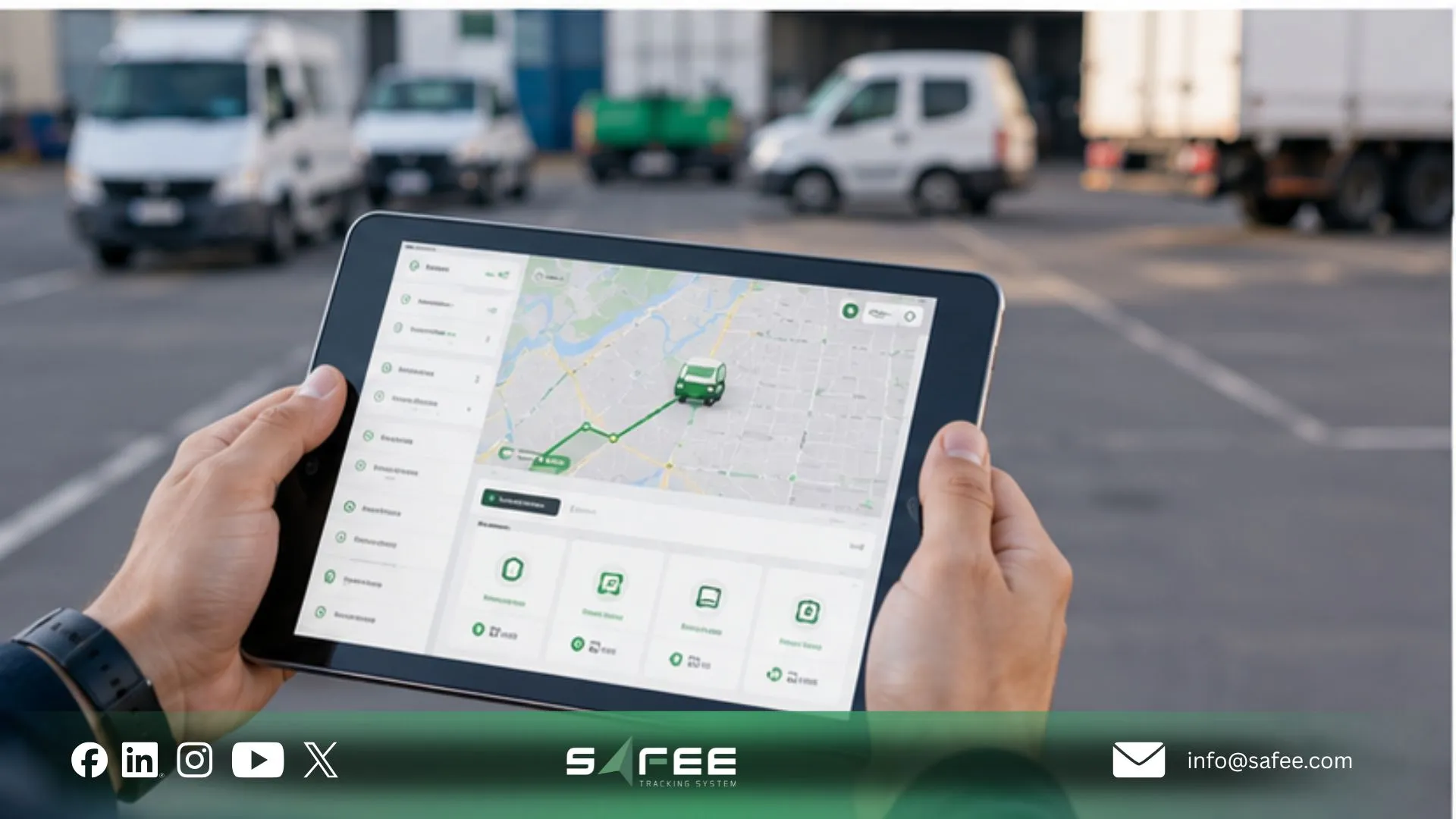
Technical checks for GPS fleet tracking system solutions
Technical evaluation should confirm whether the proposed architecture can support your operating model. The goal is not to collect the largest specification sheet. It is to identify dependencies, failure modes, and responsibilities before they become rollout problems.
Device Compatibility in a Tracking System for Fleet Vehicles
A tracking system for fleet vehicles should be validated against the actual fleet list. Vehicle age, voltage, ignition logic, installation location, available interfaces, original equipment manufacturer data access, sensors, accessories, and warranty constraints can all affect the design. A device that works well in one truck model may require a different harness, input mapping, or installation method in another.
- Require a compatibility matrix by vehicle or asset group, including power supply, connection method, required data fields, sensors, and known limitations.
- Confirm whether required engine or diagnostic fields depend on CANbus, original equipment manufacturer access, external sensors, or a separate integration.
- Validate installation controls for power stability, antenna placement, tamper risk, weather exposure, heat, vibration, and maintenance access.
- Define device commissioning evidence: device identity, vehicle identity, installation record, input tests, first communication, configuration version, and acceptance sign-off.
- Confirm firmware management, remote configuration, replacement stock, repair process, and the effect of a device change on historical records.
For trailers, generators, machinery, or non-powered assets, define the expected reporting behavior and battery life separately. Do not assume the same design used for road vehicles will meet every asset-tracking use case.
Offline Recovery in an Online Automatic Fleet Tracking System
The phrase online automatic fleet tracking system can hide an important distinction: the platform may be online while a vehicle temporarily cannot transmit. Buyers should test how the device stores records, how the server processes delayed uploads, and whether the historical journey remains usable after connectivity returns.
- How many records or operating hours can the device store under the proposed reporting rules?
- Are stored records uploaded with their original event time, sequence, and coordinates?
- How does the platform prevent duplicates, missing segments, or incorrect event order during recovery?
- Can users distinguish a current live position from a delayed or last-known position?
- Which dashboard, report, or alert shows communication health, delayed units, repeated outages, and recovered records?
For fleets operating on deserts, remote industrial routes, borders, or other low-coverage areas, evaluate whether cellular store-and-forward is sufficient or whether a secondary option such as Safee SatComm should be considered for specific vehicles and events. Coverage and continuity still depend on the selected devices, networks, environment, and project design.
Data access across GPS fleet tracking system solutions
Data access should be reviewed as a procurement requirement, not a future integration discussion. GPS fleet tracking system solutions may expose different fields, timestamps, statuses, identifiers, limits, and history through the user interface, exports, and APIs. Confirm which source is authoritative for every required record.
- Data ownership, authorized use, hosting location, access controls, and subcontractor responsibilities.
- Retention period for raw messages, processed trips, alerts, reports, audit logs, and integration records.
- Export formats, API endpoints, rate limits, field definitions, time zones, unique identifiers, and change notification process.
- User and administrator audit trails for configuration changes, exports, alert handling, and remote commands where enabled.
- Exit process for retrieving usable historical data and configuration records at contract end.
Pricing, retention, integration scope, connectivity, and hosting requirements should be confirmed for the specific fleet and operating market. Do not allow a proposal to treat these items as assumptions if they affect acceptance or total cost.
How to pilot an online automatic fleet tracking system
A pilot should reproduce operational complexity, not demonstrate that a tracker can appear on a map. Select a controlled sample that represents different vehicle types, routes, depots, connectivity conditions, user roles, and business processes. A small but diverse pilot is usually more useful than a larger pilot made up of identical vehicles on easy routes.
- Choose representative vehicles: Include the main vehicle and asset groups, older and newer models, high-use units, and any vehicles requiring sensors, CANbus, driver identification, or specialized installation.
- Choose representative operating conditions: Include urban coverage, intercity routes, warehouses, industrial sites, underground or covered areas, remote routes, border movement, or other conditions that materially affect the deployment.
- Run the agreed reliability tests: Apply the eight tests in the next section using the same vehicles, operating conditions, evidence requirements, and pass/fail criteria for every shortlisted solution.
- Train real users: Include dispatch, HSE, maintenance, administrators, supervisors, and managers. Record usability gaps, unclear terminology, missing permissions, and steps that depend on manual work outside the platform.
- Maintain a defect and decision log: Classify each issue as configuration, training, installation, device, connectivity, software, integration, or requirement change. Assign an owner, due date, retest method, and final disposition.
- Set go/no-go thresholds: Agree which defects block rollout, which can be corrected during the next phase, and which are accepted limitations. A pilot is complete only when the evidence supports a deployment decision.
The pilot should also measure adoption. The pilot should also confirm that real users can interpret alerts, access the required reports, and complete their assigned actions without excessive manual work.
Need a pilot that produces a defensible go/no-go decision? Book a Safee demo and pilot-scoping session around your real vehicles, routes, users, integrations, and acceptance tests.
Also read: Don’t Approve Real-Time Fleet Tracking Software Until the Pilot Proves It
8 tests for a GPS fleet tracking system reliability comparison
A GPS fleet tracking system reliability comparison should use the same test script, route conditions, vehicles, scoring method, and evidence standard for every shortlisted solution. Score observed results, not presentation quality. Record the test date, device and firmware version, configuration, network, vehicle, user, and any manual intervention required.
- Live-data freshness and status test: Confirm that authorized users can distinguish current data, delayed communication, and the last known position. Evaluate timestamps, communication health, status labeling, and the effect of the selected reporting rules. For a detailed diagnostic framework, use our GPS fleet tracking accuracy guide rather than repeating positioning theory here.
- Offline storage and recovery test: Drive through a known coverage gap or controlled disconnection. Compare the route before, during, and after recovery. Check original timestamps, sequence, event completeness, duplicate handling, and how quickly users can see that records have returned.
- Geofence and alert workflow test: Trigger entry, exit, dwell, route, speed, unauthorized-use, or other approved events. Verify event timing, recipient rules, mobile and desktop visibility, escalation, acknowledgment, closure, and report traceability.
- Power, tamper, and restart test: Validate behavior during ignition changes, power interruption, low voltage, device disconnection, restart, and reconnection. Confirm whether relevant conditions create visible events and whether the device resumes the approved configuration.
- Role and permission test: Use test accounts for administrators, dispatchers, HSE, maintenance, branch managers, and executives. Verify that users can access required vehicles and functions without seeing restricted data or changing unauthorized settings.
- Report and historical consistency test: Compare live events, trip history, alerts, exported records, and scheduled reports for the same vehicle and time window. Investigate time-zone differences, rounding, missing identifiers, or different event definitions before acceptance.
- Integration and data-reconciliation test: Send representative records through required APIs or integrations. Verify field mapping, identifiers, timestamps, retries, error handling, monitoring, and responsibility when the source and destination systems disagree.
- Operational load and support-response test: Test the expected number of vehicles, users, screens, report schedules, and alerts. Log an agreed support case during the pilot and evaluate triage, communication, evidence requested, resolution path, and closure quality—not only initial response time.
Use a weighted scorecard based on business criticality. A missed executive dashboard filter should not carry the same weight as unreliable offline recovery on a remote oil and gas route. Require written evidence for every score and retain the pilot record as part of procurement governance.
How should buyers use GPS fleet tracking systems reviews?
GPS fleet tracking systems reviews can identify risks worth investigating, but they cannot prove that a solution will fit your fleet. A review may reflect a different country, device, vehicle mix, software version, support team, or implementation model.
Use reviews to strengthen the RFP and pilot. Check whether the reviewer describes a comparable fleet and market, whether the issue relates to hardware, connectivity, configuration, training, software, integration, or support, and whether the same problem appears in several recent and independent reviews.
Do not rank shortlisted systems by review scores alone. Convert repeated review themes into questions, evidence requirements, and controlled pilot tests.
Evidence GPS fleet tracking system solutions must provide
Shortlisted GPS fleet tracking system solutions should provide evidence that connects product claims to the proposed design. The evidence should match your fleet, market, modules, and contract, not a generic global presentation.
- A solution architecture showing devices, connectivity, platform components, interfaces, data flow, and operational dependencies.
- A compatibility matrix and installation method for each proposed vehicle or asset group.
- Pilot results, test logs, defect closures, screenshots, reports, and integration evidence tied to agreed acceptance criteria.
- Service-level definitions, support workflow, escalation contacts, planned maintenance process, and communication expectations.
- Sample user-role design, alert matrix, report catalogue, API documentation, data-retention terms, and export method.
- Customer references with comparable operating conditions where the customer has authorized contact and the scope is relevant.
Claims such as “real time,” “automatic,” “fully integrated,” or “supports all vehicles” should be converted into measurable conditions. Ask what the statement means, what it depends on, what is excluded, and how it will be accepted.

5 contract gaps in GPS fleet tracking system solutions
A successful pilot does not protect the buyer if the contract describes a different scope. The commercial and technical schedules should reflect the tested configuration, responsibilities, acceptance criteria, support model, and data rights. Review these five gaps before signing.
- Hardware and installation exclusions: List every device, accessory, harness, sensor, SIM, mounting component, installation visit, site requirement, commissioning record, warranty condition, and replacement responsibility. Define what happens when the approved installation method cannot be used on a vehicle.
- Connectivity and coverage assumptions: State the network, data plan, roaming scope, fair-use limits, renewal, suspension, low-coverage behavior, and responsibility for communication outages. Where satellite or multi-network options are proposed, define which vehicles, messages, and costs are included.
- Data ownership, retention, and exit: Define ownership and permitted use of operational data, access during the contract, retention by record type, backups, exports, audit logs, deletion, and the format and timing of exit data. Confirm whether historical access remains available during a transition.
- Support, service levels, and replacement: Separate severity levels, response targets, restoration targets, resolution expectations, escalation, working hours, languages, on-site support, spare devices, remote diagnostics, and planned maintenance. Define how recurring faults are investigated rather than repeatedly reset.
- Change control and rollout acceptance: State how new vehicles, branches, integrations, reports, alerts, sensors, and software changes are requested, priced, tested, documented, and accepted. Tie payment milestones to verified deliverables where appropriate.
Pricing should be evaluated against the approved scope and lifecycle, including hardware, licensing, connectivity, installation, configuration, integrations, training, support, replacements, optional modules, and exit requirements. This article is not a general pricing guide; the point is to prevent scope ambiguity.
Before contract signature, talk to Safee about aligning the tested setup with the bill of materials, service scope, data access, support workflow, and phased rollout plan.
Test whether alerts lead to accountable action
A GPS fleet tracking system should not be accepted only because it detects an event. During the pilot, buyers should confirm that each important alert reaches the correct owner, communicates the required context, follows an agreed escalation path, and remains traceable until closure.
Test the complete workflow for selected operational events:
- Confirm who receives and acknowledges the alert.
- Verify the required action, escalation time, and closure evidence.
- Check that the event and final outcome appear consistently in history, reports, and management review.
Our Alarms and Alerts module can support configurable exception workflows, while Fleet Reporting and Tracking Data Analyzer (TDA) can help authorized teams review recurring patterns and unresolved actions. The exact workflow should be configured around the fleet’s operating responsibilities rather than sending every notification to every user.
Why Safee is the right partner for a reliable GPS fleet tracking system
At Safee, we help B2B fleets evaluate and deploy a GPS fleet tracking system around real operational requirements rather than a generic device package. We begin by reviewing the vehicle mix, routes, connectivity conditions, user roles, alerts, reports, integrations, and acceptance criteria.
We can then configure a representative pilot that tests device compatibility, offline recovery, permissions, alert workflows, reporting consistency, integrations, and support processes before wider rollout. Depending on the approved scope, our platform can connect Live Vehicle Tracking, Fleet Monitoring and Insights, Alarms and Alerts, Fleet Reporting, Journey Management System, Driver Management, Maintenance Module, Mobile App, Tracking Data Analyzer (TDA), SatComm, fuel data, and compatible sensors.
After acceptance, we support phased deployment, configuration, onboarding, training, and operational review across UAE, GCC, and international fleet environments. Exact devices, modules, connectivity, data outputs, and integrations are confirmed for the specific project.
Ready to test a GPS fleet tracking system against your actual fleet requirements? Request a Safee demo and bring your vehicle list, route profile, user roles, alert priorities, reporting needs, and integration requirements.

FAQs about GPS fleet tracking systems
What should a GPS fleet tracking system RFP include?
A GPS fleet tracking system RFP should define the fleet scope, operating use cases, devices, connectivity, users, permissions, alerts, reports, integrations, support, data requirements, and rollout responsibilities. Every critical requirement should include evidence and a clear pass/fail method.
How many vehicles should an online automatic fleet tracking system pilot cover?
There is no universal number. The pilot should include enough vehicles to represent the main vehicle types, installation methods, routes, connectivity conditions, users, alerts, and integrations. A diverse controlled sample is more useful than a large group of identical vehicles.
How should a GPS fleet tracking system reliability comparison be scored?
Use weighted criteria based on operational risk. Score the eight tests using documented evidence, consistent conditions, and defined minimum thresholds. A failure affecting offline recovery, safety, permissions, or critical integrations should carry more weight than a minor usability issue.
Can a tracking system for fleet vehicles support mixed assets?
Yes, provided compatibility is validated by asset category. Road vehicles, trailers, equipment, generators, and non-powered assets may require different devices, power arrangements, sensors, connectivity, and reporting rules.
What matters more than GPS fleet tracking systems reviews?
Documented requirements, a representative pilot, controlled acceptance tests, technical evidence, contract terms, support processes, and relevant customer references matter more. Reviews should identify risks to investigate, not replace direct validation.
How long does a GPS fleet tracking system rollout take?
The timeline depends on fleet size, vehicle mix, installation access, sensors, integrations, configuration, training, and acceptance requirements. The rollout plan should separate survey, pilot, corrections, installation waves, onboarding, go-live support, and post-deployment review.
Ready to improve your fleet operations?
Tell us what you would like to improve. A Safee specialist will reply by email.
Usually replies within one business day • No sales spam
Your details are used only to respond to your request. Privacy Policy