

Fleet Management in Oman for Tracking, Naql and Control
A vehicle can be legally recorded, visible on a GPS map, and still leave Operations without the context needed to manage the day. Effective fleet management in Oman starts when regulatory records, vehicle and driver data, live tracking, journeys, maintenance, exceptions, and reporting are treated as distinct responsibilities that must work together. For Fleet Managers, Operations, HSE, and logistics teams, the real challenge is not collecting more screens; it is knowing which system owns each record, which event requires action, and which evidence must be available after the journey.
This guide explains how fleet management Oman operations should separate the Ministry of Transport, Communications and Information Technology (MTCIT) Electronic Tracking System and Naql Oman from an operator’s internal fleet platform. It then shows where vehicle tracking Oman and GPS tracking Oman fit into daily decisions, what to prepare before deployment, how to test a fleet management system Oman on a real journey, and where Safee’s capabilities can support the operating workflow.
What does fleet management in Oman cover?
Fleet management is the operating discipline used to control vehicles, drivers, journeys, maintenance, tracking information, exceptions and management reporting as one connected process.
For an operator in Oman, the practical scope can extend across several layers at the same time. The business may need government-facing records for the activity it performs, while Fleet and Operations teams still need their own system for answering daily questions such as:
- Where is the vehicle?
- Which vehicle is operating now?
- Which driver is associated with it?
- Is it following the expected journey?
- Which journeys require closer control?
- Which vehicle or driver records need review?
- Has a relevant operational exception occurred?
- What information should management receive later in a report?
That distinction is important when evaluating a fleet management system Oman deployment. A government system and an internal fleet platform do not necessarily have the same responsibility.
At Safee, we separate those jobs across modules instead of asking one tracking screen to do everything. The Administration Panel structures users, vehicles, drivers, sites, categories, groups, permissions and configurations. Live Vehicle Tracking provides current location and vehicle context, Fleet Monitoring & Insights supports broader live and historical review, Alarms and Alerts surfaces configured exceptions, and Fleet Reporting converts supported operational data into management outputs. That modular structure gives a buyer a clearer question to ask: which operational responsibility belongs to which capability, user and workflow?
If your team is still defining how vehicle, driver, site, permission, event and report records should connect, our Fleet Management Information System (FMIS): From Data to Decisions guide provides a useful companion framework for the data layer behind daily fleet control.
Electronic tracking system in Oman and its regulatory role
The electronic tracking system Oman question has two parts: what MTCIT requires for land-transport operations, and what your business needs internally to run the fleet. Those are connected topics, but they are not the same system responsibility.
MTCIT describes the Electronic Tracking System as a regulatory project for land transport and states that, under Ministerial Decision No. 47/2023, land-transport vehicles operating in Oman are required to install and operate electronic tracking systems. The Ministry also describes objectives around monitoring vehicle movements, route and schedule adherence, safety, and integration with other logistics initiatives.
MTCIT’s Executive Regulations on the Management and Operation of Land Transport separately describe the wider legal framework around licensing, vehicle and driver conditions, operation cards, safety measures, tracking systems and license-holder responsibilities. That regulatory layer should be verified against the current activity, vehicle population, approved provider or device requirements, and the governing MTCIT documentation before deployment.
GPS and Telematics technology can supply location, movement and other supported operating data. It does not, by itself, prove that every licence, operating card, permit, driver condition, activity approval or authority workflow has been satisfied.
For procurement and implementation, separate the work into two layers:
- Government-facing layer: identify the MTCIT, Naql, licence, permit, operating-card, electronic-tracking and other authority requirements that apply to the land-transport activity. Confirm the current rule, record owner, approved process and evidence required.
- Internal operating layer: define what Fleet, Operations, HSE, Maintenance and management need to monitor, investigate, control and report inside the company, including driver and vehicle context, live status, journeys, exceptions, maintenance and reporting.
This separation prevents a costly mistake: buying a tracking platform and assuming that electronic visibility automatically completes the operator’s regulatory responsibilities. It also prevents the opposite mistake of treating a government-facing record system as though it were the company’s complete day-to-day fleet-control environment.
Safee provides regulatory capabilities including OPAL, WASL and Madinati. Those references demonstrate specific documented regulatory workflows, but they should not be generalized into an undocumented Naql integration. For an Oman project, the exact authority, data objects, transmission requirements, hardware, approvals and implementation scope should be verified before any compliance claim is made.
Before rollout, the implementation team should therefore verify:
- Which operating cards, licences or permits apply;
- Which driver and vehicle records must remain current;
- Which system owns the authoritative government record;
- What evidence must be retained after a journey or exception;
- Which internal users need corresponding operational visibility;
- Which land-transport activities and vehicle classes are in scope;
- Which vehicles require the current electronic-tracking configuration;
- Which approved devices or providers are required, where applicable;
- Whether and how tracking information must be transmitted to an authority system;
- Who owns failed transmissions, rejected records or expired government-facing records.
Why naql Oman does not replace an internal fleet platform
Naql Oman and an internal fleet platform should not be treated as interchangeable systems. MTCIT describes Naql as the digital platform for services such as land-transport vehicle operation cards, licences and permits, and notes integrations with the Royal Oman Police vehicle-registration system and the Invest Easy environment for verification of relevant transport records.
Your internal operations team still has a different job. It needs to know what is happening across the fleet now, which driver and vehicle are involved, whether a journey or exception needs attention, and what evidence should be available for later review.
Consider a simple operational sequence. A vehicle may hold the records required for its activity, but the dispatcher still needs to determine whether it has started its journey. Operations may need to review its current position. HSE may need to investigate a configured driving exception. The fleet may need historical movement context. Management may later need the event included in a scheduled report.
Those activities belong to an internal fleet-management workflow.
At Safee, our platform structures workflow through several features including Live Vehicle Tracking, Fleet Monitoring & Insights, Driver Management, Alarms and Alerts, Fleet Reporting, and where required, Journey Management System (JMS). The Administration Panel provides the organizational context around vehicles, drivers, sites, groups, users and permissions.
If your Oman operation currently relies on separate tracking screens, spreadsheets and regulatory records, request a Safee demo to map those responsibilities before deciding what should remain in each system.
Vehicle Tracking in Oman: Journeys, records and operating cards
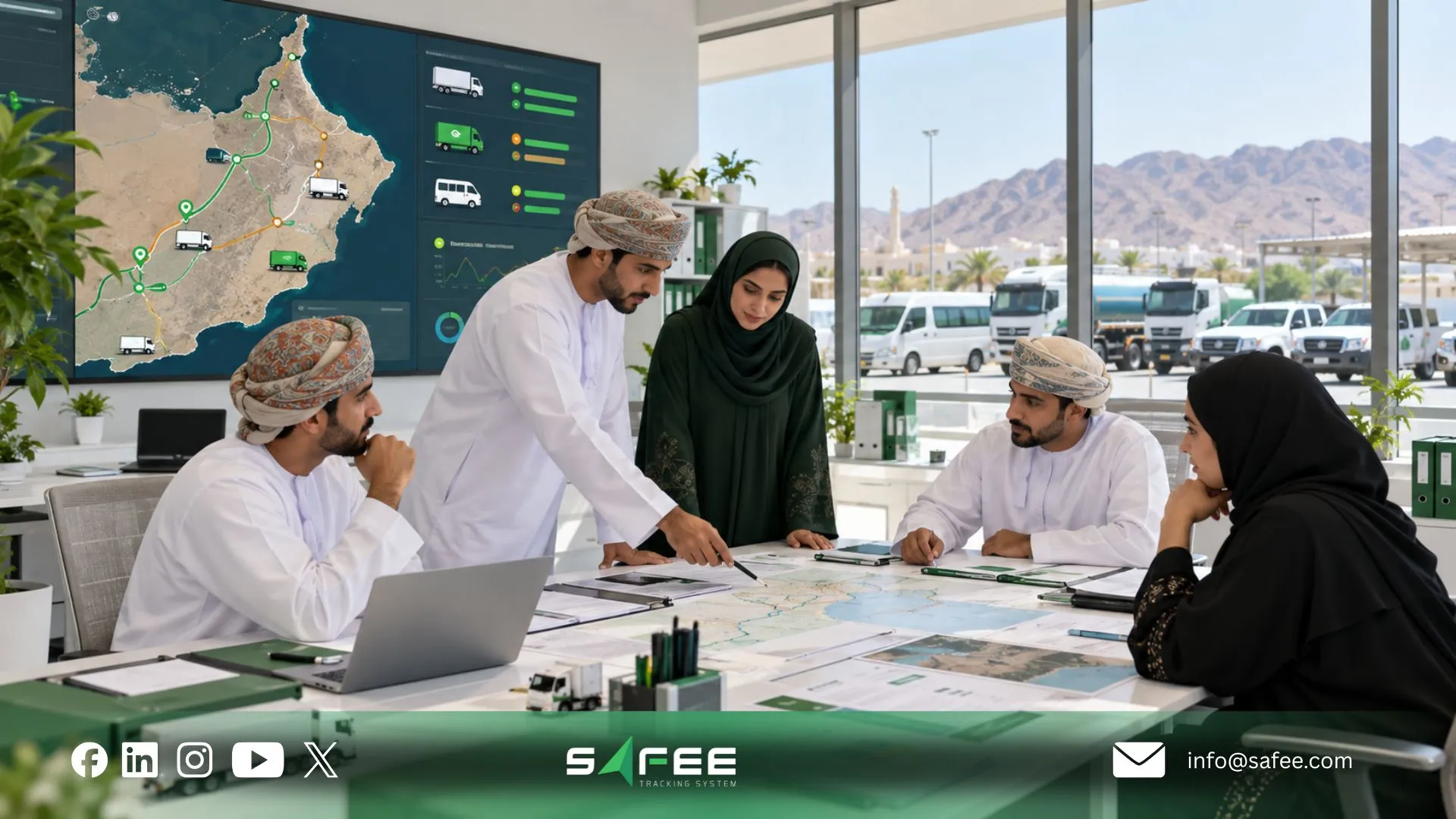
Vehicle tracking Oman becomes operationally useful when a coordinate is connected with the records and responsibilities around it.
Knowing that a truck is at a particular location is useful. Knowing which vehicle it is, which driver is assigned, which journey it belongs to, whether an exception has occurred and which user is responsible for reviewing it turns that coordinate into actionable fleet information.
This is why tracking should not be deployed as a map-only project.
A stronger operating model follows a controlled sequence: confirm the vehicle and driver, associate the journey, review live status, identify a relevant exception, assign the required action, and carry the result into historical review or reporting.
Safee supports that type of flow across the Administration Panel, Live Vehicle Tracking, Fleet Monitoring & Insights, Driver Management, Alarms and Alerts and Fleet Reporting. For a deeper look at the data-quality side of that sequence, see Fleet Data Management: Can You Trust the Data Behind Your Reports?
Electronic tracking system in Oman and activity requirements
Before selecting an electronic tracking system in Oman, define the activity, vehicle population and governing transport scope first. MTCIT’s Electronic Tracking System requirement applies to land-transport vehicles as described by the Ministry, while the wider operating model can still differ materially between delivery, industrial, oil-and-gas, construction, passenger, government and other fleet environments.
Those fleets may all require tracking, but they do not necessarily need the same internal workflows, journey controls, sensors, permissions, reports, connectivity design or customer-specific evidence.
The fleet team should document at least:
- Journey types;
- Vehicle categories;
- Operating activities;
- Connectivity conditions;
- Driver-assignment model;
- Internal HSE requirements;
- Geographic operating areas;
- Customer or site requirements;
- Management reporting expectations.
- Government records that must be maintained;
Only then should the business decide what the electronic tracking environment must provide.
For example, a Fleet Manager may require Live Vehicle Tracking, while an Operations supervisor needs configured Alarms and Alerts for selected exceptions. HSE may need a driver or journey context. Management may require scheduled Fleet Reporting rather than access to every live tracking screen.
The technology should therefore follow the operating requirement, not define it. If the hardware choice itself is still open, our GPS Fleet Tracking Device: OBD vs Hardwired vs Battery guide explains why device type, installation, power source and operating environment should be validated before a fleet-wide rollout.
Naql Oman for cards, licences and permits
Treat Naql Oman as part of the government-facing side of your operating model where its services apply. MTCIT currently lists services including issuance and renewal of land-transport vehicle operation cards, exceptional-load permits, taxi licences, and specified permits for foreign vehicles.
Do not copy every Naql field into the fleet platform simply because the information exists. Instead, identify the authoritative record owner, the current regulatory status that the business must verify, and the subset of information internal fleet users actually need for daily decisions.
A useful record-governance model asks:
| Record or Requirement | Primary Question |
| Vehicle identity | Which system owns the authoritative vehicle record? |
| Activity status | What operating activity applies to this vehicle? |
| Operating card | Is one required for this vehicle and activity? |
| Licence | Which licence applies, who owns renewal, and where is its authoritative status maintained? |
| Permit | Does the journey, cargo, vehicle or operating activity require a particular permit? |
| Driver record | Which identity and eligibility fields must Fleet maintain? |
| Tracking record | Which platform provides operational movement history? |
| Expiry or status change | Who checks it and what action follows? |
The exact answers should be verified against current Omani requirements rather than inferred from a software interface.
For procurement, ask the provider a more specific question than “Are you compliant with Naql?” Ask:
- Which data objects are exchanged?
- Which authority endpoint or process is involved?
- Who owns failed transmissions or rejected records?
- What implementation evidence can you demonstrate?
- What Oman-specific workflow is actually supported?
- Is the capability available for our activity and vehicle type?
- Is the capability an integration, report, internal record or manual process?
This approach protects the fleet from treating a generic “compliance” claim as proof of a specific government workflow.
Vehicle tracking in Oman for day-to-day operating decisions
Daily GPS tracking Oman use should help a team decide what to do, not simply provide a continuously moving map.
A dispatcher may start with a vehicle’s current location. From there, the useful questions become more operational:
- Is the vehicle moving or stopped?
- Does Operations need to intervene?
- Has a configured exception occurred?
- Does the event need investigation later?
- Should it appear in a management report?
- Which driver is associated with the vehicle?
- Has it entered or left a configured Geofence?
- Is it where the planned operation expects it to be?
Safee’s Live Vehicle Tracking supports real-time location visibility, simultaneous fleet tracking and Geofencing Alerts. Alarms and Alerts adds configurable exception workflows, while Fleet Monitoring & Insights provides wider live and historical context.
That separation is useful. Live tracking answers “Where is the vehicle now?” An alarm asks “What requires attention?” Historical monitoring helps investigate “What happened?” Reporting helps answer “What should management review?”
For a broader buyer-focused view of what tracking should prove beyond a moving map, see GPS Tracking for Fleet Vehicles: 10 Checks That Matter Beyond the Map.
Contact Safee to review one real Oman operating journey with your Fleet or Operations team. The discussion can focus on the records, alerts, users and reports required around that journey rather than a generic GPS demonstration.

How to assess a fleet management system in Oman deployment
A fleet management system in Oman should be evaluated as an operational system, not as a list of software features.
Before deployment, define what the fleet wants to control. Then test whether the platform can support the complete workflow from vehicle record to daily monitoring and management review.
Important variables include:
- Fleet size and vehicle categories;
- Operating sites and regions;
- Driver-assignment model;
- Journey complexity;
- Cellular coverage;
- Compatible tracking hardware;
- Sensor requirements;
- Alert policy;
- Reporting requirements;
- Government-facing processes;
- Existing enterprise systems;
- User and permission structure;
- Support responsibilities.
- Maintenance workflow and service triggers;
The appropriate configuration will differ between fleets, so those variables should be validated during scoping instead of assuming one standard Oman deployment.
Prepare fleet records before GPS tracking in Oman deployment
A strong GPS tracking Oman deployment begins before the first tracking point appears.
Start with the master records.
Each vehicle should have a stable identity that the fleet team can recognize across operations. Driver records and assignments should be structured. Sites and operating groups should be defined. User access should match responsibilities. Any relevant government identifiers should be mapped deliberately instead of added later as inconsistent free-text fields.
At Safee, our Administration Panel is the module for managing users, vehicles, drivers, sites, categories, groups, permissions and configurations. This administrative layer matters because operational tracking data becomes harder to interpret when the underlying business records are incorrect. The same principle is explored in Safee’s Fleet Data Management guide, which focuses on record ownership, data quality, identifiers, retention and migration readiness.
Before go-live, prepare:
- Active vehicle list;
- Stable vehicle identifiers;
- Vehicle groups or categories;
- Active driver records;
- Driver-to-vehicle assignment rules;
- Operating sites;
- Users and responsibilities;
- Permission requirements;
- Required Geofences;
- Journey or route structures where relevant;
- Alert ownership;
- Reporting recipients;
- Applicable regulatory references.
A coordinate attached to the wrong vehicle record creates misleading information. A correct vehicle with the wrong driver assignment creates an accountability problem. A useful deployment therefore treats master-data preparation as part of fleet control.
12 things to check before fleet management in Oman deployment
Use this checklist before approving a fleet management in Oman rollout:
- Vehicle records: Confirm how vehicles, trailers and other assets will be identified and grouped.
- Driver records: Define active drivers, assignment methods and which teams maintain changes.
- Oman regulatory scope: Verify the current MTCIT Electronic Tracking System requirements, Naql services, operating cards, licences, permits and activity-specific obligations that apply to the land-transport operation.
- Tracking hardware compatibility: Confirm which devices, vehicle interfaces and sensors are supported for the proposed fleet. Safee describes its architecture as Hardware Agnostic, but specific compatibility still needs project-level validation.
- Connectivity model: Identify routes or locations where cellular communication may be weak or unavailable and understand how selected hardware handles delayed transmission.
- Live visibility: Test whether authorized users can reach the vehicle, status and historical context they actually need.
- Alert governance: Decide which conditions should generate an alert, who receives each alert and what operational action follows.
- Journey workflow: Determine whether journeys only need tracking or require structured planning, approval, monitoring and additional governance through Journey Management System (JMS). Where maintenance readiness affects dispatch, confirm how the Maintenance Module fits the same pre-journey operating process.
- Reporting model: Define who needs daily, weekly or other recurring information and which filters or records belong in each report.
- User permissions: Make sure Operations, HSE, Fleet, Maintenance, management and administrators do not automatically receive identical system access.
- 1 Integration requirements: Identify whether approved fleet information must exchange with ERP, waybill, asset-management or another business system. Safee documents API-based Business Integration, while exact objects and implementation scope must be validated for the project.
- Support and post-launch ownership: Define who owns device issues, communications, configuration changes, user administration, reporting adjustments and escalation after deployment.
Test a fleet management system in Oman on a real journey
A feature demonstration can show what software contains. A journey test shows whether it fits your operation.
Choose a representative journey and follow it from preparation through closure.
For example:
Before departure: Confirm the vehicle record, driver assignment, applicable operational documents, user permissions and any required journey information.
At dispatch: Verify that the authorized Operations user can identify the correct vehicle and current status.
During movement: Review live tracking, route or Geofence context and selected operational exceptions.
At an exception: Trigger or examine a safe test condition and verify who sees the event, how it is presented and what action can be recorded.
During a communication gap: Determine what the user sees when current data is unavailable and how delayed information is handled when communications resume.
After the journey: Check the historical record and determine whether Fleet or management can retrieve the information required for review.
During reporting: Verify whether the relevant information can be filtered, scheduled, exported or delivered according to the team’s management process.
Safee separates these functions across documented modules rather than presenting every job as a GPS feature. Live Vehicle Tracking provides current visibility, Alarms and Alerts supports configured exceptions, Fleet Reporting supports structured recurring output, and JMS is available where the organization needs a more controlled journey workflow. For high-risk Oil & Gas journeys where IVMS, driver fatigue, video review and remote connectivity become central, the companion Oman article IVMS in Oman: Driver Safety for High-Risk Journeys covers that safety layer separately.
Questions to ask the provider during the test include:
- How are drivers assigned to vehicles?
- Which alert conditions are configurable?
- Can permissions differ by role, site or group?
- How are unresolved exceptions reviewed later?
- Can reports be filtered for the users who need them?
- What happens when the device stops communicating?
- Which timestamp shows when an event actually occurred?
- How does the system handle our Oman regulatory workflow?
- Can we distinguish current information from delayed information?
- Which capabilities shown in the demo are included in our proposed deployment?
Bring one representative vehicle, driver, route and management-report requirement to a Safee consultation. We can use those real operating conditions to define what should be tested before wider deployment.

Safee: Best fleet management in Oman fit for your operation
At Safee, we believe the best fleet management in Oman solution is the one that fits how your fleet actually operates. A logistics fleet, Oil & Gas operation, construction fleet, service fleet, or remote-route operation will not need exactly the same workflows, alerts, reports, or connectivity setup.
That is why we start with your operating requirements rather than a generic list of features.
If your team currently moves between GPS tracking screens, spreadsheets, driver records, maintenance files, regulatory portals, and manually prepared reports, Safee can bring the relevant fleet workflows into a more connected operating environment.
Depending on your requirements, we can support your operation with:
- Administration Panel to structure vehicles, drivers, sites, groups, users, permissions, and configurations.
- Live Vehicle Tracking for real-time fleet visibility.
- Fleet Monitoring & Insights for live and historical operational context.
- Alarms and Alerts to surface the exceptions that require attention.
- Driver Management to connect drivers with fleet activity and assignments.
- Maintenance Module to organize maintenance tasks and service requirements.
- Fleet Reporting to create customizable and scheduled management outputs.
- Journey Management System (JMS) when journeys require planning, approval, risk controls, monitoring, and review.
- Tracking Data Analyzer (TDA) when your team needs deeper analysis of tracking information.
- SatComm for supported satellite tracking and communication requirements on remote or low-coverage routes.
- Business Integration when approved fleet information needs to connect with ERP or other enterprise systems.
The value is not simply having these modules available. It is being able to configure the parts your operation actually needs so vehicle visibility, driver context, exceptions, journeys, maintenance, and reporting support the same operating process.
For Oman deployments, we also keep government-facing responsibilities separate from internal fleet management. Safee supports the operational fleet environment, while requirements involving MTCIT, Naql, operating cards, licences, permits, or electronic tracking obligations should be confirmed against the applicable authority and activity before implementation.
If you are evaluating a fleet management system in Oman, bring us your vehicle types, routes, driver model, tracking requirements, maintenance process, connectivity conditions, alert rules, and reporting needs. We can map Safee’s configuration around the operation you actually need to control.
For a broader procurement review, see Fleet Management Software Features: What to Test.
Safee vs separate tracking and records
| Dimension | Separate Tracking and Records | Safee Documented Scope | Evidence to Require Before Selection |
| Internal tracking | GPS locations may sit in a standalone tracking screen while driver, site and vehicle records remain elsewhere. | Live Vehicle Tracking, Fleet Monitoring & Insights, Driver Management and Administration Panel connect tracking with operational context. | Demonstrate the same vehicle from live status through history, driver context and user permissions. |
| Government roles | Authority records may be handled outside the tracking platform. | Safee provides regulatory capabilities including OPAL, WASL and Madinati. No Naql integration is assumed here. | Ask for written evidence of the exact Oman authority workflow supported for your project. |
| Journeys | Route or journey status may depend on calls, spreadsheets or a basic trip-history screen. | Journey Management System (JMS) is for structured journey workflows where required. | Test one representative journey from setup through monitoring and post-journey review. |
| Alerts | Teams may manually monitor a map or receive disconnected notifications. | Alarms and Alerts supports configurable operational exceptions and notification workflows. | Configure representative alerts, recipients and escalation ownership during evaluation. |
| Reporting | Staff may combine multiple exports or spreadsheets for management review. | Fleet Reporting supports customizable reports, filters, scheduled delivery and supported exports. | Build one real report used by Fleet, Operations, HSE or management. |
| Connectivity | Behaviour during communication loss depends on the chosen device and platform. | Safee notes that live visibility is unavailable while data is not being received and that some hardware configurations may temporarily store records for later transmission. | Test device behaviour, timestamps, communication status and delayed transmission on the proposed hardware. |
This comparison should also be applied to any alternative provider. Do not accept a check mark in a procurement spreadsheet as proof of capability. Ask the provider to demonstrate the actual workflow using your vehicles, users, alerts, journeys and reporting requirements.
Want to compare Safee with your current tracking-and-records setup? Contact our experts and use your existing workflow as the comparison baseline rather than relying on generic feature lists.
How do Safee customers assess journey visibility in Oman?
Journey visibility is more than seeing a vehicle move on a map. For Fleet and Operations teams in Oman, useful visibility means being able to identify the vehicle, connect it with the right driver, understand its current status, spot relevant exceptions, and retrieve the information needed for follow-up without relying on repeated calls or disconnected records.
At Safee, we help bring those parts of the journey into one operating view. Live Vehicle Tracking shows where the vehicle is and its current movement context. Fleet Monitoring & Insights adds broader live and historical visibility, while Alarms and Alerts helps Operations focus on configured exceptions instead of continuously watching the map. Driver Management provides driver context, and Fleet Reporting turns operational activity into structured outputs for recurring review.
Where your operation requires tighter journey control, our Journey Management System (JMS) extends that visibility across journey planning, approval, monitoring, exceptions, and closure.
To assess the value after deployment, compare the operating process before and after Safee using practical measures such as:
- Time required to identify a journey exception.
- Number of driver calls needed to confirm vehicle status.
- Time spent matching a vehicle with the correct driver or journey.
- Number of unresolved operational exceptions.
- Time required to prepare recurring fleet reports.
- Number of journey reviews that require information from separate systems.
The goal is simple: determine whether your team can understand what is happening across the journey and act with less delay and manual reconstruction.
For practical guidance on recurring reports, see Fleet Management Reporting: Which Report Goes to Whom.
FAQs about fleet management in Oman
How does Naql differ from an internal fleet platform?
Naql Oman supports applicable government-facing transport services, while an internal fleet platform manages daily vehicle, driver, tracking, journey, alert, maintenance, and reporting workflows. They serve different purposes.
Does every vehicle in Oman need an operating card?
Not necessarily under the same conditions. Operating-card requirements depend on the vehicle, transport activity, and current MTCIT/Naql rules, so operators should verify the requirement for their specific fleet.
What changes when a remote route loses cellular coverage?
Live cellular visibility may be interrupted. Depending on the hardware, data may be stored and transmitted after connectivity returns. For remote operations, Safee SatComm can provide supported satellite tracking and critical communication functions.
Does Safee issue government licences or operating cards?
No. Safee provides fleet-management and Telematics capabilities; government licences and operating cards remain under the relevant Omani authority and applicable process.
Ready to improve your fleet operations?
Tell us what you would like to improve. A Safee specialist will reply by email.
Usually replies within one business day • No sales spam
Your details are used only to respond to your request. Privacy Policy