
AI Fleet Report vs Traditional Fleet Report: What’s Different?
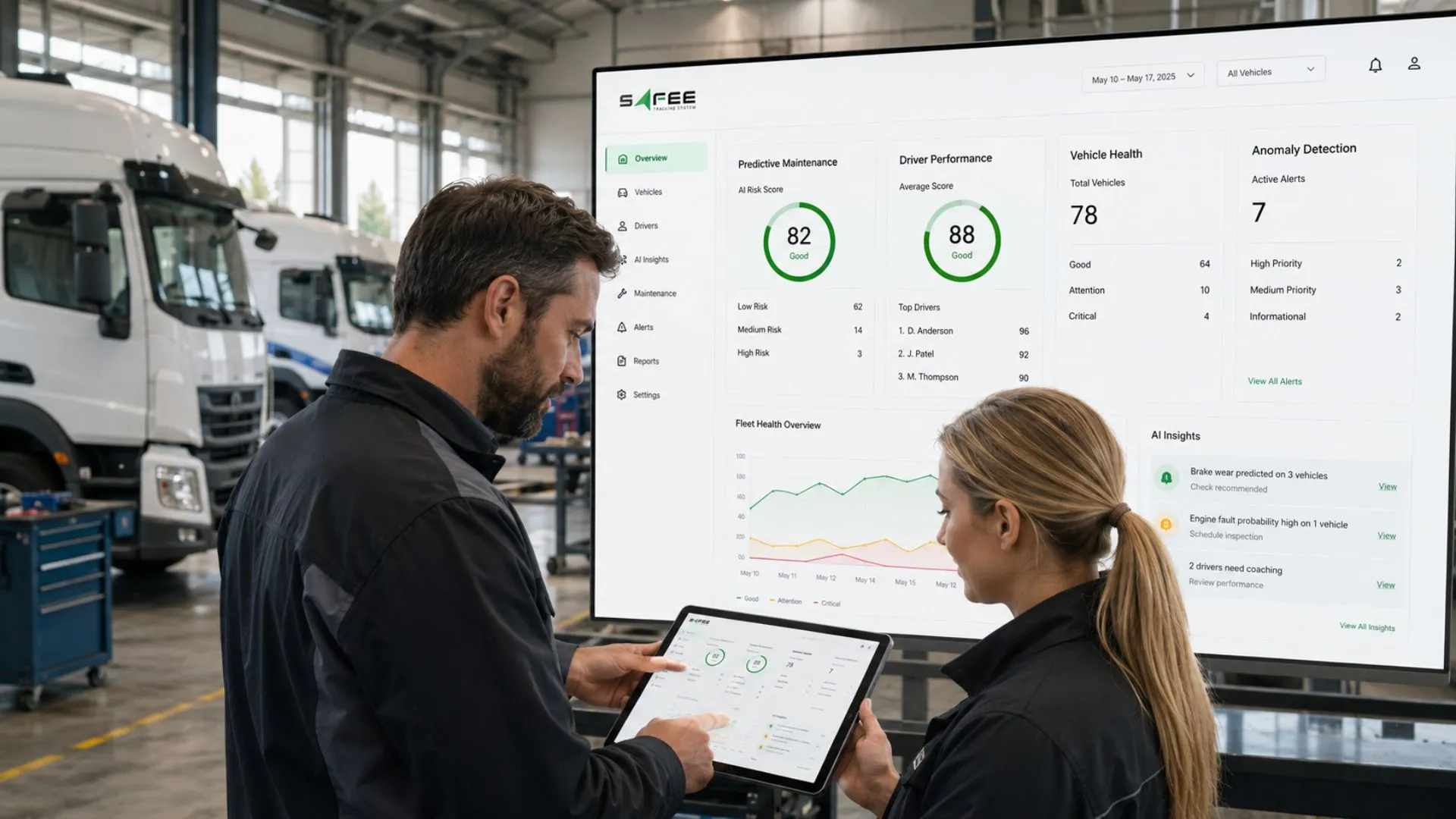
An AI Fleet Report changes how a fleet manager reaches an answer. Traditional fleet management reporting usually begins with a dashboard, predefined report, date range, vehicle group, filter, or export. AI-assisted reporting can begin with the operational question itself: What problems does my fleet have today? Which vehicles need attention? Why did idle time increase?
That distinction is important. Safee’s Fleet Reporting remains the structured environment for scheduled reports, historical review, filters, PDF or Excel exports, and formal management records. The AI Fleet Assistant adds a conversational route into authorized connected fleet data, allowing users to ask questions in everyday operational language, investigate the result, and return to the supporting vehicle, journey, alarm, driver, maintenance, or report record before taking action.
The real comparison, therefore, is not “AI instead of reporting.” It is traditional reporting alone versus AI-assisted reporting built on reliable fleet data and governed reporting workflows.
What does a traditional fleet report look like & what is missing?
Traditional fleet management reports are valuable because they impose structure. Managers can review a defined period, compare vehicles or drivers, distribute the same information to relevant stakeholders, retain records, and establish a repeatable management cadence.
What they do not always provide is the fastest route from a business question to the evidence needed to answer it.
The standard fleet report
A standard fleet report normally starts with a predefined reporting object. The user selects the report, chooses the time range, applies the relevant vehicle, driver, branch, or operational filters, and reviews the resulting tables, charts, or exported records.
That model works particularly well for recurring questions such as monthly utilization, trip history, driver events, idling, geofence activity, temperature records, vehicle activity, or scheduled management reviews. Our Fleet Reporting Module supports customizable parameters, scheduled delivery, and PDF or Excel exports, making structured reporting valuable for recurring control and formal review.
The limitation appears when the manager’s question crosses several reporting areas.
Consider:
Why did idle time increase yesterday?
A conventional workflow may require the manager to find the relevant idling report, identify the affected vehicles, compare routes or journeys, check stops and geofences, review driver assignments, identify repeated alarms, and decide whether the pattern came from driver behavior, dispatch conditions, customer-site waiting, route design, or another operational factor.
The report contains evidence. The manager still has to assemble the explanation.
An AI Fleet Report can change that sequence by starting with the question, retrieving only the information available within the user’s authorized data scope, summarizing relevant patterns, and directing the user toward the underlying records that require verification.
Traditional reporting therefore answers “What does the selected report contain?”
AI-assisted reporting can help answer “What should I investigate about this operational question?”
Hours spent on traditional fleet reporting each week
The hidden workload in traditional reporting is rarely the existence of the report itself. It is the work around it: choosing reports, rebuilding filters, moving between screens, comparing records, identifying exceptions, writing summaries, responding to follow-up questions, and repeating the same search for another branch or stakeholder.
That does not justify a universal claim that every Fleet Manager spends a specific number of hours each week on reporting. Safee’s own AI time-savings guidance explicitly warns that there is no defensible universal time-saving number for every fleet. The correct method is to compare the same task, user, data scope, evidence requirement, and completion point before and after AI assistance.
A useful comparison is:
| Reporting task | Traditional workflow | AI-assisted workflow |
| Daily fleet briefing | Open several views and summarize exceptions manually | Ask for a scoped briefing, then verify supporting records |
| Delayed journey investigation | Search journey, vehicle, driver, route and alarms separately | Ask which journeys are delayed and refine the investigation conversationally |
| Driver-event review | Reconstruct assignment, vehicle and historical context | Request the event context, then verify it in Driver Management and source records |
| Maintenance readiness | Review service status and open tasks vehicle by vehicle | Ask which vehicles require review before dispatch |
| Cross-branch exceptions | Filter each branch and consolidate manually | Request an authorized cross-branch summary and validate the underlying records |
The key metric is not how quickly AI produces text. It is whether the verified end-to-end workflow becomes faster.
Want to compare your current reporting workflow with an AI-assisted one? Request a Safee demo using the exact fleet questions your managers already investigate every day.
Also read: What Can an AI Fleet Assistant Do for Your Team?
5 things AI fleet reporting adds beyond traditional fleet reports
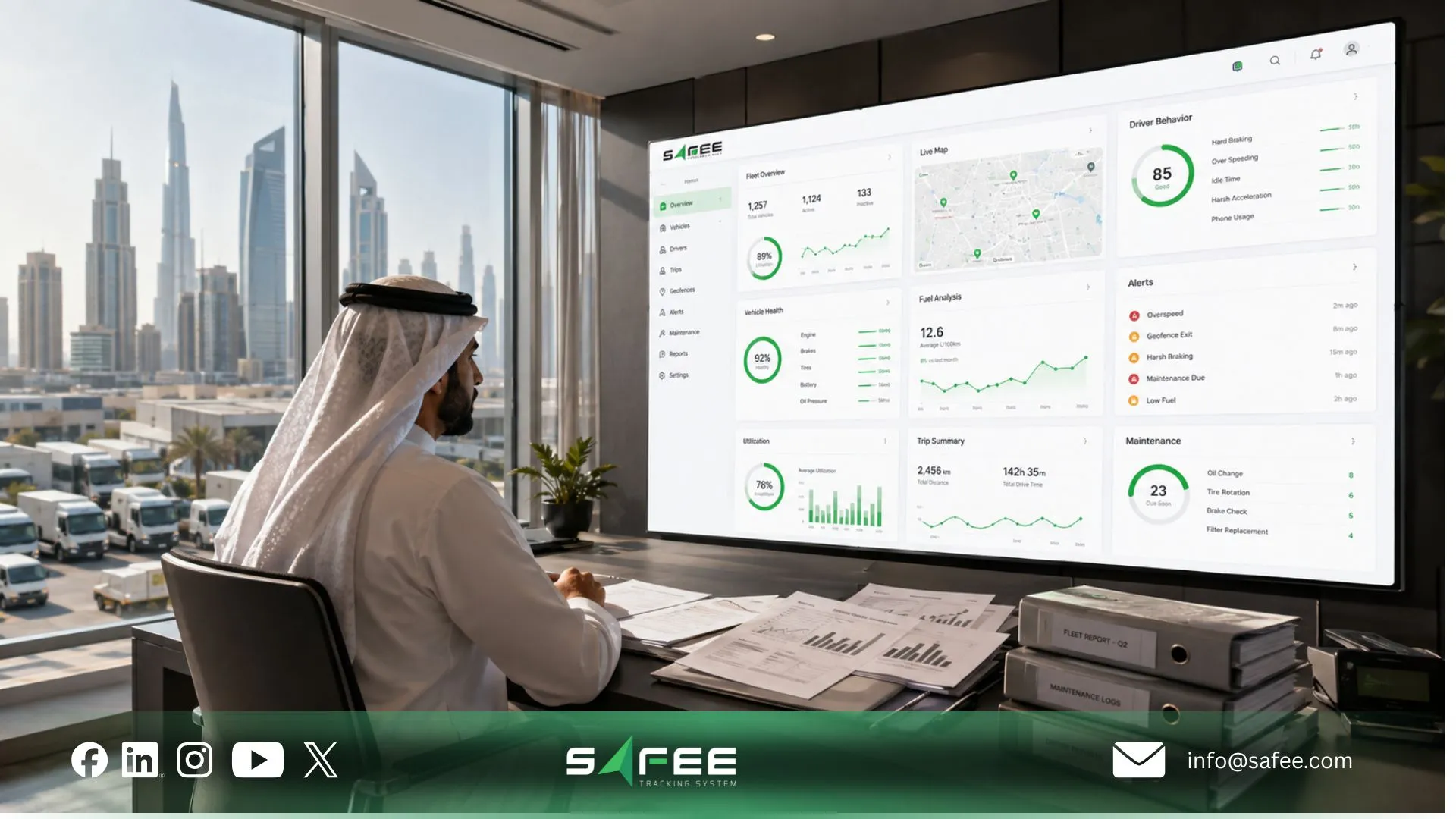
An AI Fleet Report adds most value when it removes the need for the user to know which report or screen contains the answer.
It should not create a second, disconnected source of truth. Our model keeps structured dashboards, operational modules, Alarms and Alerts, Fleet Reporting, and source records available while using the AI Fleet Assistant as a faster conversational route into that environment.
Full overview in the natural language report
Traditional fleet reporting software normally expects users to understand its interface. They must know which report, dashboard, filter, vehicle group, or date range corresponds to their question.
Fleet management natural language reverses the sequence.
A manager can begin with:
“Give me a full overview of my fleet today.”
The assistant can interpret the requested scope and organize authorized information around operational categories such as vehicle status, journeys, unresolved Alarms and Alerts, maintenance readiness, repeated exceptions, or other connected records available to the user.
The manager can then narrow the result:
Which branch has the most unresolved issues?
Which vehicles need immediate review?
Show me the records behind those vehicles.
This conversational progression is difficult to reproduce efficiently with a static report because every follow-up may require another filter or another report.
AI-generated issue detection
AI-generated issue detection should not mean that a language model invents a new operational problem from unsupported context.
A controlled workflow begins with actual connected evidence: configured Alarms and Alerts, journey exceptions, maintenance status, vehicle activity, driver events, utilization patterns, reporting records, or other available data.
The AI layer can then help group, summarize, rank, and explain what deserves investigation first.
For example, instead of giving the Fleet Manager a long list containing every event generated during the shift, the system can help organize questions such as:
- Which unresolved Alarms and Alerts deserve immediate review?
- Which vehicles have repeated exceptions rather than isolated events?
- Which delayed journeys may affect current operations?
- Which maintenance records may affect vehicle readiness?
- Which patterns should HSE, Operations, or Maintenance investigate separately?
The distinction matters: detection provides a starting point; verification establishes the operational fact.
Faster full-fleet status reviews
Fleet status is rarely one metric.
Operations may need movement status and current journeys. HSE may care about speeding or other configured safety events. Maintenance needs readiness context. Leadership wants significant exceptions without reading operational detail vehicle by vehicle.
When these records are connected, an AI-assisted summary can consolidate relevant information around the user’s question rather than forcing the user to read every available report.
For example:
“Which vehicles require management attention today?”
A useful answer could separate moving vehicles from idle or unavailable vehicles, identify important unresolved Alarms and Alerts, highlight relevant journey or maintenance exceptions, and point the user toward the records supporting each item.
Accident or incident information should only appear when corresponding records are actually captured, connected, and authorized. An AI summary should never convert an unverified alert into a confirmed accident.
(Internal link: Safee Live Vehicle Tracking — connect AI summaries to live vehicle context)
The predictive report
“Predictive” does not mean that an AI system knows with certainty what will happen tomorrow.
In fleet operations, a useful predictive report is a forward-looking risk or readiness view based on available patterns and current records.
A manager might ask:
Which vehicles should Maintenance review before tomorrow’s dispatch?
Instead of producing a guaranteed failure prediction, the AI-assisted workflow can surface vehicles whose available records justify additional attention—for example, open maintenance tasks, repeated relevant alarms, utilization patterns, or readiness information.
The correct output is therefore closer to:
“These vehicles deserve preventive review before assignment, and here is the supporting evidence.”
It should not be:
“These vehicles will fail tomorrow.”
We already connect the Maintenance Module with service schedules, maintenance alerts, tasks, and readiness workflows, while the AI Fleet Assistant can help users reach that context through operational questions.
AI-assisted root-cause investigation
Traditional reports are strong at showing events and measurements. Root-cause investigation usually requires the manager to connect several records.
If idle time rises, for example, the manager may need to compare vehicle activity, journeys, stops, geofences, driver assignments, repeated operational patterns, or route conditions.
An AI-assisted investigation can reduce that reconstruction work.
The user asks:
“Why did idle time increase yesterday?”
The AI Fleet Assistant can surface likely contributing factors, identify which vehicles or branches contributed most, and direct the user toward relevant supporting records.
“Automatically” should not be interpreted as proven causation. Operational root cause still requires human validation, especially where disciplinary, safety, financial, customer, or compliance decisions may follow.
If your team repeatedly reconstructs the same problem across several screens, talk to our experts about turning those investigations into governed natural-language workflows.
5 types of AI fleet reports every manager should be using
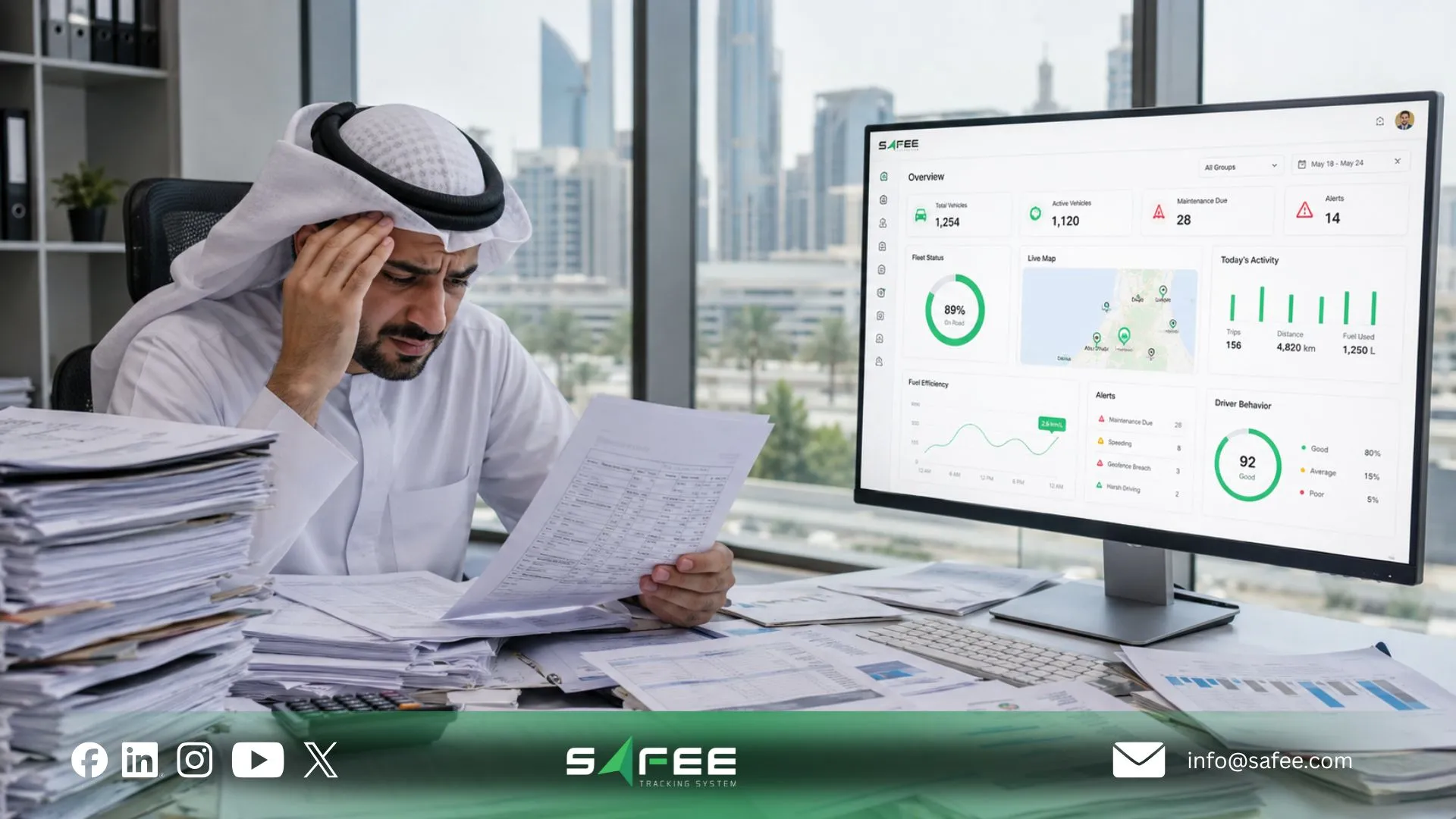
The highest-value AI reports are not necessarily new formal report templates. They are recurring management questions that can be answered faster when the AI layer can reach connected, authorized fleet information.
The fleet health overview
A Fleet Health Overview should answer one broad management question:
What requires attention across the fleet right now?
Depending on the connected modules and permissions, the answer may organize vehicle availability, current movement, delayed journeys, unresolved Alarms and Alerts, maintenance readiness, repeated driver events, utilization concerns, or other operational exceptions.
The value comes from prioritization. Leadership does not necessarily need every raw event. Operations does not need an executive summary with no vehicle-level detail.
The same connected data can be summarized according to the role asking the question.
The predictive maintenance report
A responsible predictive maintenance report should flag vehicles that deserve review before an operational disruption occurs, not claim perfect failure prediction.
Possible signals depend entirely on the connected data and deployed Maintenance Module configuration. They can include open tasks, service status, recurring relevant events, operating patterns, utilization, or other maintenance-related records available in the platform.
The manager can move from:
“Which vehicles may affect tomorrow’s dispatch?”
to:
“Why is this vehicle on the list?”
and then to the supporting maintenance or operational record.
That makes the report useful for prevention without turning prediction into certainty.
The driver performance report
Raw driver-event logs create activity records. Management requires context.
A useful driver report should help answer:
- Is the behavior recurring?
- Which driver and vehicle were connected to the event?
- Did it occur on one route or across several?
- Is the pattern isolated or repeated?
- Which drivers require coaching or additional review?
Our Driver Management Module supports driver identity, assignments, behavior context, and accountability, while Fleet Reporting supports structured driver-related reporting. The AI layer can help users move from the management question to the appropriate records more quickly.
Where a configured driver-performance score or KPI framework is used, AI can help interpret the result. It should not generate an unsupported disciplinary judgment from a score alone.
The cost anomaly report
Cost anomalies usually become useful when the manager can connect the financial signal to operational context.
Suppose a department shows unusual fuel use or asset utilization. A static cost report can reveal the variance. Investigation may then require data from trips, idling, drivers, vehicle activity, routes, fuel records, or maintenance.
Where approved cost, fuel, utilization, and operational information is connected, AI-assisted reporting can help narrow the investigation and identify likely contributing factors.
Again, “root cause included automatically” should mean the system organizes relevant evidence and likely explanations for review, not that AI has independently proven financial causation.
The compliance and risk report
Compliance-support reporting becomes more useful when exceptions are connected to ownership and urgency.
A report that merely lists every speeding event, route deviation, expired item, unresolved incident, or other configured exception can overload the team.
AI-assisted prioritization can help distinguish:
- Urgent unresolved issues.
- Repeated patterns.
- Exceptions already acknowledged.
- Events assigned to an owner.
- Issues requiring escalation or additional evidence.
- Lower-priority records suitable for scheduled review.
The underlying compliance obligation must still come from the applicable law, customer requirement, contract, site rule, or company policy. AI should help organize the evidence; it should not invent the governing requirement.
Who controls what the AI sees in fleet data?
AI fleet reporting adds an important governance question that traditional reporting alone does not fully answer:
What information can the AI retrieve for this particular user and this particular question?
Our current AI guidance states that the information available through the AI Fleet Assistant depends on user permissions, connected Safee modules, and the configuration deployed for the organization. Safee also advises buyers not to treat the customer permission screen as proof of every wider hosting, support, retention, integration, or AI-processing pathway.
Why AI fleet reports only show data the administrator has explicitly authorized
The operational principle is role-based access.
A dispatcher, Fleet Manager, HSE user, Maintenance user, Finance user, executive, contractor, or administrator may require different access to sites, vehicles, drivers, modules, reports, and historical records.
An AI Fleet Assistant should not create an unrestricted path around those boundaries.
For example, a dispatcher authorized for one vehicle group should not be assumed to gain access to another branch simply because the question is asked through AI.
However, customer-side permissions are only one part of the privacy review. Buyers should separately verify provider-side access, integrations, hosting, retention, AI-processing pathways, exports, backups, and contract-exit requirements for the deployment under consideration. Safee’s privacy guidance explicitly recommends testing those areas rather than inferring them from a login screen.
How developers define AI data access boundaries within fleet platforms
A well-governed implementation defines access at more than one level.
The practical boundary can include:
| Boundary | What should be defined |
| User role | What the individual is authorized to see and do |
| Fleet scope | Vehicles, sites, branches, departments, or groups available to the user |
| Module scope | Which connected operational modules can provide context |
| Report scope | Reports, exports, periods, and historical records available |
| AI retrieval scope | Which authorized records the assistant can retrieve for the question |
| Output scope | What may be summarized, displayed, exported, or retained |
| Verification path | Which source record supports the generated answer |
| Provider-side pathways | Hosting, integrations, support, logs, AI processing, and other deployment-specific access that must be contractually and technically verified |
This is where role-based access and data minimization become important. A user investigating one delayed journey should not require unrelated records from another branch merely because those records exist in the same fleet platform.
Also read: Does Safee See My Fleet Data? AI Privacy Explained
Privacy for companies with confidentiality and data governance requirements
For government, Oil & Gas, large multi-site fleets, regulated operations, or organizations handling commercially sensitive vehicle and driver information, AI procurement should include a specific data-governance review.
Questions to ask us or any provider include:
- Which customer roles can use the AI function?
- Which sites, vehicles, drivers, modules, reports, and historical records can each role reach?
- What information can be retrieved into an AI conversation?
- Can users open the source record behind an important answer?
- How are prompts, outputs, logs, exports, and conversation history treated for the proposed deployment?
- Which provider-side, hosting, integration, support, or AI-processing pathways apply?
- How are retention, deletion, backup, and contract exit handled?
- What deployment-specific privacy or compliance documentation is available for review?
These questions convert broad assurances into a testable governance model.
For confidentiality-sensitive fleets, contact us for a deployment-specific discussion covering users, permissions, AI scope, source-record verification, integrations, retention questions, and compliance-related governance.
How does AI fleet reporting save over an hour a week?
The mechanism for saving time is real: reduce repetitive search, filter changes, screen switching, manual consolidation, and first-draft summarization.
The “over an hour a week” threshold, however, must be demonstrated within the customer’s own workflow rather than presented as a universal Safee guarantee. Safee’s published time-savings methodology specifically recommends measuring the same task before and after AI assistance and states that different fleets can produce different results.
How did fleet managers Spend time before AI reports?
Traditional reporting work can extend well beyond reading a report.
A manager may have to:
- Find the correct report and reporting period.
- Reapply vehicle, branch, driver, or operational filters.
- Move between dashboards and modules.
- Identify which exceptions matter.
- Compare several records to reconstruct context.
- Consolidate information from multiple branches.
- Prepare a management summary.
- Answer follow-up questions by repeating part of the investigation.
- Verify evidence before escalation or closure.
The strongest AI opportunity is therefore not “write the report for me.” It removes unnecessary navigation between the question and the evidence.
How natural language queries change the reporting workflow
A natural-language query can produce an initial answer quickly because the user no longer has to navigate manually to the first relevant screen.
Instead of:
- Reports
- category
- report
- date
- branch
- vehicle group
- filter
- export
- Analyze
the workflow can begin:
“Which vehicles need attention today?”
The manager can then continue:
“Only show my Abu Dhabi operations.”
“Which issues are unresolved?”
“Which three should Maintenance review first?”
“Show the supporting records.”
The AI response itself may take seconds, but that is not the same as claiming the complete business task takes seconds. Source verification, approval, communication, escalation, driver contact, maintenance decisions, or formal report retention may still require human-controlled steps.
That distinction is essential when evaluating ai fleet reporting commercially.
Less time analyzing, more time Acting on insights
AI is most valuable when it compresses the investigative part of the workflow without removing accountability.
The target operating model is:
- Ask
- Find
- Explain
- Verify
- Act
- Follow Up
Our AI Fleet Assistant is designed around a similar conversational process: users ask the operational question, the assistant searches authorized connected information, provides relevant context, and guides the user back to supporting records before a consequential decision is made.
- For Operations, that can mean investigating delays faster.
- For HSE, it can mean reaching repeated driver-event contexts faster.
- For Maintenance, it can mean identifying vehicles requiring readiness review before dispatch.
- For leadership, it can mean receiving a prioritized operational briefing without first learning every report menu.
The manager still owns the decision.
Also read: How Much Time Does an AI Fleet Assistant Actually Save?
Why choose Safee for AI-powered fleet reporting?
The value of our approach is that AI reporting is not positioned as an isolated chatbot sitting outside the fleet system.
At Safee, we connect Live Vehicle Tracking, Alarms and Alerts, Fleet Reporting, Driver Management, Maintenance Module, Journey Management System, Tracking Data Analyzer, and other supported fleet workflows inside a broader Fleet Management and Telematics environment. The AI Fleet Assistant provides a conversational entry point into the authorized information available from that connected setup.
How Safee’s AI reports answer the questions that matter most to fleet managers
A useful AI reporting demonstration should not start with generic AI prompts.
It should start with questions your operation already asks:
- What problems does my fleet have today?
- Which active journeys need attention?
- Which unresolved Alarms and Alerts should we review first?
- Why did idle time increase?
- Which vehicles should Maintenance review before dispatch?
- Which drivers had repeated events during the selected period?
- What should management discuss in the weekly fleet meeting?
Our advantage in this workflow is the connection between the question and the operational environment behind it.
The AI Fleet Assistant can help users locate and summarize relevant information, while the underlying Safee modules remain available for detailed review and verification.
That is particularly important for B2B operations. A management answer that cannot be traced back to a vehicle, journey, driver, alarm, maintenance record, or governed report is much less useful than an answer that can be verified before action.
Book Safee’s AI Fleet Assistant demo and bring real reporting questions from your own operation not generic chatbot prompts.
Safee: The Best AI Fleet Reporting Platform in UAE and Saudi Arabia
At Safee, we believe the best AI fleet reporting platform is not defined by a universal ranking. For B2B fleets in the UAE and Saudi Arabia, the right platform is the one that fits the organization’s data, workflows, reporting requirements, integrations, governance, and operational decision-making needs.
Based in the UAE, we support B2B fleets across the GCC and wider international markets. Within Safee, our AI Fleet Assistant works as part of a connected fleet management environment that brings together Live Vehicle Tracking, Alarms and Alerts, Fleet Reporting, Driver Management, Maintenance, Journey Management, and analytics.
This connected environment allows Fleet Managers and operations teams to move from an operational question to the relevant fleet information without relying only on manual navigation between dashboards and reports. Access remains determined by the deployed configuration and approved user scope.
How Safee delivers natural language reports, predictive insights, and AI-driven decisions?
At Safee, we bring AI-assisted reporting into the fleet workflow through three connected layers.
- Natural-language access: Instead of starting with a report name or searching through multiple screens, users can begin with an operational question. Our AI Fleet Assistant can interpret questions related to vehicles, journeys, drivers, Alarms and Alerts, maintenance, utilization, and reports according to the connected data and authorized scope.
- Forward-looking decision support: We help managers go beyond reviewing historical activity alone. They can investigate which vehicles, journeys, alerts, or operational patterns may deserve closer attention next. Predictive outputs are treated as prioritization and risk indicators, not as guaranteed future outcomes.
- Human-controlled decisions: Our AI can summarize information, highlight areas for review, and support investigation, while Fleet Managers and authorized teams remain responsible for decisions related to dispatch, safety, maintenance, finance, disciplinary actions, policy, and compliance.
For us, the value of AI reporting comes from connecting conversational investigation with the fleet’s operational environment and source records—not from placing an isolated AI interface on top of fleet data.
Why do fleet operations teams in the region choose Safee over traditional reporting tools ?
At Safee, we do not treat AI reporting as a replacement for every traditional reporting workflow.
Scheduled PDFs, recurring KPI reports, historical records, and standardized management exports can still be essential for fleet operations. Our approach is to connect these reporting requirements with the wider operational environment.
| Fleet Requirement | How We Support It at Safee |
| Live operational context | Live Vehicle Tracking |
| Configured operational exceptions | Alarms and Alerts |
| Formal and recurring reporting | Fleet Reporting |
| Driver-related context | Driver Management |
| Maintenance and service readiness | Maintenance Module |
| Journey control | Journey Management System (JMS) |
| Recurring-pattern analysis | Tracking Data Analyzer (TDA) |
| Conversational fleet investigation | AI Fleet Assistant |
This connected model is especially relevant for organizations operating fleets across the UAE, Saudi Arabia, and the wider GCC, where operations may involve multiple branches, departments, depots, routes, customer sites, HSE responsibilities, reporting roles, and decision levels.
At Safee, our goal is not simply to make AI generate information faster. We help Fleet Managers move from a practical fleet question to the relevant operational evidence through a connected fleet management and reporting environment, reducing unnecessary navigation and supporting clearer, better-informed operational review.
FAQs about AI fleet reports
Can AI fleet reports replace traditional monthly fleet reports completely?
Usually, they should not.Traditional fleet management reports remain important for scheduled review, repeatable KPI packs, exports, historical comparison, governance, and formal management records. An AI Fleet Report is better positioned as an additional decision-support layer that speeds up daily questions, exception investigation, prioritization, and follow-up.
For most B2B fleets, the stronger architecture is AI-assisted investigation plus governed Fleet Reporting, not AI instead of reporting.
Does AI fleet reporting require technical knowledge to use daily?
Not necessarily. One of the main benefits of fleet management natural language is that authorized users can begin with the operational question they already understand rather than learning a technical query language.
A dispatcher can ask about delayed journeys. An HSE user can ask about repeated safety events. Maintenance can ask which vehicles deserve readiness review. Users still need operational knowledge because they must understand the answer, verify supporting evidence, and decide what action is appropriate.
How does Safee’s AI decide what to include in a fleet overview report?
The output should depend on the question, user permissions, connected Safee’s modules, available records, agreed fleet definitions, and deployed configuration.
Our AI Fleet Assistant should not be understood as independently deciding that every available fleet record belongs in every overview. The information returned should remain within the user’s approved scope, and important conclusions should be verifiable through the underlying source records.
Ready to improve your fleet operations?
Tell us what you would like to improve. A Safee specialist will reply by email.
Usually replies within one business day • No sales spam
Your details are used only to respond to your request. Privacy Policy