
17 Real Use Cases That Show the Benefits of a Fleet Management System
The benefits of fleet management system technology are easy to overstate when the discussion stops at features. A live map, an alert, or a report creates little value on its own. The real benefit appears when fleet data helps a team detect an exception earlier, assign responsibility, protect vehicle availability, control a recurring cost, or make a faster operational decision.
This guide explains the benefits of fleet management through practical use cases rather than generic promises. It shows why fleet management matters across logistics and service fleets, how IoT and connected sensors support measurable outcomes, which metrics Operations, Finance, and HSE should track, and how Safee connects Live Vehicle Tracking, Fleet Monitoring & Insights, Alarms and Alerts, Fleet Reporting, Driver Management, Maintenance Module, Journey Management System (JMS) and specialized capabilities into accountable fleet workflows.
What ‘benefits of fleet management’ really means
The real fleet management benefits are not produced simply because vehicles appear on a digital map. They appear when information changes the way a fleet is managed.
A vehicle location becomes valuable when dispatch can identify an operational exception. A speeding event becomes useful when it reaches the right supervisor and leads to a documented response. A maintenance record creates value when it prevents a service task from being forgotten. A management report matters when it supports a decision about utilization, risk, cost, or vehicle availability.
This creates a simple value chain:
Data, Context, Exception, Ownership, Action, Review, and Measurable result
Our platform reflects this operational model by connecting real-time monitoring, configurable alerts, reporting, driver context, maintenance and deeper fleet analysis rather than treating tracking as an isolated function.
For decision-makers asking why fleet management matters, this distinction is critical. The strongest benefit is not necessarily having more data. It is making existing fleet activity easier to see, investigate, control and improve.
Why fleet management is important for day-to-day operations
The answer becomes clear when the daily workload of an operations team is examined.
Without structured fleet information, managers may depend on phone calls, driver messages, spreadsheets, paper maintenance records or delayed reports to answer basic questions:
- Which vehicles are moving, idle, offline or unavailable?
- Which driver is assigned to which vehicle?
- Which vehicles have crossed a Geofence or deviated from an expected operating area?
- Which safety events need review?
- Which maintenance tasks are due or overdue?
- Which trips show abnormal idling, delays or inefficient use?
- Which exceptions should be escalated?
- Which information needs to appear in tomorrow’s management report?
With Live Vehicle Tracking and Fleet Monitoring & Insights, fleet teams can review current or recently received operational information and investigate historical activity rather than reconstructing events from fragmented updates. We also use Alarms and Alerts to turn configured conditions into exceptions that responsible users can review.
This explains the broader importance of fleet management system technology: It can create a repeatable operational process rather than leaving every event to individual memory and manual follow-up.
For a deeper view of real-time visibility, see our Live Vehicle Tracking module. For the decision-making layer beyond the map, Our GPS Tracking for Fleet Vehicles: 10 Checks That Matter Beyond the Map explains how location data connects with driver context, Geofences, alerts, trip history, and reporting.
If your team still spends significant time assembling fleet status from calls, spreadsheets and disconnected systems, request a Safee demo to map those daily workflows against Live Vehicle Tracking, alerts and reporting.
Importance of fleet management in logistics vs service fleets
The importance of fleet management in logistics is often linked to movement between depots, customer locations, distribution points and delivery routes. The operating question is not merely “Where is the truck?” but whether the journey is progressing as expected and whether an exception may affect service.
A logistics operation may therefore prioritize:
- Route and journey visibility;
- Depot entry and exit;
- Geofence activity;
- Arrival and departure evidence;
- Journey exceptions;
- Driver assignment;
- Idling and utilization;
- Fuel-related monitoring;
- Vehicle readiness;
- Management reporting.
This is why fleet management is important in logistics has a different answer from the same question in a field-service fleet.
A service fleet—utilities, maintenance teams, inspection vehicles or mobile technicians—may focus more heavily on vehicle availability, territory coverage, site arrival, unauthorized use, working patterns and response to urgent assignments.
Both environments need visibility, but the operational definition of success differs.
For logistics, success may mean protecting journey execution and service reliability. For service fleets, it may mean placing the right vehicle or team where it is needed while keeping enough vehicles operational.
Our Journey Management System (JMS) is positioned around planning, monitoring and managing structured journeys, while Driver Management, Maintenance Module and Fleet Reporting connect driver accountability, vehicle readiness and management review to the same wider fleet environment.
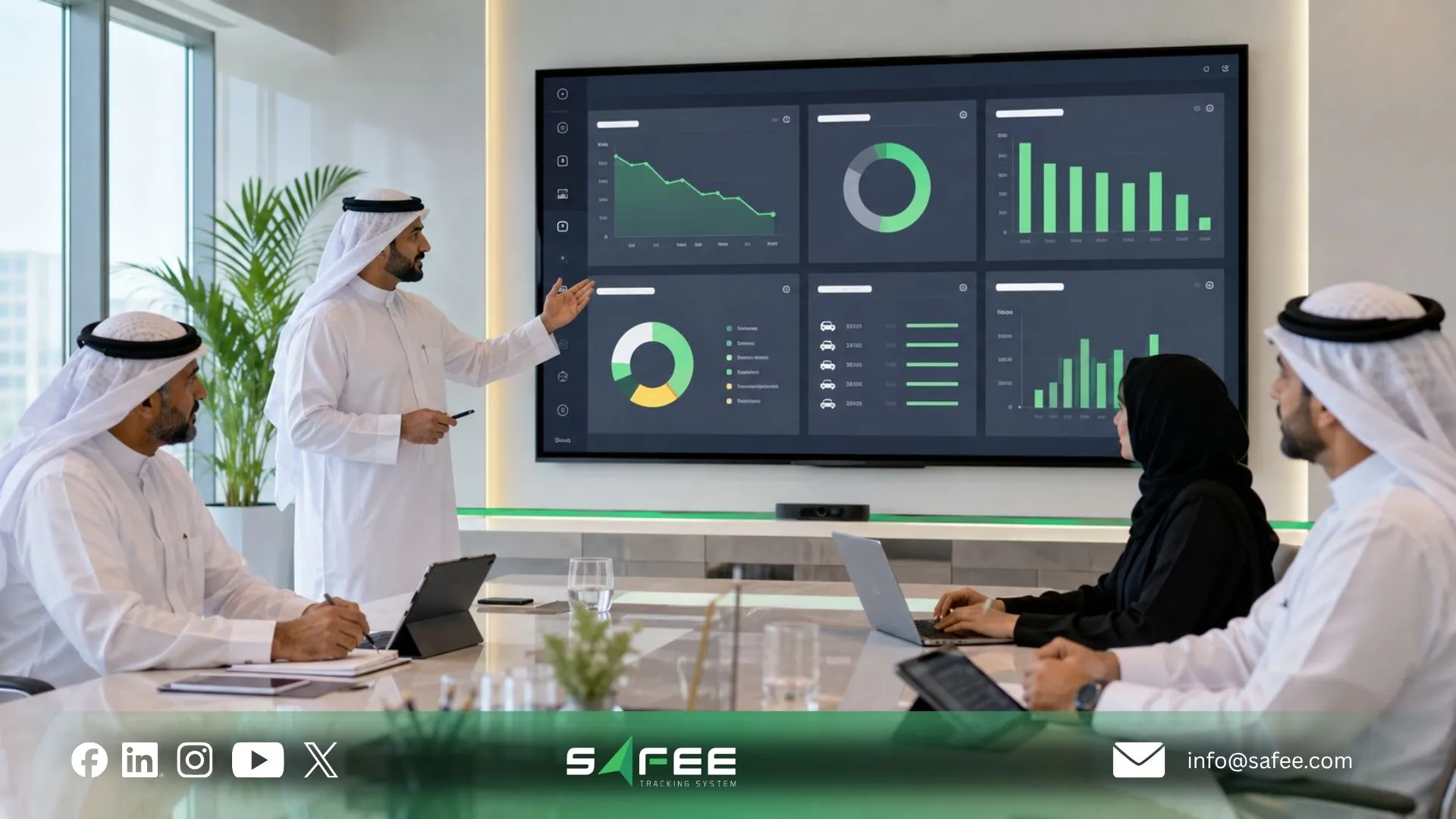
Fleet management use cases and what they actually fix
The most useful way to evaluate fleet management use cases is to start with the operational problem rather than the feature.
Instead of asking, “Does this system have GPS tracking?” ask:
What operational decision will location data improve?
Instead of asking, “Does the platform generate alerts?” ask:
Which exceptions should become alerts, who receives them, and what action follows?
Instead of asking whether reporting exists, determine which reports Operations, Finance, HSE and management actually need and how frequently each report should be reviewed.
That shift turns a feature comparison into an operating-model evaluation.
Fleet management system benefits
The major fleet management system benefits normally fall into four connected areas.
Cost control begins with visibility. Fuel usage, excessive idling, inefficient routing, low utilization, repeated maintenance problems and other operating patterns are difficult to manage if they cannot be identified consistently.
At Safee, we support fuel-related monitoring through our Fuel Monitoring Module, which can use compatible vehicle or sensor inputs and connect fuel information with trip and operating context. The wider platform can then use Alarms and Alerts and Fleet Reporting to bring relevant exceptions into operational review.
Our platform improves when driver events can be identified, reviewed and used for corrective action. Driver Management environment includes driver-related analysis, while its wider platform can surface configured events such as speeding and harsh-driving conditions. Specialized Video-iVMS capabilities can add video-backed context where included in the deployment scope.
Uptime depends on moving from memory-based maintenance toward controlled maintenance workflows. Our Maintenance Module supports maintenance tasks, scheduling logic and automated alerts based on operating or scheduling conditions, helping teams follow required work more systematically.
Compliance-related governance should be treated carefully. A fleet management system may support records, alerts, access control, driver information and reporting, but the applicable requirements depend on jurisdiction, fleet type, customer obligations, company policy and deployment scope.
Before treating compliance as a system benefit, fleet teams should verify:
- Which regulatory or contractual records must be retained;
- Which users may access each record;
- Which driver or vehicle documents must be monitored;
- What reporting format is required;
- Whether approval workflows are needed;
- Whether data must integrate with another system;
- Which exceptions require escalation;
- What evidence must remain available for audit or management review.
A useful provider comparison should therefore examine traceability, configurable permissions, report availability, alert ownership and integration readiness, not simply whether a vendor uses the word “compliance.”
Questions to ask the provider include:
- Which data relevant to our compliance process is actually captured?
- Which records can be exported or reported?
- How are user roles and permissions configured?
- How are alerts assigned to responsible users?
- Can our internal reporting cadence be supported?
- Which integrations are available for our required external systems?
- How are historical events investigated?
- Which requirements remain our organization’s responsibility rather than the platform’s?
Our Alarms and Alerts module provides the internal reference point for configurable exception management and alert workflows.
IoT fleet management use cases where sensors improve measurable results
The Internet of Things (IoT) refers here to connected physical devices, interfaces and sensors that capture or transmit fleet data into software workflows.
The most important principle behind IoT fleet management use cases is that a sensor is not the outcome.
We find the IoT layer as potentially including GPS-enabled tracking hardware, vehicle interfaces, identifiers, sensors and communication components. Depending on the configuration, inputs may represent location, ignition, driver identity, supported engine data, tire pressure, temperature, weight, fuel or equipment activity.
The measurable result comes from what happens next.
For example:
- Temperature Sensors can provide temperature readings, but a cold-chain workflow also needs acceptable thresholds, responsible users, alerts and investigation.
- Tire Pressure Monitoring System (TPMS) can provide tire pressure and temperature information, but value comes from acting on abnormal readings before they become operational problems.
- Weight Sensors can add load information, but fleet teams need rules for identifying unexpected or unsafe load conditions.
- Fuel-related sensors or supported vehicle information can reveal changes in fuel level, but the team still needs trip, location and operating context to decide whether an event requires investigation.
- Tracking hardware can provide position and movement, but dispatch needs Geofences, journeys, alerts or reports to translate that data into control.
Our IoT architecture connects compatible device and sensor inputs with platform capabilities including Live Vehicle Tracking, Fleet Monitoring & Insights, Alarms and Alerts, Fleet Reporting, Driver Management, Maintenance Management, CANbus Integration, Tracking Data Analyzer (TDA) and other modules where applicable.
The practical evaluation question is therefore:
Can the fleet move from sensor reading to accountable action without creating another isolated data silo?
For a deeper technical treatment of the device-to-workflow chain, see our Fleet Management Using IoT: Devices, Protocols and Architecture.
Advantages of a fleet management system vs manual tracking
One of the clearest advantages of a fleet management system is consistency.
Manual tracking is not necessarily inaccurate because people are careless. It becomes difficult because fleet activity changes continuously.
A spreadsheet can record yesterday’s mileage. It cannot by itself tell a dispatcher that a vehicle has just entered an unexpected area.
A maintenance sheet can record a service date. It does not automatically create an operational workflow around the next task.
A driver can call dispatch to explain a delay. That communication may never become structured data that management can later analyze.
The advantages of fleet management therefore emerge in processes where manual coordination struggles to scale. When buyers compare the advantages of fleet management system adoption with manual tracking, the difference is usually not a single feature but the repeatability of the operating process:
| Manual approach | Fleet-management approach |
| Staff repeatedly request vehicle status | Vehicle activity is visible through a shared system |
| Exceptions are discovered during later review | Configured exceptions can generate alerts |
| Maintenance depends heavily on calendars or memory | Maintenance tasks and reminders can be structured |
| Driver assignments are stored separately | Driver and vehicle context can be connected |
| Reports are rebuilt manually | Fleet Reporting can provide reusable reporting workflows |
| Management investigates across several sources | Relevant events can be reviewed with operational context |
The point is not to remove people from fleet management. It is to give them a more reliable operating environment for decisions. Our 7 Essential Fleet Management Tasks for Better Control expands on the recurring maintenance, driver, trip, fuel, compliance, incident, and performance tasks that benefit most from structured ownership.
Contact us to review which manual fleet processes are consuming the most operational time and identify where monitoring, alerts, reporting or workflow configuration could reduce that dependency.
Matching fleet management benefits to measurable results
Claims such as “improve efficiency” are too broad to guide a purchasing decision.
A stronger approach is to define the problem, establish a baseline, configure the system, assign ownership and then compare results over time.
This is how the benefits of a fleet management system become measurable rather than promotional.
A practical measurement framework is:
- Define the operational problem.
- Identify the data required to observe it.
- Confirm that the data source is reliable.
- Configure the relevant threshold, alert, report or workflow.
- Assign responsibility for action.
- Record what happened after each important exception.
- Review whether recurrence, cost, downtime, risk or service disruption changes over time.
In practice, the same discipline should continue after an insight is detected: return to the underlying record, assign a response and escalation path, and measure whether the operational action produces a meaningful change.
Fleet management advantages across operations, finance and HSE
Different departments experience different fleet management advantages because they make different decisions.
Operations generally need to know what is happening now and what needs attention.
Relevant measures may include:
- Vehicle availability;
- Trip completion;
- Idle time;
- Route or journey exceptions;
- Asset utilization;
- Delayed or offline tracking units;
- Open operational alerts.
Finance needs to understand where operating cost is generated and whether it can be linked to vehicles, drivers, activities or operating patterns.
Relevant measures may include:
- Fuel consumption;
- Maintenance cost records where available;
- Vehicle usage;
- Cost patterns by vehicle or group;
- Repeated exceptions that create avoidable expenses.
Health, Safety and Environment (HSE) teams focus on behavior, exposure, accountability and evidence.
Relevant measures may include:
- Speeding events;
- Harsh-driving events;
- Driver workload or driving-hour information where configured;
- Repeated safety exceptions;
- Journey risk controls;
- Incident context;
- Corrective-action follow-up.
At Safee, we connect several of these workflows through Driver Management, Alarms and Alerts, Journey Management System (JMS), Maintenance Module, Fleet Reporting and specialized capabilities such as Video-iVMS, where required.
The strategic advantage is shared operational evidence: Operations, Finance and HSE can examine different questions without building three unrelated versions of what happened.
Benefit of fleet management through metrics worth tracking from day one
A measurable benefit of fleet management starts with a baseline.
Before changing policies or setting aggressive targets, collect enough reliable operational data to understand current conditions. The purpose is not to create a massive KPI library. It is to identify a small group of indicators linked to decisions.
Useful metric categories include:
| Metric category | Example question |
| Utilization | Are available vehicles actually being used? |
| Idling | Where and when does unnecessary idling occur? |
| Fuel | Which vehicles or operating patterns require review? |
| Safety | Which driver events recur most frequently? |
| Maintenance | Are required tasks being completed before they become overdue? |
| Availability | Which vehicles spend the most time unavailable? |
| Journey performance | Where do repeated delays or route exceptions occur? |
| Alerts | Which alerts create useful action and which create noise? |
| Data quality | Are devices, driver assignments and vehicle records reliable enough for decisions? |
| Management reporting | Are recurring reports answering a defined business question? |
One common mistake is setting a large number of alerts simply because the system allows it. Alert governance matters more than alert volume.
For every operational alert, define:
Condition, Recipient, Expected action, Escalation, Closure, and Review
This is especially important as fleets grow across sites, branches, projects or business units.
Our Fleet Reporting module shows how recurring operational KPIs can be structured into reusable management reports.
17 use cases where fleet management can deliver measurable value fast
“Pays for itself” should not be interpreted as a guaranteed financial payback period. The strongest candidates are use cases where a measurable operational problem already exists and the fleet can establish a baseline before deployment.
- Reducing excessive idling: Identify where extended idling occurs, determine whether it is operationally necessary and compare patterns after policy or driver interventions.
- Improving vehicle utilization: Compare how frequently vehicles are used so managers can identify underused or heavily loaded assets.
- Detecting route or operating-area exceptions: Use location, route and Geofence context to identify vehicles operating outside expected workflows.
- Improving dispatch visibility: Give Operations a shared view of vehicle status rather than relying on repeated driver calls.
- Managing speeding and harsh-driving events: Use configurable alerts and driver information to identify repeated behavior and support targeted coaching.
- Strengthening driver accountability: Connect driver identity and vehicle assignment so managers can determine who was operating a vehicle during relevant activity.
- Preventing missed maintenance tasks: Use the Maintenance Module to structure service tasks and reminders around the fleet’s maintenance requirements. For a deeper workflow guide, see our How Fleet Maintenance Management Prevents Costly Downtime.
- Investigating repeated vehicle downtime: Combine maintenance records, operating history and relevant vehicle information to identify recurring patterns.
- Improving fuel visibility: Review compatible fuel information against trips, location, idling and vehicle activity instead of relying only on receipts or aggregate totals.
- Managing cold-chain temperature exceptions: Use Temperature Sensors and configured thresholds where the fleet’s hardware and deployment support them.
- Monitoring tire conditions: Use Tire Pressure Monitoring System (TPMS) information to identify pressure or temperature conditions requiring operational attention.
- Monitoring vehicle or trailer weight: Connect compatible Weight Sensors to alerts and reporting where load monitoring is operationally required.
- Improving journey governance: Use Journey Management System (JMS) where trips require structured planning, monitoring, approvals or post-journey review.
- Reducing manual management reporting: Standardize recurring information through Fleet Reporting rather than rebuilding the same spreadsheet repeatedly.
- Investigating operational incidents: Combine trip history, alerts, driver context and—where deployed—Video-iVMS evidence to establish a clearer record of what happened.
- Managing remote fleet operations: Where normal communications are difficult and the deployment requires it, specialized capabilities such as SatComm can form part of the wider fleet-connectivity architecture.
- Creating cross-department accountability: Give Operations, HSE, Finance and management controlled access to the fleet information relevant to their responsibilities instead of maintaining disconnected datasets.
The right use case is not automatically the one with the most sophisticated technology. It is the one where the business problem, data source, responsible user and measurable outcome are all clearly defined.
Request a Safee demo and bring three recurring fleet problems from your own operation. Safee can help map each one to the relevant data, module, alert, report and operating workflow.

Safee: Where these fleet management benefits come from in practice
Our platform’s value comes from connecting fleet activities that would otherwise be reviewed separately.
Live Vehicle Tracking provides fleet-location and activity visibility. Fleet Monitoring & Insights adds a broader operational monitoring environment. Alarms and Alerts turns configured conditions into actionable exceptions. Fleet Reporting structures operational information for recurring review. Driver Management links driver context and assignment. Maintenance Module structures maintenance tasks and follow-up. Journey Management System (JMS) supports more controlled journey workflows.
Additional capabilities can extend this model when the operating requirement exists, including Tracking Data Analyzer (TDA), Video-iVMS, SatComm, Tire Pressure Monitoring System (TPMS), Temperature Sensors, Weight Sensors, Mobile App, fuel-related monitoring and supported APIs and integrations.
The important point is architecture.
A fleet does not benefit from an alert merely because it fired. It benefits when:
- The data behind the alert is reliable;
- The threshold reflects the operating policy;
- The correct person receives it;
- The expected response is clear;
- Unresolved exceptions are escalated;
- The outcome remains available for later review.
That turns technology into fleet governance.
See our Essential Modules for the core modules that connect monitoring, alerts, reporting, maintenance, fuel, driver, and vehicle-management workflows.
Safee vs No fleet management system
| Outcome | No Fleet System | With Safee |
| Vehicle downtime | Reactive, discovered late | Maintenance tasks, scheduling and proactive alerts through Maintenance Module |
| Fuel cost visibility | Estimated mainly from receipts or disconnected records | Fuel information can be reviewed with vehicle, trip and operating context where compatible data is available |
| Driver safety incidents | Often reviewed after the fact | Configurable driver-event alerts and Driver Management workflows |
| Compliance audit prep | Manual document and record collection | Centralized reporting, driver records and controlled operational evidence where configured |
| Reporting to management | Ad hoc spreadsheets | Fleet Reporting with configurable, scheduled and exportable reporting |
| Vehicle location | Calls and manual status updates | Live Vehicle Tracking and Fleet Monitoring & Insights |
| Journey exceptions | Dependent on manual follow-up | Journey Management System and configurable exception workflows |
| Maintenance ownership | Calendars, spreadsheets or individual memory | Structured Maintenance Module tasks and alerts |
| Operational accountability | Information split across users and files | Driver, vehicle, alert and reporting context connected within one platform |
| Exception investigation | Multiple sources must be reconciled manually | Historical activity, alerts, reports and relevant module data can support investigation |
Our own Essential Modules position live monitoring, reporting, alerts, maintenance, fuel monitoring and Driver Management as connected parts of the wider fleet-management environment rather than isolated applications.
How fleets can start measuring these benefits in the first 90 days
The first 90 days should be treated as an adoption and measurement window, not as a universal promise that every Safee customer will achieve the same ROI or operational result within a fixed period.
Fleet size, hardware scope, data quality, integrations, internal approvals, user training, operating complexity and the number of workflows being configured can all affect adoption.
A disciplined 90-day approach focuses on four stages.
First, establish the operating baseline.
Before judging improvement, the team should confirm:
- Vehicles and assets in scope;
- Driver records and assignments;
- Device and communication status;
- Sites, groups and operational hierarchy;
- Existing maintenance processes;
- Current alerts and escalation practices;
- Reports required by each department;
- KPIs that will be used for comparison.
This prevents an organization from confusing configuration activity with actual operational improvement.
Second, configure high-value workflows before expanding scope.
Instead of activating every possible alert and report, begin with the conditions connected to the largest operational problems.
Examples could include:
- Speeding;
- Harsh-driving events;
- Geofence exceptions;
- Unauthorized stops or movement;
- Excessive idling;
- Maintenance due events;
- Fuel anomalies where supported;
- Temperature conditions for relevant fleets.
Each should have a responsible owner and an expected action.
Third, create reporting and governance routines.
Operations may need daily exception visibility. HSE may need a recurring safety review. Maintenance teams need task follow-up. Leadership may need a smaller management scorecard.
Fleet Reporting should therefore be configured around the decisions each audience makes rather than producing reports simply because data exists.
Finally, compare the new operating evidence with the baseline.
The fleet should ask:
- Are repeated exceptions decreasing?
- Are managers responding faster?
- Are maintenance tasks being followed up more consistently?
- Has data quality improved?
- Are manual status requests decreasing?
- Are reports easier to reproduce?
- Can management identify who owns unresolved issues?
- Which alerts are producing action, and which should be changed?
That is how fleet management optimization should continue beyond initial deployment: measure, adjust thresholds, improve ownership, remove unnecessary alert noise and focus on the workflows producing operational value.
For a specific deployment, Safee should be consulted directly about configuration, hardware scope, integrations, rollout requirements and local governance needs rather than assuming one implementation model applies to every organization.
For deployment scope, integrations, hardware, and governance requirements, contact us to discuss the configuration that fits your operation.

FAQs about the benefits of fleet management
What are the main benefits of a fleet management system?
The main benefits of a fleet management system are stronger operational visibility, better control of exceptions, improved driver and vehicle accountability, more structured maintenance, cost visibility and repeatable reporting. The greatest value comes when fleet data is connected to clear actions and measurable KPIs rather than simply collected.
Why is fleet management important for small fleets?
Fleet management is important for small fleets because even a limited number of vehicles can create maintenance, fuel, driver, dispatch and reporting work. A structured system can reduce dependence on spreadsheets, phone calls and individual memory while giving managers clearer operational evidence.
Biggest advantage of fleet management software vs manual?
The biggest advantage is repeatability. Fleet management software can continuously organize vehicle activity, alerts, driver context, maintenance and reporting, while manual processes depend on people repeatedly collecting and reconciling the same information.
How fast do fleet management benefits usually show up?
There is no universal timeline. How quickly benefits become measurable depends on deployment scope, data quality, fleet processes, hardware and integrations, user adoption, configuration quality and whether the organization establishes a baseline before implementation.
Ready to improve your fleet operations?
Tell us what you would like to improve. A Safee specialist will reply by email.
Usually replies within one business day • No sales spam
Your details are used only to respond to your request. Privacy Policy