
Fleet Management Using IoT: Devices, Protocols and Architecture
Connected devices alone do not create an effective fleet operation. The real challenge in fleet management using IoT is turning location, sensor, vehicle and driver data into information that a fleet platform can interpret, connect to operational context and convert into alerts, reports and accountable actions.
This article explains how that architecture works from the perspective of platform integrators, IoT providers and telecom partners. It covers the boundary between the device and connectivity layer and the fleet-management layer, including IoT devices, sensors, modules, protocol handling, cellular and Wi-Fi connectivity, data processing and integration with Safee’s Fleet Management and Telematics environment.
What ‘fleet management using IoT’ means
Fleet management using IoT means connecting physical fleet assets and their data sources to software workflows that help people monitor, investigate and manage fleet operations.
The Internet of Things (IoT) layer can include GPS-enabled tracking hardware, vehicle interfaces, identifiers, sensors and communication components. Safee defines fleet management hardware broadly as physical devices, interfaces, identifiers, sensors and communication components that capture or transmit operational data to the fleet platform.
Depending on the implementation, those inputs can represent location, movement, ignition, driver identity, supported engine data, tire pressure, temperature, weight, fuel or equipment activity.
That makes internet of things fleet management a connected data-and-workflow model rather than one specific device category.
For example, Safee distinguishes between several sources because they answer different operational questions:
- GPS-enabled tracking hardware provides location and movement context.
- Controller Area Network bus (CANbus) and On-Board Diagnostics II (OBD-II) can expose supported vehicle and diagnostic data.
- The Driver Identification System can use supported identifiers including RFID, iButton, BLE or fingerprint ID.
- Weight Sensors provide load information.
- Tire Pressure Monitoring System (TPMS) provides tire pressure and temperature data.
- Temperature Sensors and the Cold Chain Solution support temperature-sensitive operations.
- SatComm provides an additional communications option for relevant remote or low-cellular-coverage operations.
The iot-based fleet management system begins to create value when those inputs no longer terminate in separate hardware portals and instead support operational processes.
For the physical device layer behind this architecture, see our Fleet Management Hardware & IoT guide.
IoT workload vs fleet management system
An IoT workload and a fleet management system solve related but different problems.
The IoT workload is primarily concerned with capturing, transmitting, receiving and processing device data. Typical technical concerns include device identity, protocol ingestion, message format, data fields, communications availability, timestamps, sensor readings, data quality and storage.
The fleet management system adds operational meaning.
A raw GPS coordinate needs a vehicle identity. A sensor value needs a measurement definition and expected range. A Geofence event needs an operating rule. An alarm needs a responsible recipient. A diagnostic signal may need Maintenance Management context. A driver event needs a verified driver assignment before it becomes useful for accountability.
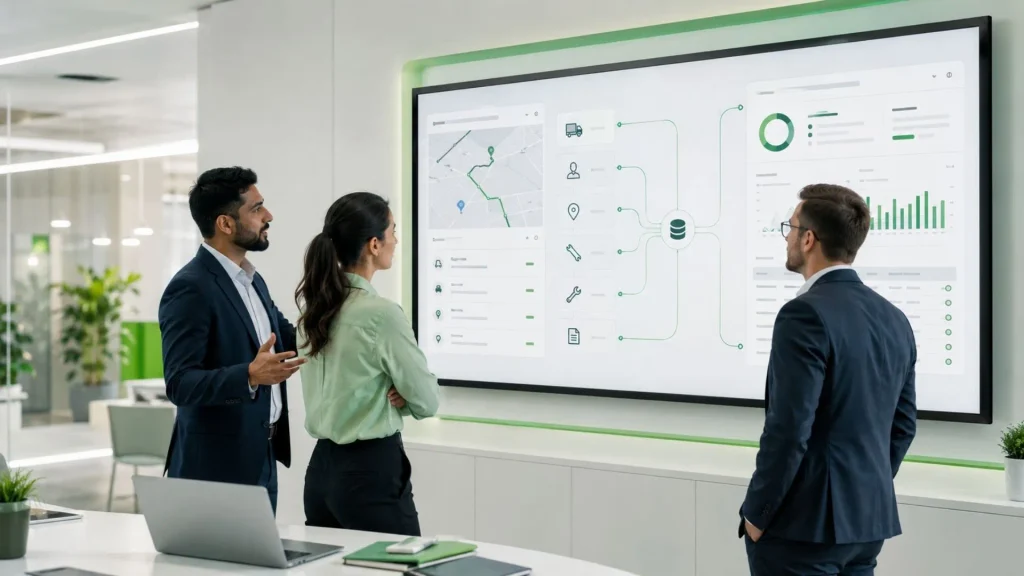
Safee’s architecture illustrates this distinction. Its Telematics material describes data being captured through devices and vehicle interfaces, transmitted through communications networks and processed through an IoT architecture consisting of Messaging, Message Route and Data Warehouse before the information is presented through fleet-management workflows.
The result is a useful separation:
Device signal → data transmission → protocol/message processing → fleet context → exception or insight → operational action → reporting and review.
A fleet management system IoT project should therefore be evaluated across that complete chain rather than only at the device or connectivity level.
The problem an IoT fleet tracking system solves for platforms
For an IoT platform provider, the difficult part is rarely displaying one GPS coordinate or storing one sensor reading. The challenge grows when customers expect those signals to behave like a complete IoT fleet tracking system.
Fleet customers typically need the data connected to concepts such as:
- Vehicles and equipment;
- Devices;
- Drivers;
- Trips and journeys;
- Locations and Geofences;
- Vehicle status;
- Alarms and operational exceptions;
- Maintenance activity;
- Reporting;
- Dashboards;
- Permissions and responsible users.
Safee’s platform is a protocol-based IoT system capable of ingesting different device protocols and message formats, mapping incoming fields, and turning them into fleet-oriented monitoring, trips, dashboards, alarms and reports.
That creates a useful division of responsibilities for an IoT or telecom integrator. Your connected-device infrastructure can focus on producing and transporting reliable data, while the fleet layer must make the resulting information understandable to Fleet, Operations, HSE, Maintenance and management.
An IoT fleet tracking software evaluation should therefore ask not only, “Can this platform receive our devices?” but also, “What can the customer do with the data once it arrives?”
If you already have tracking hardware, sensor infrastructure or an IoT connectivity stack, request a Safee integration discussion to map your device feeds to the fleet workflows your customers actually need.
Also read: How to Deploy Fleet Management Sensors That Teams Trust

Why IoT and fleet management work better together
The relationship between IoT and fleet management is complementary. IoT expands what can be observed; fleet-management software determines how that information supports an operational decision.
Consider a temperature sensor. The IoT layer can transmit a reading. The fleet layer can associate that reading with a vehicle, journey or cargo workflow, place it beside location data, evaluate configured conditions, send an alert to the correct team and preserve the event for later reporting.
The same principle applies to weight, tire pressure, engine data, driver identity and equipment activity.
Our own platform reflects this model by bringing together real-time GPS fleet tracking, IoT integrations such as Weight Sensors, cold chain monitoring and driver cameras, along with reporting, alerts and wider fleet workflows.
How wireless fleet management changes on an IoT network
Wireless fleet management introduces an architectural question that traditional software projects can sometimes avoid: how should data move from a mobile asset to the platform?
For road-going fleets, cellular communications provide the wide-area transport layer for many normal operating routes. Safee’s hardware guidance explicitly identifies cellular connectivity as suitable for many normal routes while recognizing that remote operations may need an additional communication layer such as SatComm.
Cellular IoT fleet management therefore needs more than a SIM card. Integrators should validate:
- Operating geography and known coverage gaps;
- Device and modem capability;
- SIM and APN configuration where relevant;
- Expected message frequency;
- What happens when connectivity is interrupted;
- Whether the device buffers information;
- Which events require rapid transmission;
- How communication health is displayed;
- How offline or delayed units are investigated.
Our Live Vehicle Tracking environment includes GPS signal and communication-health visibility so teams can identify units that are no longer communicating normally.
WiFi fleet management, by contrast, is better understood as a different connectivity design rather than an automatic substitute for mobile wide-area communications. Wi-Fi depends on access to the relevant wireless network, so its role needs to be evaluated around the actual operating environment, such as depots, yards, workshops or other controlled locations.
The important architecture rule is not to assume that Cellular IoT, Wi-Fi, BLE and satellite communications are interchangeable. BLE, for example, appears in Safee as a supported driver-identification option; that does not make it the same kind of wide-area transport layer as cellular or SatComm.
Connection technology should always be selected against the distance, mobility, data, latency and coverage requirements of the workflow.
Turning IoT sensors for fleet management from raw data Into decisions
IoT sensors for fleet management become useful only when the platform understands what their readings mean and when somebody is responsible for responding.
Safee’s Advanced Modules demonstrate several different forms of sensor-driven fleet context:
- Weight Sensors provide Real-Time Weight Data and support Analog, ROADEK and KIMAX sensor options.
- Tire Pressure Monitoring System (TPMS) provides Tire Pressure & Temperature Data and Real-Time Alerts.
- Temperature Sensors support Multiple Temperature Sensors and Real-Time Temperature Monitoring.
- Cold Chain Solution connects Temperature & Humidity Monitoring with Smart Alerts & Alarms and Fridge Door Security.
- Equipment monitoring supports Real-Time Sensor Data, Movement Tracking and multiple sensor options for equipment use cases.
The process should therefore move through several stages:
Measure → transmit → validate → associate → contextualize → detect → notify → investigate → report.
Suppose a weight sensor produces an abnormal reading. Before treating that reading as an operational event, the platform and fleet team may need to know which vehicle produced it, whether a trailer was connected, whether calibration is correct, where the vehicle was located, whether the reading changed during loading, and whether a configured threshold has actually been crossed.
The same principle applies to temperature. A cold-chain reading without vehicle, time, location and journey context gives Operations much less information than the same reading connected to the Cold Chain Solution, Live Vehicle Tracking, Alarms and Alerts and Fleet Reporting.
Tracking Data Analyzer (TDA) provides another layer. Safee positions TDA as a way to turn connected tracking data into dashboards, visualizations, scheduled reports and deeper analytical views instead of leaving the organization with raw tracking records alone.
This is the fundamental difference between collecting IoT data and operating an iot-based fleet and equipment management solution.
Talk to our experts about mapping your sensor outputs to Live Vehicle Tracking, Alarms and Alerts, Fleet Reporting or TDA before expanding the device rollout.
For the sensor and specialist-module layer, review our Advanced Modules.
Where the IoT-based fleet management market is headed
Searches for the IoT-based fleet management market, IoT enabled wireless fleet management market and broader IoT fleet management market often focus on device adoption or market-size forecasts. For a fleet or platform buyer, those figures are less useful than understanding which architecture decisions are becoming strategically important.
Without relying on unverified market forecasts, several practical directions are visible in the way Safee structures its current platform.
First is hardware flexibility. Safee describes the platform as hardware agnostic and able to integrate with diverse hardware and sensors. That reduces the need to treat the fleet application and a single device manufacturer as one inseparable technology choice.
Second is specialized sensor data. Fleet visibility increasingly involves more than position: weight, temperature, humidity, tire pressure, fuel, EV data and equipment signals can all answer different operating questions where the relevant modules and hardware are deployed.
Third is business integration. Safee supports API-based integration with business systems, including ERP, waybill and asset-management environments. The fleet platform therefore needs to participate in a larger enterprise data architecture instead of operating as an isolated tracking portal.
Fourth is analytics and operationalization. TDA, Fleet Reporting, Alarms and Alerts and Fleet Monitoring & Insights turn data streams into views that different teams can use.
Finally, connected-fleet architectures increasingly need to accommodate specialized workflows rather than replace the entire stack whenever a new requirement appears. Safee’s modular environment includes capabilities such as Journey Management System (JMS), Video iVMS, SatComm, Cold Chain Solution, equipment monitoring and specialized sensors around the same broader Fleet Management and Telematics environment.
For an integrator, the relevant market question is therefore not simply how many IoT devices fleets will deploy. It is whether your architecture can absorb new devices and signals while preserving data quality, operational context, governance and integration.
Also read: How to Implement Fleet Telematics in 7 Controlled Steps
Fleet management IoT architecture for devices, modules and protocols
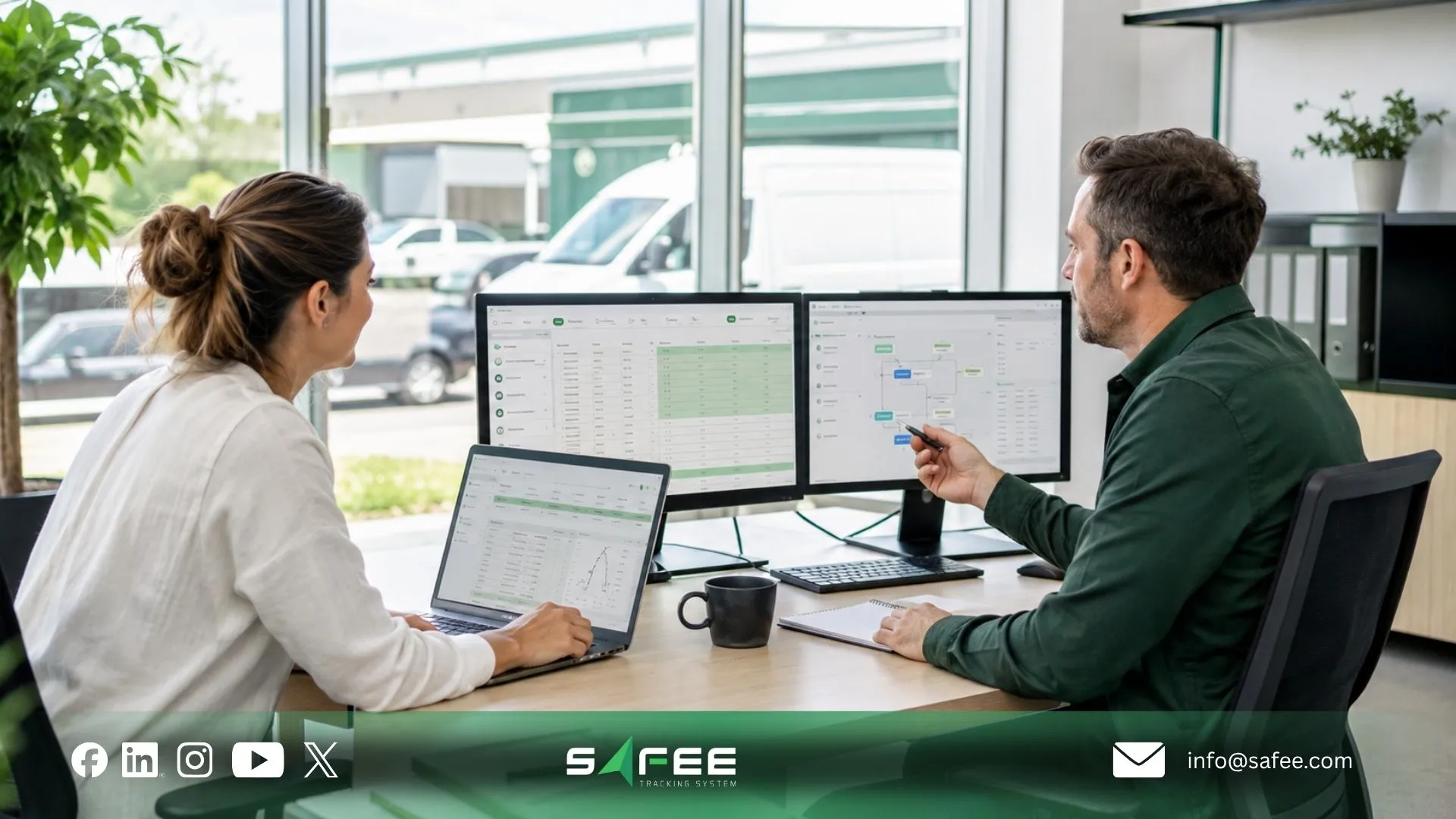
A practical fleet management IoT architecture should separate physical data capture from transport, ingestion, processing and fleet operations.
At the edge are tracking devices, vehicle interfaces, identifiers and sensors. They may capture GNSS position, movement, vehicle data, driver identity, weight, temperature, tire data or other supported inputs.
The connectivity layer transports the information. Depending on operating conditions, this can involve cellular communication, while relevant remote operations may use Safee SatComm as an additional communication layer.
The ingestion and processing layer must then interpret device messages. Safee describes an architecture consisting of Messaging, Message Route and Data Warehouse, while its device-integration material describes protocol ingestion and field mapping before information becomes available through monitoring, trips, dashboards, alarms and reporting.
Above that sits the fleet application layer, where data becomes operational through capabilities such as:
- Live Vehicle Tracking;
- Fleet Monitoring & Insights;
- Alarms and Alerts;
- Fleet Reporting;
- Driver Management;
- Maintenance Management;
- CANbus Integration;
- Advanced Modules;
- Tracking Data Analyzer (TDA);
- Journey Management System (JMS);
- Mobile App.
Finally, APIs and business integrations allow relevant fleet information to connect with other systems.
This layered architecture prevents one common IoT design mistake: expecting the sensor, tracker or communications protocol itself to solve the fleet-management problem.
Fleet management IoT devices and the roles of modules, sensors and gateways
A fleet management IoT device is a physical connected component that captures, receives or transmits data. But not every device performs the same function, and fleet management IoT devices should not be grouped together simply because they are connected.
A useful distinction is:
- Tracking device: Captures location and movement and can provide the communications path for supported vehicle or sensor information.
- Vehicle interface: CANbus or OBD-II can expose supported diagnostic or vehicle signals, subject to vehicle and hardware compatibility.
- Sensor: Measures a physical condition such as weight, temperature or tire pressure.
- Identifier: RFID, iButton, BLE or fingerprint ID can be used within Safee’s Driver Identification System to associate the correct driver with a vehicle or workflow.
- Fleet management IoT module: The software capability that interprets or operationalizes the relevant data. Weight Sensors, TPMS, Temperature Sensors, Cold Chain Solution and equipment monitoring are examples of specialized capabilities available in Safee’s modular environment.
- Gateway or communications component: Provides or manages the path between edge data and the platform. Its exact implementation depends on the hardware design, network and integration scope.
This distinction matters in heavy equipment fleet management IoT projects. An excavator or generator does not automatically need the same device configuration as a road-going truck. Safee’s Equipment Activity Monitoring focuses on equipment usage, movement and Real-Time Sensor Data, reflecting the different operational questions involved in managing machinery.
For mixed fleets, begin with the data requirement, not the device catalogue:
- What must the business know?
- Which source can produce that information?
- How will the information reach the platform?
- Which Safee module or workflow will use it?
- Who acts when the data indicates an exception?
For machinery-specific monitoring, see our Equipment Activity Monitoring module.
Choosing the connection layer for cellular IoT and Wi-Fi fleet management
Choosing between cellular IoT fleet management and WiFi fleet management should start with asset mobility and operating coverage.
Cellular connectivity is suited to moving assets that need to report while operating across normal road networks. Safee specifically describes cellular connectivity as appropriate for many normal routes, with SatComm available for relevant remote or low-cellular-coverage operations.
Wi-Fi should be assessed where assets can reliably communicate through known wireless infrastructure. It may be relevant to controlled locations or specific device workflows, but it should not automatically be treated as a continuous road-tracking substitute.
For each connection layer, compare:
- Geographic coverage;
- Mobility requirements;
- Device compatibility;
- Data volume;
- Reporting frequency;
- Latency requirements;
- Offline behavior;
- Buffering and retransmission;
- Power consumption;
- Network ownership;
- SIM/APN administration where applicable;
- Security responsibilities;
- Remote diagnostics;
- Operational consequences of losing connectivity.
Platform integrators should also separate transport protocol from device protocol. A device may use a cellular network to reach the cloud while sending messages in its own protocol and message format. Safee’s integration approach is designed around ingesting different device protocols and message formats, followed by field mapping and validation.
That is why the connectivity question cannot be solved independently from protocol support, device configuration and the data model expected by the fleet workflow.
18 checks before connecting a fleet management system to IoT
- Define the operational question first. Identify whether the project is intended to improve location visibility, driver accountability, fuel control, maintenance, cold chain, load monitoring, equipment utilization, safety or another specific workflow.
- Inventory the existing devices. Record tracker, sensor, vehicle interface, identifier and communications hardware already deployed instead of assuming every asset needs replacement.
- Identify the device protocol and message format. Confirm how every device sends data and whether its protocol can be ingested and mapped by the target platform.
- Map the required data fields. Define the location, timestamp, speed, ignition, IO, driver, diagnostic, sensor or other fields required by each use case.
- Validate vehicle compatibility. CANbus, OBD-II and external sensor availability varies across vehicles and equipment. Test representative asset groups before assuming fleet-wide compatibility.
- Validate sensor compatibility. Confirm sensor type, installation method, signal format, measurement range and expected accuracy for the intended workflow.
- Define calibration responsibility. Weight, fuel and other sensor-driven deployments may require configuration or calibration. Establish who owns initial validation and later recalibration.
- Map cellular coverage. Review actual operating routes, depots, sites and known dead zones rather than relying only on general network coverage.
- Define offline behavior. Decide what the device should do when communications fail, which information can wait and which operational events require faster escalation.
- 10. Evaluate remote communications needs. Determine whether specific routes or assets genuinely require an additional communications layer such as SatComm rather than adding the same connectivity complexity everywhere.
- Standardize device identity. Maintain a controlled relationship between device identifiers, vehicle or equipment records, operating site and relevant driver information.
- Map device data into fleet context. Decide how raw messages become vehicles, drivers, statuses, trips, Geofences, alarms, dashboards and reports instead of remaining isolated telemetry. Safee’s device-integration approach includes protocol ingestion, field mapping and operationalization.
- Define alert logic. For every important condition, establish the trigger, threshold, scope, recipient, action, escalation and closure process. Safee’s Alarms and Alerts module is designed around configurable fleet exceptions.
- Assign access and permissions. Decide which Fleet, Operations, HSE, Maintenance, IT or management users can view, configure or act on each category of information.
- Define reporting cadence. Determine which events require live monitoring and which trends should be reviewed daily, weekly, monthly or according to the organization’s own operating cycle.
- Plan API and business-system integration. Identify whether ERP, waybill, asset management or other systems need fleet data, which system owns each field and how synchronization should be governed. Safee supports API-based business integrations.
- Define device lifecycle ownership. Establish how disconnected, damaged, replaced, transferred or decommissioned devices will be handled while preserving vehicle and data continuity.
- Run a controlled validation before scale. Test representative vehicles, devices, sensors, coverage areas, alerts, users and reports before expanding the iot-based fleet management system across the wider operation.
Before approving an integration, platform teams should be able to answer five questions clearly: Which devices are supported? Which data fields are available? How are messages mapped? What happens when communication fails? Which fleet workflow consumes each signal?
Contact us with your device list, protocols, vehicle classes, sensor requirements and integration scope to validate the architecture before rollout.
Also read: 5 Steps to Turn Fleet Management Analytics into Action
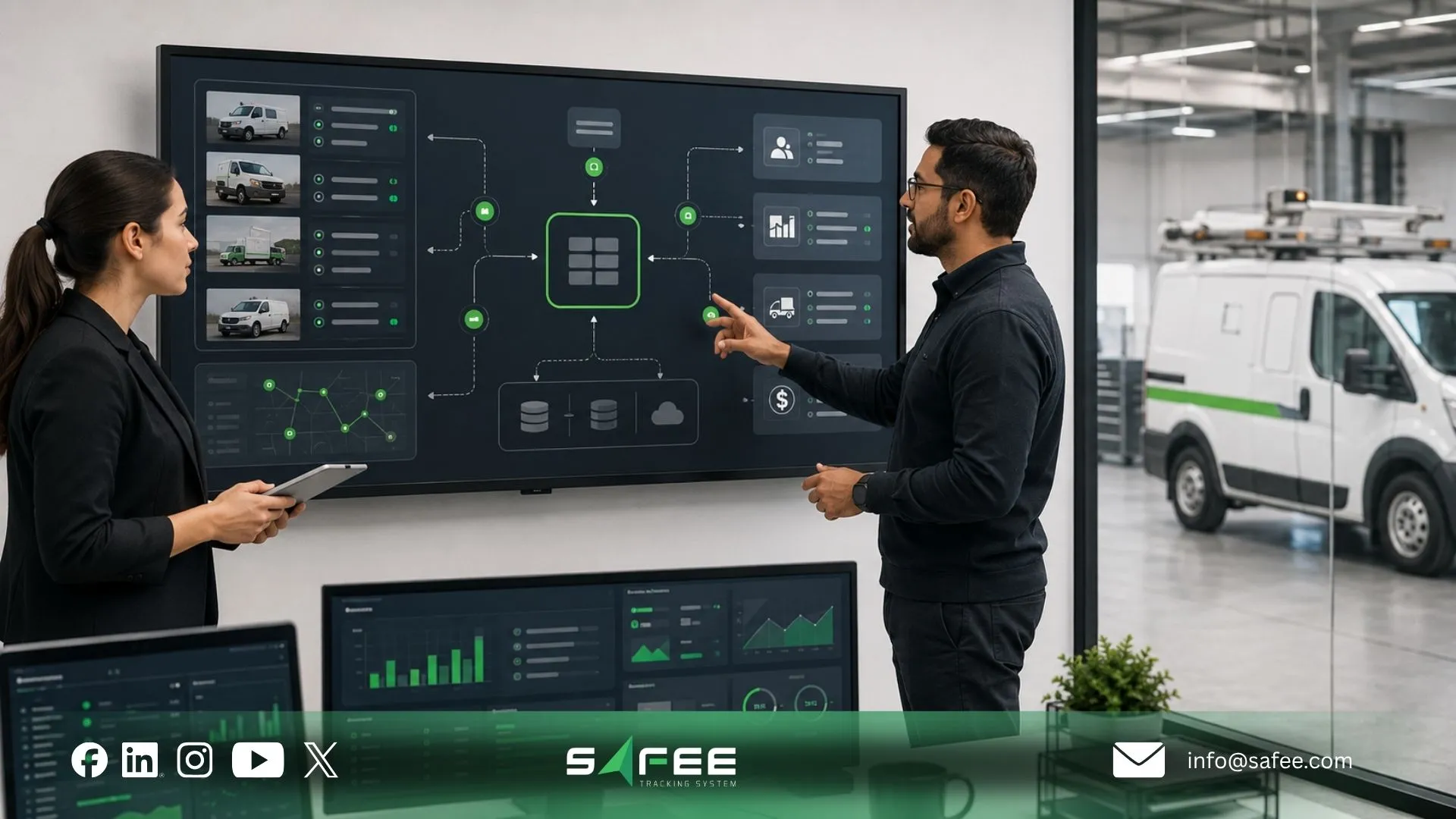
Safee as fleet management IoT solutions for platform integrators
For platform integrators, telecom operators and IoT providers, fleet management IoT solutions need to solve the gap between device connectivity and fleet operations.
Safee’s role is not limited to receiving location feeds. The company describes its platform as hardware agnostic, supports diverse hardware and sensors, provides advanced APIs for business integration, and uses a protocol-based architecture capable of processing different device protocols and message formats.
Once compatible data reaches the platform, it can be connected with fleet capabilities such as Live Vehicle Tracking, Fleet Monitoring & Insights, Alarms and Alerts, Fleet Reporting, Driver Management, Maintenance Management, specialized sensors, TDA and other modules according to the approved deployment scope.
This creates a practical integration model:
Your device and connectivity capability plus Safee protocol/data processing plus Safee fleet workflows plus customer business integrations.
For an IoT or telecom partner, that can reduce the amount of fleet-specific application logic that must be designed separately for every project. Compatibility, data fields and implementation scope still need validation; hardware agnostic does not mean that every device or signal is automatically supported. Safee itself emphasizes validating hardware, data fields, integrations, installation method and connectivity during implementation.
Safee vs generic IoT platforms
| Capability | Generic / DIY IoT Platform | Safee Fleet Layer |
| Device onboarding | Device registration, provisioning, protocol parsing and asset mapping may need to be designed for the project | Safee supports protocol ingestion, field mapping and linking device information into fleet monitoring workflows; compatibility is validated during integration |
| Protocol and hardware support | Depends on the IoT stack, selected device ecosystem and integrations built by the implementation team | Safee describes its platform as hardware agnostic and capable of integrating different device protocols, message formats, hardware and sensors, subject to validation |
| Data model | Often begins with device IDs, timestamps and telemetry fields | Incoming data can be operationalized around vehicles, devices, drivers, statuses, trips, Geofences, alarms, dashboards and reports |
| Fleet-specific logic | Fleet rules, alert ownership, driver context, maintenance workflows and reporting may need custom application development | Live Vehicle Tracking, Alarms and Alerts, Fleet Reporting, Driver Management, Maintenance Management and other Safee modules provide fleet-specific operational workflows |
| From device data to fleet dashboard | Ingestion, normalization, storage, application logic and visualization must be assembled according to the platform design | Safee describes an IoT processing architecture built around Messaging, Message Route and Data Warehouse, followed by monitoring, analytics and fleet modules; rollout timing depends on the agreed integration scope |
Our platform’s difference is therefore not that generic IoT platforms cannot process telemetry. They can. The distinction is how much fleet-domain functionality must still be designed after the telemetry arrives.
A generic platform can be appropriate when an organization wants to build and own the entire application layer. Safee becomes relevant when the project needs an established Fleet Management and Telematics layer that can connect compatible device data with operational workflows.
See our Essential Modules for the fleet application layer available above connected device data.
How Safee shortens fleet rollouts for IoT and telecom partners
Our platform, Safee, can simplify the fleet-specific portion of an IoT integration by giving partners an existing operational layer around compatible device data rather than requiring every dashboard, alarm, report and fleet workflow to start as a custom software project.
A practical partner rollout can follow this sequence:
- Define the customer use case: Clarify the fleet problem before discussing devices: tracking, driver control, maintenance, fuel, temperature, weight, equipment, safety or another operational requirement.
- Review the installed hardware: Identify GPS trackers, CANbus or OBD-II interfaces, sensors, identifiers, cameras and communications equipment already in the customer’s environment.
- Validate protocol ingestion: Confirm device protocol, message format, identifiers, required fields and available events.
- Map the data: Connect location, time, speed, IO, event, sensor and other supported fields to the required Safee fleet context.
- Link devices with operational records: Validate device-to-vehicle relationships, driver assignment logic, equipment identity and site or group structure.
- Configure fleet workflows: Use Live Vehicle Tracking, Alarms and Alerts, Fleet Reporting, Driver Management, Maintenance Management, TDA or specialist modules according to the customer requirement.
- Define users and governance: Determine who monitors each workflow, who receives exceptions, who can change configuration and who reviews recurring reports.
- Connect business systems where required: Use the agreed API integration scope to connect relevant fleet data with ERP, waybill, asset management or other customer systems.
- Validate representative assets: Test data quality, coverage, sensors, alerts, dashboards and reports using representative vehicle and equipment groups.
- Expand only after the operating model works: Scale the deployment when device connectivity, data mapping and operational ownership are working together.
Our existing device-integration model already describes protocol ingestion, field mapping and conversion of device messages into monitoring, trips, dashboards, alarms and reports. Its main platform also supports API-based Business Integration and a hardware-agnostic approach.
That makes the collaboration particularly relevant when an IoT or telecom provider already owns the connectivity or hardware relationship but does not want to build an entire fleet-management application around every implementation.
If your company provides IoT connectivity, GPS hardware, sensors or telecom services, contact Safee to discuss how your existing technology stack can connect with Safee’s Fleet Management and Telematics workflows.
FAQs About fleet management using IoT
Is fleet management a type of IoT?
Fleet management itself is not simply a type of IoT. IoT provides connected devices, sensors and communications that capture and transmit data, while fleet management adds the vehicles, drivers, journeys, alerts, reports and operational workflows needed to use that data. Fleet management using IoT combines the two layers into one connected operating model.
Can I use existing IoT devices for fleet tracking?
Potentially, but compatibility should be validated rather than assumed. Safee describes its platform as hardware agnostic and capable of integrating different device protocols and message formats, but the device protocol, available data fields, installation, connectivity and required fleet workflows still need to be reviewed before deployment.
What is the difference between an IoT sensor and fleet management IoT module?
An IoT sensor measures a physical condition such as temperature, weight or tire pressure. A fleet management IoT module is the software layer that places that data in fleet context and supports monitoring, alerts, reporting or another workflow; Safee examples include Weight Sensors, TPMS, Temperature Sensors and Cold Chain Solution.
Does cellular IoT work better than Wi-Fi for fleet tracking?
Cellular connectivity generally fits mobile, wide-area fleet operations because the vehicle must communicate while moving across routes, while Wi-Fi depends on access to the relevant local network. The correct design depends on coverage, mobility, device requirements, offline behavior and the operational consequence of delayed data; Safee also provides SatComm for relevant remote or low-cellular-coverage operations.
Ready to improve your fleet operations?
Tell us what you would like to improve. A Safee specialist will reply by email.
Usually replies within one business day • No sales spam
Your details are used only to respond to your request. Privacy Policy